When Can Kids Finally Sit Up Front? The Answer Is More Complicated Than You Think
Riding Shotgun: The Age, Height, and Weight Rules Parents Get Wrong
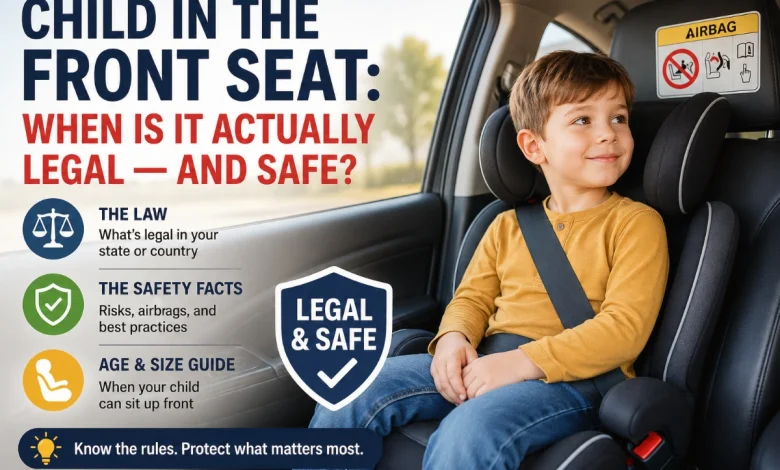
A child’s eagerness to sit next to the driver often puts parents in an uncomfortable position: caught between their child’s enthusiasm and the requirements of the law. Many parents mistakenly assume that the rules for the front and back seats are identical — they aren’t. The law draws a clear distinction, and in an era where traffic cameras can analyze seat belt position and passenger height, even well-intentioned mistakes result in fines. Understanding when a child may legally move to the front seat is not just a matter of avoiding penalties. In a crash, it can be the difference between life and death.
Why the Front Seat Is Different: The Physics of Airbags
Before getting into the legal rules, it’s worth understanding why they exist. Front-seat airbags and seatbelt pretensioners in modern vehicles are engineered for adult occupants — typically those standing over 150 cm (about 5 feet) tall. When a shorter passenger sits in the front without a proper booster, the diagonal shoulder belt falls across the neck rather than the chest, and in a crash, the deploying airbag strikes the head or throat rather than absorbing torso impact as designed.
This is not a minor inconvenience — it is a documented cause of child death and serious injury. The National Highway Traffic Safety Administration (NHTSA) has tracked airbag-related child fatalities since the mid-1990s and has consistently warned: never place a rear-facing car seat in front of an active airbag. The same caution applies broadly to young children in the front seat without appropriate restraints.
A child restraint system (car seat or booster) solves this problem by elevating the child and repositioning their body geometry to match what the car’s safety systems were designed for. This is why restraints are not optional accessories — they are the mechanism that makes a vehicle’s built-in safety equipment work correctly for a smaller body.
The Law in the United States
Child passenger safety in the US operates on two levels: federal standards govern the design and performance of car seats, while state laws dictate when and how children must use them.
Federal Standards: FMVSS No. 213
The performance requirements for all child restraint systems sold in the United States are set by Federal Motor Vehicle Safety Standard No. 213 (49 CFR § 571.213), administered by NHTSA. This standard covers all types of child restraints — infant carriers, forward-facing seats, booster seats, and harnesses — and requires them to meet crash performance criteria, head excursion limits, buckle release force specifications, and labeling requirements.
In December 2023, NHTSA published a final rule adding FMVSS No. 213b, which updates the standard seat assembly on which child restraints are tested for frontal crash compliance — ensuring that car seat performance keeps pace with the geometry of modern vehicles. Mandatory compliance begins December 5, 2026.
What FMVSS 213 does not do is tell parents when to move their child out of each seat type. That is the domain of state law.
State Laws: A Patchwork Approach
All states and territories have child passenger safety laws, although requirements vary based on age, weight, and height. The result is a patchwork across 50 states that can be genuinely confusing for families who travel across state lines. Here is a breakdown of the general progression required in most states:
Stage 1 — Rear-facing car seat: Infants and toddlers must ride in a rear-facing seat. NHTSA recommends keeping children rear-facing until they reach the maximum weight or height limit of their seat. Front passenger airbags can injure or kill young children in a crash — rear-facing seats should never be placed in the front seat.
Stage 2 — Forward-facing car seat with harness: Once children outgrow their rear-facing seat, they move to a forward-facing seat with a harness and top tether, still in the rear seat.
Stage 3 — Booster seat: Safety experts, including the Insurance Institute for Highway Safety (IIHS) and NHTSA, generally agree that children should remain in some form of child restraint until they are 4’9″ (57 inches) and weigh 80 lbs. Most states require booster seats until age 7 or 8; some extend this to age 9 or until the child reaches 4’9″. Proper seat belt fit — where the lap belt sits across the upper thighs and the shoulder belt crosses the center of the shoulder and chest — typically occurs between ages 9 and 12.
Stage 4 — Seat belt only (and front seat eligibility): Some states, like New York and California, mandate that children remain in the back seat until age 13, based on airbag injury risks. In contrast, states like Florida and South Dakota have no formal minimum age for the front seat — a child as young as six could legally sit up front in those states, provided they meet the applicable restraint requirements. Florida law only requires booster seats up to age six and allows children to ride in the front seat at any age.
NHTSA and pediatric safety organizations universally recommend that children remain in the back seat until at least age 13, regardless of what any individual state law allows. The legal minimum is a floor, not a recommendation.
Penalties
Fines for child restraint violations vary widely: fines range from as low as $25 in South Dakota to over $100 in states like California and New Jersey. Some states also apply demerit points to the driver’s licence. Violations are typically assigned to the driver, not a parent who may be a passenger.
The Law in Canada
Canada takes a similarly tiered, province-by-province approach to child restraint law, but with an important distinction: Canada does not have a single national rule for child car seats. Instead, car seat laws are regulated at the provincial and territorial level, though all provinces follow similar safety principles and require children to ride in approved seats that meet Canadian Motor Vehicle Safety Standards (CMVSS).
Transport Canada sets minimum performance standards for car seat manufacturers, and provinces can impose stricter rules on top of those minimums.
The Four Stages Under Canadian Provincial Law
Stage 1 — Rear-facing infant seat: Required from birth until the child reaches the weight or height limits of the seat. Most provinces align with the general guideline of keeping children rear-facing until at least age 2 or the manufacturer’s limit.
Stage 2 — Forward-facing seat with harness: Once a child outgrows the rear-facing stage, they transition to a forward-facing seat with a harness, still in the rear seat.
Stage 3 — Booster seat: In Ontario, children under 8 years old, weighing 40 to 80 pounds (18–36 kg) and standing less than 4 feet 9 inches tall (145 cm) must use a booster seat. Similar thresholds apply in other provinces. Once a child is taller than 145 cm (4 feet 9 inches), they may begin to safely fit an adult seat belt — this usually happens between the ages of 10 to 12.
Stage 4 — Seat belt and front seat: Most provinces and territories allow children aged 13 years and older to sit in the front seat. Transport Canada emphasizes this age threshold because front airbags remain a risk for younger children. In Ontario, children under 12 are considered safest in the back seat, given the injury risk from inflating airbags.
Penalties in Canada
Improper child restraint in a vehicle in Ontario can result in a $240 fine and two demerit points. Penalties vary by province, but the responsibility falls squarely on the driver — all drivers are responsible for the safety of passengers under 16 years old.
If a Child Must Ride in the Front Seat
There are situations where a child has no choice but to sit in the front — a two-seat vehicle, a full rear seat, or a medical or physical need. In these cases, technical regulations must be followed carefully:
Rear-facing seat in the front: The front passenger airbag must be deactivated. An inflating airbag in a crash can kill an infant in a rear-facing seat. This is non-negotiable — if you cannot deactivate the airbag, the rear-facing seat cannot go in the front seat under any circumstances.
Forward-facing or booster seat in the front: Move the front passenger seat as far back as possible to maximize the distance between the child and the dashboard. Ensure the child sits upright, not slouching toward the dash. When a child 13 or older sits in the front, the seat should still be moved as far back as possible while leaving room for any rear passengers.
Seat belt fit check: Before concluding that a child no longer needs a booster, apply the five-step fit test: the child should be able to sit fully against the seatback with knees bent comfortably over the seat edge; the lap belt must lie flat across the upper thighs (not the stomach); and the shoulder belt must cross the center of the chest and shoulder — not the neck or face.
Common Misconceptions
“My child is tall for their age, so they’re fine in the front seat.” Height alone does not determine readiness. The seat belt fit test must be passed — and the child must be able to maintain correct posture for the entire journey without slouching. A tall 9-year-old who cannot keep the shoulder belt off their neck is not ready.
“The law says age 8 (or whatever my state requires), so they’re safe at 8.” State and provincial laws set legal minimums, not safety optima. Safety experts broadly recommend that children remain in some form of child restraint until they reach 4’9″ (57 inches) and weigh 80 lbs, and in the back seat until age 13. These thresholds exist because they reflect crash test data, not legislative compromise.
“We’re only going a short distance.” Most fatal crashes happen within a few kilometers of home. Distance traveled does not reduce airbag deployment risk.
“I turned off the airbag warning light, so the airbag is off.” Warning lights indicate sensor status, not airbag deactivation. Only a deliberate, manufacturer-approved airbag cutoff switch (an OEM-installed feature or a dealership-installed retrofit) actually disables the airbag.
Quick Reference: Front Seat Eligibility by Jurisdiction
| Jurisdiction | Minimum age recommendation (front seat) | Legal minimum (varies) |
|---|---|---|
| USA — NHTSA/AAP recommendation | 13 years | Varies by state |
| California, New York, New Jersey | 13 years | Required by law |
| Florida, South Dakota | No state minimum | None |
| Most other US states | 13 (recommendation) | 8–12 (by state) |
| Canada — Transport Canada | 13 years | Most provinces: 13 |
| Ontario | 13 (guidance) | No explicit minimum; under 12 recommended in rear |
The Bottom Line
The legal answer to “when can my child sit in the front seat?” is genuinely different depending on where you live. In strict states like California and New York, and across most of Canada, the answer is 13. In looser jurisdictions, a younger child may technically be legal in the front — but that does not mean it is safe.
The consistent advice from NHTSA, Transport Canada, the American Academy of Pediatrics, and Canada’s Parachute safety organization is the same: keep children in the back seat until 13, in the appropriate restraint for their size at every stage before that, and never put a rear-facing seat in front of an active airbag.