GAC S9: The Flagship That Floats
GAC is making a bold push into Europe — and the flagship S9 hybrid crossover may be its most compelling card yet. We take it for a first drive to assess whether it can hold its own in one of the world’s most competitive premium SUV markets.
hp combined
km electric range
per 100 km highway
boot volume
GAC in Europe: a brand on the move
GAC is no longer a name that European buyers can afford to ignore. The Chinese state-owned automaker has established a European headquarters in the Netherlands, opened a design studio in Milan, and is building Aion V electric SUVs at Magna’s plant in Graz, Austria — a strategic move that sidesteps EU import tariffs. The brand has set an ambitious target of 50,000 European sales by 2027, up from around 3,000 in 2025.
Signs and hints from the East
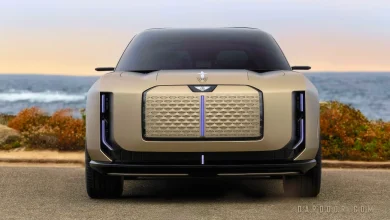
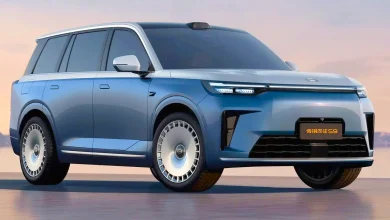
GAC says its designers drew inspiration from Chinese pagodas for the S9’s front end — and standing directly in front of the car, that’s not an entirely implausible claim. The stacked, layered quality of traditional multi-tiered rooflines does emerge, faintly, in the way the grille and hood meet. What’s harder to ignore from a three-quarter angle is how the massive, radiator-free face, the continuous LED strip across the hood’s leading edge, and the vertically-stacked headlight columns create an aesthetic language that reads as confident and contemporary — important attributes for a newcomer trying to make a first impression in Europe.
In profile, the S9 echoes its stablemate the GS8, but the two cars share only a platform. Their powertrains are fundamentally different: the S9 is a serial hybrid, meaning the 1.5-litre petrol engine never drives the wheels — it exists solely to generate electricity. At over 5 metres long with a near-3-metre wheelbase, it’s unambiguously a full-size flagship — squarely in the territory of the BMW X7 and Mercedes GLS on European showroom floors.
“The rear light bar consists of 2,592 individual LED elements — and you can swap its signature image between a dozen designs, from a lotus flower to a goose, via the infotainment menu. Novelty or genuine signature? For European buyers, that may depend on age and taste.”
The rear of the car is where GAC really wants to show off. The LED brake-light bar running the full width of the tailgate is a genuine talking point. Whether European buyers embrace its playful configurability or quietly leave it on the default setting remains to be seen — but it gives the S9 a rearview that is entirely its own.
Touchscreen, nappa leather, and natural wood
Step inside and the premium ambitions are immediately legible. Surfaces are wrapped in high-grade leatherette and nappa leather; American walnut veneer runs through the cabin in tasteful bursts. The dominant feature of the dashboard is a 15.6-inch touchscreen carrying the full infotainment suite — Apple CarPlay and Android Auto are present, though European buyers will find local streaming and navigation services substituted for the Chinese-market integrations. A swipe down surfaces a quick-settings overlay that is intuitive despite its depth.
The instrument cluster is a 10.25-inch display capable of showing navigation prompts alongside the usual driving data. The head-up display is large and bright enough to remain legible in direct sunlight. Physical buttons have been pared back almost to zero; the steering wheel replaces them with a pair of capacitive trackpads, and the right stalk doubles as the gear selector — a layout that takes some adjustment for drivers coming from German rivals.
Every seat occupant gets heating, ventilation, and massage. After three hours at the wheel, the front seats left nothing to complain about. The rear gets its own climate zone and electrically adjustable seatbacks. The five-seat-only configuration unlocks a full 960-litre boot — a very practical choice for the family SUV segment Europe demands.
We’re not going fast, but we’re going smoothly
The S9’s two electric motors combine for 340 hp and reach the wheels through axle-mounted drives. The 1.5-litre generator adds 156 hp to the equation only as a charging source. A 44.5 kWh battery claims 208 km of pure electric range by NEDC — a figure that real-world European motorway driving will trim, but the underlying capacity is substantial. On the WLTP cycle, expect something in the 150–170 km range, which remains class-competitive.
The 0–100 km/h figure of 7.2 seconds is the one number that will raise eyebrows among European buyers accustomed to plug-in hybrid performance. At this price point, a BMW X5 xDrive50e dispatches the sprint in 4.6 seconds; even the Volvo XC90 Recharge manages under 6 seconds. The S9 is not built for urgency — a fact that is apparent the moment you switch to Sport mode and find very little changes about the car’s demeanour.
“The S9 doesn’t cruise through roads — it floats, isolating its occupants from the outside world with the unhurried calm of a luxury barge. On a long European motorway, that’s a genuine and underrated talent.”
What the S9 excels at is comfort. The noise isolation is exceptional — detecting the combustion engine requires deliberate concentration, and the electric motors contribute only a barely audible hum. The adaptive dampers deal with road imperfections with relaxed equanimity; only serious potholes register, and even then softly. Air suspension would push the ride quality further, but the chassis geometry doesn’t accommodate it.
Fuel economy is one of the S9’s genuine strengths and a key argument for the European market. At sustained motorway speeds around 130 km/h — the typical German Autobahn cruise — our test returned 7.5 litres per 100 km for a vehicle weighing nearly 2.5 tonnes. In urban traffic, energy recovery improves that figure further. Running on pure electric, the S9 is entirely silent and emissions-free for city centre low-emission zones across Europe.
How the S9 scores
Overall score
A serene, well-equipped flagship that trades outright performance for exceptional ride comfort and real-world fuel efficiency — a compelling value proposition if GAC can land it at the right European price.
The case for and against
✓ Strengths
✗ Weaknesses
GAC S9 — key figures
| Dimensions (L × W × H) | 5,060 × 1,950 × 1,760 mm |
| Wheelbase | 2,930 mm |
| Ground clearance | 188 mm |
| Kerb weight | 2,440 kg |
| Combined power output | 340 hp |
| ICE (generator only) | 1.5L petrol, 156 hp |
| Battery capacity | 44.5 kWh |
| Electric range (NEDC) | 208 km |
| Electric range (WLTP est.) | ~150–170 km |
| 0–100 km/h | 7.2 sec |
| Fuel consumption (highway) | 7.5 L / 100 km |
| Boot volume (seats up) | 960 L |
| Boot volume (seats folded) | 1,950 L |
| Seating | 5 |
| Wheel size | 21 inch |