
 330 km
 175 km/h
  6.9 Sec
  490 km/h
Charging Port Type CCS Type 2 (Charging Port type affects charging station compatibility.) 
Max AC Charging 11 KW Home Charging, 3-Phase support. On-board AC charger (inverter) Capacity affects AC charging speed. Max DC Charging 160 KW Maximum power the car can accept from a DC faster charger. Architecture 400 V Higher power train voltage means faster charging and better efficiency. Battery Capacity (Usable) 60.0 kWh Net battery capacity that is available for use. Tested Range (EU -WLTP)
430 km Estimated Distance of a Full Charge Tested Range (USA – EPA) 410 km Estimated Distance of a Full Charge Motor / Power Performance Around 160 kW (218 PS) FWD Torque 320 Nm Peak Toque of the car’s electric motor 0-100 km/h 6.9 Second acceleration time from standstill to 100 km/h Top Speed 235 km/h Maximum speed the car can reach Charging 10→ 80% 28 minutes Under Ideal Conditions Drive Type FWD PMSM (front)
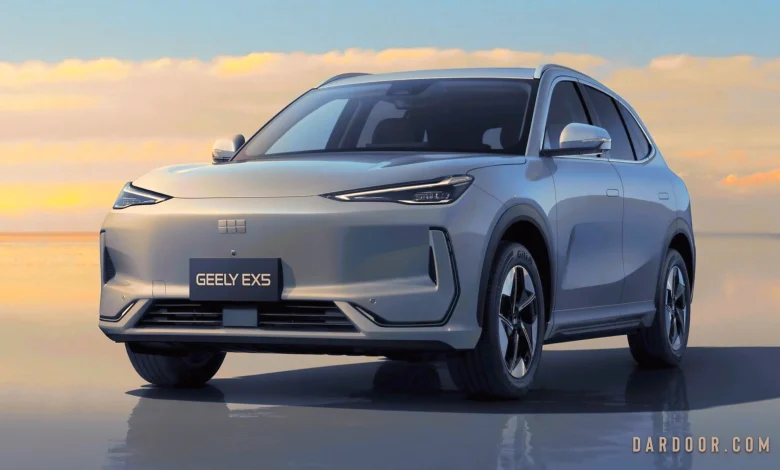
Geely EX5
About Geely EX5 FWD 🚘
Reasons to Buy Geely EX5 FWD
Why You'll Love It 😘
- Unbeatable Value – Get massaging seats, HUD, panoramic sunroof, and 16-speaker audio for $20,000+ less than competitors. It’s a $60,000 car at $40,000 pricing.
- Fast Charging – 160kW DC charging (30-80% in 20 minutes) is double the BYD Atto 3’s speed and matches vehicles costing far more.
- Spacious Interior – “Limo-like” rear legroom and 33 storage compartments make it genuinely practical for families, with space efficiency exceeding rivals.
- Low Running Costs – $517 for 3-year servicing, 7-8 year warranty, and excellent efficiency (13.5 kWh/100km) mean minimal ownership expenses.
- 5-Star Safety – Euro NCAP and ANCAP top ratings with comprehensive ADAS features standard, even on base trims.
Reasons Not to Buy Geely EX5 FWD
Why You Might Think Twice 🤔
- Limited Range – Only 410-430km WLTP (350-380km real-world) with no long-range option. Not ideal for frequent highway trips or those needing 500+ km.
- Unknown Brand – Geely lacks recognition outside China, creating resale value uncertainty and potential buyer hesitation despite Volvo/Polestar ownership.
- Smaller Boot – 461L cargo space trails Kia EV5 (513L), Skoda Enyaq (585L), and Tesla Model Y (854L) by significant margins.
- Generic Styling – Described as “bland,” “plain as motoring gets,” and “anonymous”—won’t turn heads or make a statement.
- Annoying ADAS – Overly aggressive driver monitoring, lane-keeping, and speed warnings require menu diving to disable, creating daily frustration for owners.
Geely EX5: Reported Owner Issues & Complaints
Key Owners-Reported Issues 🗒️
🚨 MAJOR RECURRING ISSUES
1. Overly Aggressive Driver Assistance Systems
Frequency: Very Common ⚠️⚠️⚠️
- Driver Monitoring System: Triggers “distraction detected” warnings within minutes, especially with sunglasses
- Speed Limit Warnings: Beeps at 101 km/h in 100 km/h zones (zero tolerance)
- Lane Keeping Assist: Inconsistent performance, sometimes fails to center properly
- Problem: Requires deep menu navigation to disable, resets on restart
- Owner quote: “The driver monitoring is infuriating—I got warnings 3 times in the first 10 minutes”
2. Missing Features vs Chinese Spec
Frequency: Common ⚠️⚠️
Australian/International versions lack:
- Dashcam recording functionality
- mmWave radar sensors
- 50W wireless charging (some markets get 50W, others don’t)
- Certain ADAS features standard in China
- Owner frustration: “Paying more than Chinese buyers but getting less features”
3. Android Auto Delay
Frequency: Resolved in most markets ⚠️
- Initially launched without Android Auto support
- Required over-the-air (OTA) update to enable
- Some markets still waiting as of late 2024
- Apple CarPlay worked from launch
- Status: Being addressed via software updates
⚠️ MODERATE ISSUES
4. Software Glitches & Bugs
Frequency: Occasional ⚠️
- Touchscreen freezes/lag reported by some owners
- Bluetooth connectivity dropouts
- Infotainment system reboots while driving
- Navigation issues in non-Chinese languages
- Owner feedback: “Had to do a full system restart twice in first month”
5. Cupholders Too Small
Frequency: Universal complaint ⚠️
- Won’t fit standard coffee cups or water bottles
- Described as “surprisingly small” and “impractical”
- Forces use of door pockets for drinks
- Owner quote: “My takeaway coffee doesn’t fit—basic design oversight”
6. Interior Material Quality Inconsistencies
Frequency: Occasional ⚠️
- Vinyl smell complaints: Autocar UK noted “pervasive and deeply unpleasant vinyl smell”
- Some owners report cheap-feeling plastics on lower door panels
- Faux leather shows wear quickly in high-touch areas
- Gap inconsistencies between panels noted by detail-oriented buyers
7. Climate Control Quirks
Frequency: Occasional ⚠️
- Auto climate control sometimes overcorrects (too hot/cold)
- Rear vents provide weak airflow
- Seat ventilation “not very effective” per some owners
- Takes time to learn optimal settings
⚙️ MINOR ISSUES
8. Charging Cable & Home Charger Quality
Frequency: Common concern
- Included “Mode 2” charging cable basic quality
- Home charger (where provided) not “smart” enabled
- Lacks scheduling or load management features
- Affects resale value for those upgrading
- Owner advice: “Budget for a proper wallbox separately”
9. Regenerative Braking Feel
Frequency: Preference-based
- Some owners find regen braking calibration abrupt
- Limited customization of regen levels vs competitors
- Takes adjustment period coming from ICE vehicles
- Not technically a fault, but noted frequently
10. Wind Noise at Highway Speeds
Frequency: Occasional
- Some owners report increased wind noise above 100 km/h
- Door seal quality questioned
- A-pillar area suspected source
- Not universal—many owners report library-quiet cabin as advertised
🔧 EARLY RELIABILITY CONCERNS
11. 12V Battery Issues
Frequency: Rare but documented
- Some Australian owners reported 12V auxiliary battery drain
- Vehicle wouldn’t start after sitting for days
- Required dealer replacement under warranty
- Status: Isolated cases, likely manufacturing batch issue
12. Brake Squeal When Cold
Frequency: Occasional
- Morning brake squeal reported by some owners
- Especially in wet/humid conditions
- Dealers claim “normal” for brake pad type
- Diminishes after warm-up
13. Paint Quality Concerns
Frequency: Rare
- Some owners report thin paint, chips easily
- Particularly on front bumper/bonnet
- PPF (paint protection film) recommended by some owners
- Standard concern for many Chinese EVs
📱 APP & CONNECTIVITY ISSUES
14. Geely/Flyme App Problems
Frequency: Occasional
- App connectivity drops intermittently
- Remote climate pre-conditioning unreliable
- Slow to update vehicle status
- Some features advertised not yet working
- Owner feedback: “App is clearly not finished—needs work”
15. OTA Update Anxiety
Frequency: Ongoing concern
- Uncertainty about long-term software support
- Will Geely continue updates for export markets?
- Features promised “coming soon” but no timeline
- Comparison to Tesla/Chinese brand update frequency
🔋 BATTERY & RANGE ISSUES
16. Range Anxiety in Winter
Frequency: Seasonal concern
- Real-world range drops to 280-320km in cold weather
- Battery preconditioning helps but not always effective
- LFP battery more temperature-sensitive than NMC
- Owner strategy: “Plan for 300km max in winter”
17. State of Charge Display Accuracy
Frequency: Occasional
- Some owners report % remaining vs km remaining mismatch
- Predicted range jumps unexpectedly
- Recalibrates over time but initially confusing
🏪 DEALER & SERVICE CONCERNS
18. Limited Dealer Network
Frequency: Location-dependent
- Only 25 UK dealers at launch, 22 in Australia
- Service appointment wait times longer than established brands
- Parts availability concerns for crash repairs
- Mobile service not widely available
- Owner concern: “Nearest dealer is 2 hours away”
19. Dealer Knowledge Gaps
Frequency: Common in early period
- Sales staff unfamiliar with EV features
- Service technicians still learning the platform
- Inconsistent information between dealerships
- Improves over time as network matures
20. Warranty Claim Process
Frequency: Too early to assess fully
- Limited data on how Geely handles warranty claims
- Some owners report slow response times
- Language/communication barriers in some markets
- Unknown: Long-term support for export markets
💰 VALUE & OWNERSHIP CONCERNS
21. Resale Value Unknown
Frequency: Universal concern
- No historical data for Geely brand in Western markets
- Chinese EV depreciation concerns
- Will brand still exist in these markets in 5 years?
- Mitigation: Strong warranty provides some protection
22. Insurance Costs Higher Than Expected
Frequency: Regional variation
- Some insurers classify as “specialist” or “import”
- Repair costs unknown, leading to higher premiums
- Improves as more vehicles on road and data available
✅ POSITIVE OWNER FEEDBACK (Balance)
Despite issues, owners consistently report:
- Excellent value: “No regrets, saved $25,000 vs alternatives”
- Comfortable ride: “Very easy to just get in and drive”
- Spacious interior: “Rear seat room amazing for price”
- Feature-rich: “Has everything I wanted”
- Smooth performance: “Perfect for daily commuting”
📊 ISSUE SEVERITY BREAKDOWN
| Severity | Count | Examples |
|---|---|---|
| Critical (safety/reliability) | 1-2 | 12V battery drain (rare) |
| High (major annoyance) | 3-4 | ADAS aggression, missing features |
| Medium (noticeable issues) | 8-10 | Software bugs, climate quirks |
| Low (minor niggles) | 8+ | Cupholders, app issues, noise |
🎯 BOTTOM LINE
Most Common Owner Complaints:
- Overly aggressive ADAS systems
- Small cupholders
- Missing features vs Chinese spec
- Limited dealer network
- Software needs refinement
Most Serious Issues:
- Unknown long-term reliability (too new)
- Resale value uncertainty
- Dealer/service network immaturity
- Winter range reduction
Owner Satisfaction: Despite these issues, early adopters report 7-8/10 satisfaction, with value for money offsetting the niggles. The Facebook groups show active, engaged communities troubleshooting issues together rather than widespread buyer’s remorse.
Recommendation: Wait 6-12 months if possible for software updates, dealer network expansion, and real-world reliability data. Early adopters accept these trade-offs for the price savings.
| Combined Efficiency | 182 Wh/km |
|---|---|
| Total System Power | 160 kW (218 PS) |
| Total Torque | 320 Nm |
| 0–100 km/h | 6.9 s |
| Top Speed | 175 km/h |
| Drive | Front-wheel drive |
Price & Regional Availability
Based on Dardoor research, here’s a comprehensive price table for the Geely EX5 across selected countries globally:
| Country/Region | Currency | Price Range | USD Equivalent | Trim Levels | Notes |
|---|---|---|---|---|---|
| 🇨🇳 CHINA | CNY | ¥107,800 – ¥148,800 | $15,140 – $20,900 | 5 variants (49.5kWh & 60.2kWh) | Home market, Galaxy E5 nameplate |
| 🇬🇧 UNITED KINGDOM | GBP | £29,690 – £36,990 | $37,400 – $46,600 | SE / Pro / Max | After £2,300-£3,750 “Geely Grant” discount |
| 🇦🇺 AUSTRALIA | AUD | $40,990 – $44,990 | $26,200 – $28,700 | Complete / Inspire | 60.2kWh battery only |
| 🇳🇿 NEW ZEALAND | NZD | ~$43,000 – $47,000 | $25,800 – $28,200 | Complete / Inspire | Estimated similar to Australia |
| 🇹🇭 THAILAND | THB | ฿799,000 – ฿899,000 | $22,600 – $25,400 | Pro / Max | After significant discounts from ฿989,000 |
| 🇮🇩 INDONESIA | IDR | Rp 465M – Rp 505M | $29,100 – $31,600 | Pro / Max | With early-bird ₽10M discount; CKD from Q3 2025 |
| 🇲🇾 MALAYSIA | MYR | RM105,800 – RM119,800 | $23,700 – $26,800 | Prime / Premium | Sold as Proton eMas 7 |
| 🇵🇭 PHILIPPINES | PHP | ₱1,799,000 | $30,800 | Max variant only | ₱110,000 promo discount available |
| 🇸🇬 SINGAPORE | SGD | ~$55,000 – $65,000 | $41,000 – $48,500 | Proton eMas 7 | Estimated (sold as Proton) |
| 🇪🇺 EUROPE (Balkans) | EUR | €21,500 – €26,000 | $23,000 – $28,000 | Basic / Max | Greece, Serbia, Croatia, Slovenia, Bosnia |
| 🇳🇴 NORWAY | NOK | ~350,000 – 400,000 | $32,000 – $36,500 | Standard / Max | Estimated (announced but pricing TBC) |
| 🇲🇽 MEXICO | MXN | ~$550,000 – $650,000 | $27,500 – $32,500 | GF variant | Launched August 2025 |
| 🇻🇳 VIETNAM | VND | ~900M – 1,100M | $35,400 – $43,300 | Pro / Max | Launched July 2025 |
| 🇧🇷 BRAZIL | BRL | ~₽160,000 – ₽190,000 | $26,500 – $31,500 | Standard / Max | Announced for 2025 launch |
| 🇿🇦 SOUTH AFRICA | ZAR | ~₽550,000 – ₽650,000 | $30,000 – $35,500 | Standard / Max | Announced for 2025 launch |
Key Observations:
1- Massive Price Variation: The EX5 costs 3x more in Europe (£31,990/$42,970 UK) than China (¥107,800/$15,140) due to tariffs, import duties, and market positioning
2- Most Affordable Markets:
-
- 🇨🇳 China: $15,140 (home market advantage)
- 🇹🇭 Thailand: $22,600 (after heavy discounting)
- 🇦🇺 Australia: $26,200 (competitive positioning)
3- Most Expensive Markets:
-
- 🇬🇧UK / 🇪🇺 Europe: $37,400-$46,600 (18.8% tariffs + VAT)
- 🇸🇬 Singapore: $41,000+ (high vehicle taxes)
- 🇻🇳 Vietnam: $35,400-$43,300 (import duties)
4- Regional Branding: Sold as Proton eMas 7 in Malaysia, Singapore, Nepal, and Trinidad to leverage Proton’s established presence
5- Discounting Trends: Thailand has seen aggressive price cuts (₽100,000-130,000 baht) due to fierce EV competition, now undercutting even the Proton eMas 7 in Malaysia
6- Configuration Differences: Most export markets get only the 60.2kWh battery, while China offers both 49.5kWh and 60.2kWh options
This pricing positions the Geely EX5 as a genuine value leader in most markets, typically 20-40% cheaper than comparable EVs like the BYD Atto 3, Kia EV3, and Tesla Model Y.
Real-World Range Estimates
Between 235 – 490 km
| Condition | City | Highway (110 km/h) | Combined |
|---|---|---|---|
| 🌤️ Mild Weather | 490 km | 300 km | 375 km |
| 🌦️ Average Weather | — | — | 330 km |
| ❄️ Cold Weather | 330 km | 235 km | 280 km |
Indication of real-world range in several situations.
- ❄️ Cold Weather: “worst-case” (−10 °C with heating).
- 🌤️ Mild Weather: “best-case” (23 °C without A/C).
- 🛣️ Highway assumes a constant 110 km/h.
- 🏎️ Actual range depends on speed, driving style, weather and route conditions.
Long Distance Suitability (1-Stop Range)★★☆☆☆
| First Leg Distance | 237 km | First Leg Duration | 2h 9min |
| Charging Stop | 0km | Charging Stop | 15 min |
| Second Leg Distance | 128 km | Second Leg Duration | 1h 10min |
| Total Distance | 365 km | Total Duration | 3h 34min |
| Weather | 1-Stop Range |
|---|---|
| 🌤️ Mild Weather | 415 km |
| 🌦️ Average Weather | 365 km → ★★☆☆☆ |
| ❄️ Cold Weather | 326 km |


The “Long Distance Suitability” is a 5-star rating indicating how suitable a vehicle is for long trips. It’s based on the 1-Stop Range: total distance with one 15-minute DC fast-charging stop.
2025 thresholds:
- 0☆ <200 km;
- 1★ 200–325;
- 2★ 325–450;
- 3★ 450–575;
- 4★ 575–700;
- 5★ >700 km.
- Half-stars are assigned by linear interpolation.
Battery Details
| Nominal / Usable Capacity | 62.0 kWh / 60.2 kWh |
|---|---|
| Battery Type / Cathode | Lithium-ion • LFP (GEELY Short Blade) |
| Architecture / Nominal Voltage | 400 V |
| Number of Cells / Pack Config | Not publicly specified |
| Form Factor / Name | — / GEELY Short Blade |
| Warranty | 8 years |
Charging Overview
| Category | Details |
|---|---|
| Home / Destination (AC) | Type 2 (right-front). Onboard AC charger up to 11 kW. 0→full ≈ 6 h 30 min; ~51 km/h. |
| Fast DC (CCS) | CCS Combo 2 (right-front). Peak 160 kW DC; typical 95 kW (10→80%). ~28 min 10→80%. |
| Plug & Charge | Not supported. |
| Battery Preconditioning | Not publicly listed. |
Home & Destination Charging (0 → 100%)
Charging possible via wall plug or charging station. Speed depends on EVSE and vehicle’s AC charging limit. Public charging always via dedicated EVSE.
| Charging Point | Max Power | Power | Time (0→100%) | Rate |
|---|---|---|---|---|
| Wall Plug (230 V 1×10 A) | 2.3 kW | 2.3 kW | 26 h | 11 km/h |
| 1-Phase 16 A (230 V) | 3.7 kW | 3.7 kW | 17 h | 17 km/h |
| 1-Phase 32 A (230 V) | 7.4 kW | 7.4 kW | 9 h 45 m | 34 km/h |
| 3-Phase 16 A (400 V) | 11 kW | 11 kW | 6 h 30 m | 51 km/h |
| 3-Phase 32 A (400 V) | 22 kW | 11 kW † | 6 h 30 m | 51 km/h |
† limited by onboard charger.
Fast Charging (10 → 80%)
Connector: Combined Charging System (CCS Combo 2). Rapid charging enables longer trips by adding as much range as possible in the shortest time. Charging power will decrease significantly after ~80% SoC; typical rapid charging rarely exceeds 80% SoC.
| Point | Max Power | Avg Power | Time | Rate |
|---|---|---|---|---|
| CCS 50 kW DC | 50 kW | 45 kW † | 59 min | 230 km/h |
| CCS 100 kW DC | 100 kW | 75 kW † | 35 min | 390 km/h |
| CCS 150 kW DC | 150 kW | 90 kW † | 30 min | 460 km/h |
| CCS 175+ / 160 kW DC | 160 kW † | 95 kW † | 28 min | 490 km/h |
† limited by vehicle capabilities. Actual charging rates may differ due to outside temperature, battery state and driving style.
Claimed Charging Specs (Manufacturer)
- Max. Power = maximum power provided by charge point
- Avg. Power = average power over session from 10% to 80%
- Time = time to charge from 10% to 80%
- Rate = average charging speed over session
| Max Power | From | To | Time |
|---|---|---|---|
| 160 kW | 10% | 80% | 28 min |
Performance & Drivetrain
| Total Power / Torque | 160 kW • 320 Nm |
|---|---|
| 0–100 km/h | 6.9 s |
| Top Speed | 175 km/h |
| Drive | Front-wheel drive (single motor, 11-in-1 electric drive unit) |
Energy Consumption & Efficiency
- TEL = Test Energy Low
- TEH = Test Energy High (if applicable).
- Rated = official figures as published by the manufacturer; includes charging losses.
- Vehicle = calculated battery energy used for propulsion and on-board systems.
| Basis | Range | Rated Consumption | Vehicle Consumption | Fuel-eq. |
|---|---|---|---|---|
| Real Range | 330 km | — | 182 Wh/km | 2.1 L/100 km (veh.) |
| WLTP (TEL) | 430 km | 166 Wh/km | 140 Wh/km | 1.9 / 1.6 L/100 km |
| WLTP (TEH) | 410 km | — | 147 Wh/km | 1.7 L/100 km |
Real Energy Consumption Estimation
Between 123 – 256 Wh/km
| Scenario | City | Highway | Combined |
|---|---|---|---|
| ❄️ Cold Weather | 182 Wh/km | 256 Wh/km | 215 Wh/km |
| 🌤️ Mild Weather | 123 Wh/km | 201 Wh/km | 161 Wh/km |
- ❄️ Cold Weather: “worst-case” (−10 °C with heating).
- 🌤️ Mild Weather: “best-case” (23 °C without A/C).
- 🛣️ Highway assumes a constant 110 km/h.
- 🏎️ Actual range use depends on speed, driving style, weather and route conditions.
Safety Rating ★★★★★
| Region | Rating | Details |
|---|---|---|
| Europe (Euro NCAP) | — | Adult 86% • Child 87% • VRU 83% • Assist 83% (2025 |
| North America | — | NHTSA / IIHS – no data available |
Dimensions & Weight
| L × W × H | 4615 × 1901 × 1670 mm |
|---|---|
| Wheelbase | 2750 mm |
| Weight (EU) / GVWR / Payload | 1815 kg / 1715 kg / −25 kg (note: payload appears negative — check local homologation) |
| Cargo Volume (up / max / frunk) | 461 L / 1877 L / 0 L |
| Roof Load | Not specified |
| Towing Hitch / Tow Capacity | Not possible / 0 kg |
| Turning Circle | 10.8 m |
| Platform | GEELY GEA |
| Body / Segment / Roof Rails | Compact SUV / JC – Medium / Yes |
| Heat Pump | Yes (standard) |
Bidirectional Charging (V2X / BPT)
| Capability | Status | Meaning |
|---|---|---|
| V2L (Vehicle-to-Load) | Yes | Power external devices from vehicle port (via adapter) |
| V2H / V2G / BPT | No data / Not supported | Not supported / no information |
Miscellaneous
| Seats / ISOFIX | 5 / Not specified |
|---|---|
| Platform / Segment | GEELY GEA / JC – Medium |
* = estimated value where indicated. Average energy consumption & range assume moderate drive style and climate. Real-life values may differ significantly. Pricing may not reflect all regions. No rights can be derived from the information on this site.
Preceding Model
| Metric | Previous EX5 (pre-2025) | 2025 EX5 | Δ |
|---|---|---|---|
| Real Range (Combined) | – | 330 km | – |
| 0–100 km/h | ~7.0 s | 6.9 s | – |
| Efficiency (Vehicle) | – | 182 Wh/km | – |
Comparison uses available data and approximate values where earlier gen may vary by market/year. *Acceleration varies by test methodology; †WLTP listed by Genesis worldwide site.
1-Stop Range Definition ✋
For vehicles without fast-charging capability, only the distance of the first stop is considered.
🚗 Driving Profile
- Begin with a fully charged battery
- Stop 1: Drive until the battery reaches 10% state-of-charge (SoC)
- Perform a 15-minute fast charge
- Stop 2: Continue driving until the battery again reaches 10% SoC
📋 Assumptions
- Driving speed, climate, and environmental conditions are based on Real Range Highway data
- No additional time required to initiate or stop the charging session
- The charging station always delivers the maximum power requested by the vehicle
- The battery is assumed to be in optimal health and condition
⚠️ Important Note : In real-world driving, it is practically impossible to replicate these conditions exactly.
This benchmark should therefore be viewed as a comparative metric, designed to evaluate vehicles under standardized conditions rather than predict exact trip distances.
5-Star Rating Definition ⭐️
- The 1-Stop Range rating in 2025 is a practical benchmark for EVs: it measures the distance a vehicle can travel after a single 15-minute charging session, under combined real-world weather conditions.
- This rating provides a clear, star-based measure of long-distance travel practicality—judged by how far a car can go after a single 15-minute DC fast charge.
- The rating puts instant, comparable context on each EV’s long-distance travel ability, helping buyers easily compare real-world charging performance between models.
- This value is translated into star ratings: In 2025, the system assigns stars as follows:
| Star Rating | 1-Stop Range (combined conditions) |
|---|---|
| ☆ | less than 200 km |
| ★ | 200 km to 325 km |
| ★★ | 325 km to 450 km |
| ★★★ | 450 km to 575 km |
| ★★★★ | 575 km to 700 km |
| ★★★★★ | more than 700 km |
- The 1-Stop Range is calculated using real-world benchmarks in three temperature scenarios to show suitability for road trips, regardless of weather.
- Half-star ratings interpolate between these whole-star bands, so a result of 490 km would earn 3½ stars.
- This system makes it easier for drivers to quickly assess and compare vehicles for long-distance suitability, regardless of ambient temperature or charging conditions.
Fast Charging (10 -> 80%) ⚡
- Max. Power: maximum power provided by charge point
- Avg. Power: average power provided by charge point over a session from 10% to 80%
- Time: time needed to charge from 10% to 80% Rate: average charging speed over a session from 10% to 80%
EV Charger Connector Types 🔌

This table provides a quick reference for which plug types are used for AC vs DC charging and their regional prevalence. Here’s a comparative table of major EV charger connector types, showing whether they are for AC or DC charging, their suitability, and the countries/regions where they are widely adopted:
| Connector Type | AC/DC | Suitability | Countries/Regions Adapted |
|---|---|---|---|
| Type 1 (SAE J1772) | AC | Standard US/Japan AC, slow–medium | USA, Canada, Japan |
| Type 2 (Mennekes) | AC | European AC standard, universal | Europe, UK, Australia, South Africa |
| Tesla (North America) | AC/DC | Tesla vehicles only, fast Supercharge | USA, Canada |
| CCS1 (Combo 1) | DC | US fast DC charge, some AC support | USA, Canada |
| CCS2 (Combo 2) | DC | Europe fast DC charge, AC support | Europe, UK, Australia, South Africa |
| CHAdeMO | DC | Nippon/Japanese, some global DC | Japan, parts of Europe, USA |
| GB/T (AC/DC) | AC/DC | China national standard, all speeds | China |
| Tesla (Europe) | DC | European Tesla fast charging (CCS2) | UK, Europe |
- Type 1 (J1772): Used for AC charging in North America and Japan; now fading in favor of CCS1 for DC.
- Type 2 (Mennekes): Universal AC connector across Europe; most wallboxes/public AC points use this.
- CCS (Combined Charging System): CCS1 for North America, CCS2 for Europe/Australia/South Africa. Enables both AC and high-power DC charging in one socket, now the global DC fast charge standard.
- CHAdeMO: Used mostly for rapid DC charging in Japan and some regions; declining outside Japan as CCS adoption grows.
- GB/T: Unique AC and DC connectors for China, incompatible with Western standards.
- Tesla: Proprietary plug in North America; now shifting to “NACS” standard which will be more widely adopted by Ford, GM, and others. In Europe, Tesla uses CCS Type 2, fully compatible with local standards.
No YouTube IDs provided for this post.