Tire Pressure in Summer: What You Need to Know and Why Overinflation Is Dangerous
Tires are the only part of your car that actually touches the road. Everything else — brakes, steering, suspension — works through them. Yet tire pressure is one of the most overlooked aspects of vehicle maintenance, especially as temperatures climb in summer. Here’s what every driver should know.
Normal Tire Pressure in Summer
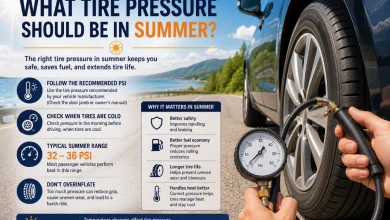
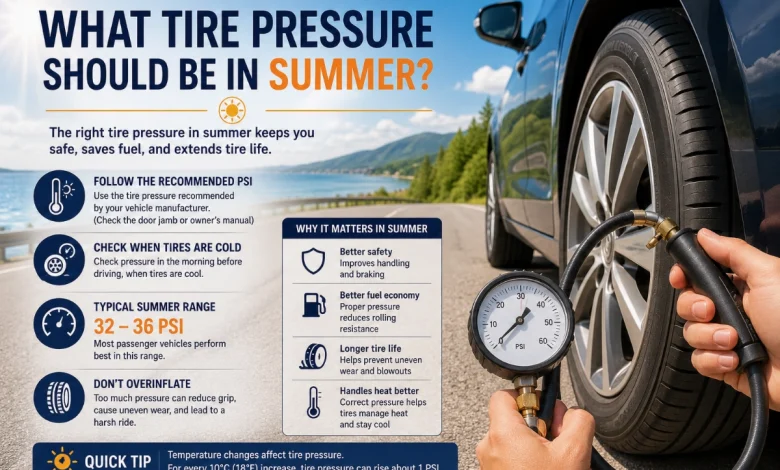
For most passenger vehicles, the recommended tire pressure falls between 30 and 35 PSI (pounds per square inch), or roughly 2.1 to 2.4 bar. Some SUVs and light trucks may call for slightly higher values — typically 35 to 40 PSI.
These numbers are not universal. They are specific to your vehicle, your tire size, and how your car is designed to handle load and road contact. A one-size-fits-all approach to tire pressure simply doesn’t exist.
One important thing to understand about summer: heat increases tire pressure naturally. For every 10°C (18°F) rise in temperature, tire pressure goes up by approximately 1–2 PSI. On a hot day, after driving a while, your tires can easily be 4–6 PSI above their cold-morning reading — without you adding a single pump of air.
Where to Find Manufacturer Recommendations
Never guess at the correct pressure for your tires. The right numbers are always documented — you just need to know where to look:
- Driver’s door jamb sticker — The most reliable source. A label is printed on the inside edge of the driver’s door (or door frame) listing the recommended cold tire pressure for front and rear tires.
- Owner’s manual — Contains detailed pressure specs, including for full load conditions.
- Fuel filler flap — Some manufacturers place the sticker here instead.
- Glove compartment card — Less common, but occasionally included.
Important: Do not use the maximum pressure printed on the tire sidewall. That number is the absolute maximum the tire can hold safely — not what your car needs. Following the sidewall number is a common and potentially dangerous mistake.
Pressure When the Vehicle Is Fully Loaded
When you’re carrying passengers, luggage, or towing a trailer, your tires bear significantly more weight. Most manufacturers recommend increasing tire pressure by 3 to 5 PSI under full load conditions — the exact figure is specified in your owner’s manual or on the door jamb sticker, which often lists both standard and maximum-load pressures separately.
Failing to adjust for load puts excessive strain on the sidewalls and increases the risk of blowouts — particularly at highway speeds on a hot day, when both thermal expansion and road stress are at their peak.
Why Is It Dangerous to Overinflate Tires?
The instinct to “add a little extra air just in case” is understandable — but it backfires badly with tires.
An overinflated tire becomes rigid and drum-tight. Instead of flexing to absorb road irregularities, it acts like a hard rubber ball: bouncing over bumps rather than rolling through them. This rigidity has a cascade of negative consequences for safety, comfort, and tire longevity.
Physics works against you here in summer especially: if you inflate your tires to the manufacturer’s recommended pressure on a cool morning, then drive for an hour on a hot highway, the pressure inside the tire will rise further due to heat. Tires that started at 36 PSI might reach 40–42 PSI mid-journey. If you overinflated them to begin with, the situation gets worse still.
Consequences of Overinflated Tires
Reduced contact patch. An overinflated tire bulges at the center, causing only the middle portion of the tread to contact the road. This dramatically shrinks your grip — especially relevant when braking or cornering.
Worse braking distances. Less contact with the road means your brakes have less rubber to work with. Studies have shown that significantly overinflated tires can increase stopping distances by 10–20%.
Uneven and accelerated wear. The center of the tread wears faster than the edges. This means you’ll need to replace tires sooner, at greater expense.
Harsher ride and increased vibration. The cabin will feel every bump, crack, and seam in the road. This is uncomfortable — and over time, it puts added stress on suspension components.
Higher blowout risk. Overinflated tires have less capacity to absorb impact. Hitting a pothole or road debris at speed can exceed the tire’s structural tolerance, resulting in a sudden blowout — one of the most dangerous events that can happen while driving at highway speed.
Reduced cornering stability. With a narrower footprint, the car is more prone to sliding or losing traction, especially in wet conditions.
Signs of Incorrect Pressure
Your tires will often tell you something is wrong before your pressure gauge does. Watch for:
- Uneven tread wear — Center wear = overinflated; edge wear = underinflated.
- Rougher-than-usual ride — Excessive bouncing or harshness over normal road surfaces.
- Car pulling to one side — Can indicate uneven pressure between tires.
- Visible bulging or deformation — A tire that looks “too round” in the center or shows sidewall bulges.
- TPMS warning light — Most vehicles made after 2008 have a Tire Pressure Monitoring System that illuminates when pressure is significantly off. Note that this system typically only alerts you when pressure is 25% or more below the recommended level — it will not warn you about overinflation.
Never rely solely on visual inspection. A tire can be dangerously over- or underinflated and look completely normal to the naked eye.
Does Pressure Change with the Season?
Yes and no.
The recommended pressure from your manufacturer does not change — it’s the same number year-round. What changes is how ambient temperature affects the air inside the tire.
- In summer: Heat expands air, so pressure rises. You may need to release a small amount of air if tires were inflated during cold weather.
- In winter: Cold contracts air, so pressure drops. You may need to add air when temperatures fall significantly.
The rule of thumb: check your tire pressure every time there’s a significant temperature change — roughly 10°C (18°F) or more. A tire inflated correctly in October may be noticeably underinflated by January, and a tire that was fine in spring might be over-pressured by July.
Always measure pressure when the tires are “cold” — meaning the car hasn’t been driven for at least three hours, or has been driven fewer than 1–2 km. Heat from driving artificially raises pressure and gives you an inaccurate reading.
How and When to Check Tire Pressure
How:
- Remove the valve cap from the tire stem.
- Press a tire pressure gauge firmly onto the valve stem.
- Read the PSI displayed.
- Compare against your vehicle’s recommended pressure (door jamb or manual).
- Add air if low; release air (press the small pin inside the valve) if high.
- Replace the valve cap.
A quality digital gauge costs very little and is accurate to within 0.5–1 PSI. Gas station gauges are convenient but can be unreliable — bring your own if precision matters.
When:
- Once a month — as a baseline habit.
- Before long trips — especially highway driving in summer heat.
- After significant temperature changes — any swing of 10°C or more.
- After hitting a pothole or curb — impact can cause sudden pressure loss or internal damage.
- When the TPMS light appears — check all four tires immediately, plus the spare.
Check all four tires, and don’t forget the spare. A flat spare when you need it is a frustrating and avoidable problem.
Conclusion
Tire pressure is a small maintenance task with outsized consequences. The correct pressure isn’t a guess — it’s specified precisely by your vehicle manufacturer and found in seconds on your door jamb sticker. In summer, heat will push your pressure up naturally, so starting from the right baseline matters even more.
Overinflation is not a cautious choice. It reduces grip, accelerates wear, worsens ride quality, and increases the risk of blowouts — all of which are more dangerous at summer highway speeds. The goal is precision, not extra air.