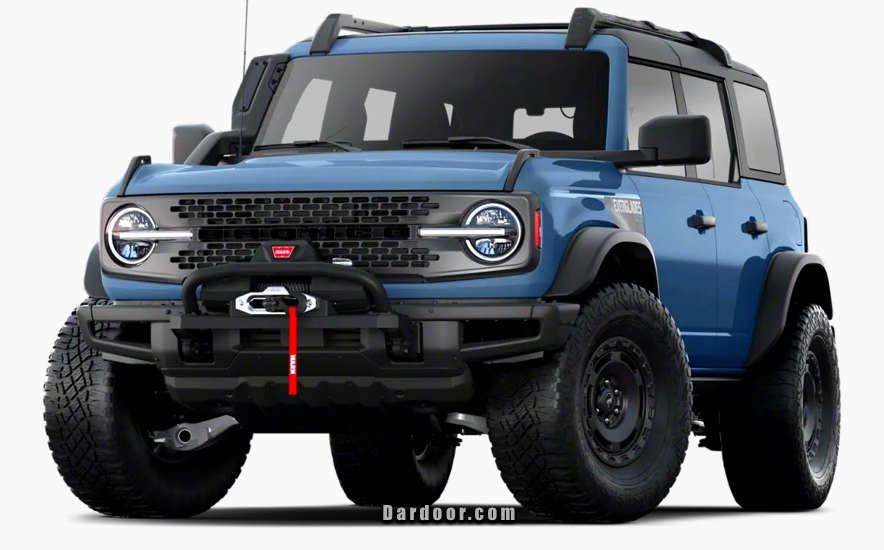
Get the official OEM Wiring Diagram Manual for the 2021–2024 Ford Bronco, available in an easy-to-use PDF format.
📌 Overview
The Ford Bronco (2021–2024) is a body-on-frame, removable-roof 4×4 designed to compete directly with the Jeep Wrangler. It’s offered in 2-door and 4-door layouts, with serious off-road hardware (locking differentials, low range, disconnecting sway bar on some trims) and a wide trim lineup (Base → Wildtrak/Badlands, plus specialty editions). It’s also known for a few repeat-problem areas—roof/trim leaks, steering/suspension noises, camera/driver-assist glitches, and some powertrain-specific concerns.
🧾 Technical Specs (Key Highlights)
- 🧱 Platform: Body-on-frame rugged 4×4 SUV (2-door & 4-door)
- ⚙️ Engines (common): 2.3L EcoBoost I-4 and 2.7L EcoBoost V6
- 🔁 Transmissions: 7-speed manual (6+ crawler) on 2.3L; 10-speed automatic on 2.3L & 2.7L
- 🛞 Drivetrain: 4×4 with low range; available advanced 4×4 with auto mode (trim dependent)
- 🧰 Off-road systems: G.O.A.T. modes, trail control/turn assist (trim dependent), available lockers
- 🧊 Roof/doors: Removable doors; removable hardtop/soft top (varies by trim)
Note: Exact output varies by year/trim/package (Sasquatch, axle ratios, tire size, etc.).
🏁 Performance & Capability
- 🚀 2.3L EcoBoost: strong mid-range torque, lighter feel, manual option available
- 💪 2.7L EcoBoost: best “effortless” acceleration and hill-climb power; popular for towing/off-road builds
- 🪨 Off-road: excellent breakover/approach potential on proper tires; advanced traction/lockers shine on rocks/sand
- 🛣️ On-road: some trims can feel noisy (tires/top), with occasional steering wander complaints depending on alignment/tire setup
🛠️ Top 10 Common Mechanical Issues (Reported by Owners)
1) 🧯 2.7L rough running / misfire / power loss (intake valve concern on some builds)
- Symptoms: rough idle, misfire under load, check-engine light, reduced power / limp mode
- Root cause: on some 2.7L engines, intake valves may crack/break (batch/material issue on affected units)
- Fix: dealer diagnosis; affected engines may require inspection procedures or engine replacement per recall guidance
- Cost (typical): $0 if covered by recall/warranty; out of warranty can be $4,000–$12,000+ depending on damage
2) 🛞 Steering wander / loose feel / clunk over bumps
- Symptoms: drifting at highway speed, frequent corrections, clunking, uneven tire wear
- Root cause: alignment (caster/toe), tire type/pressure (MT tires), loose fasteners, worn tie rods/track bar components, or steering rack wear
- Fix: proper alignment to spec, inspect/torque suspension & steering hardware, replace worn components
- Cost (typical): $150–$350 (alignment) to $500–$2,500 (parts + labor)
3) 🧊 Hardtop wind noise / water leaks (roof seals, panel fitment)
- Symptoms: wind whistle, drip marks, wet headliner, water in cargo area after rain/wash
- Root cause: seal misalignment, panel fitment, missing/weak sealing points, hardware loosening over time
- Fix: reseat panels, replace seals, adjust latches, apply approved sealant/updated parts if available
- Cost (typical): $0–$600 under warranty; out of warranty $150–$1,200 depending on parts
4) 🧱 Doors hard to align / rattles / squeaks (frameless removable doors)
- Symptoms: rattles at speed, squeaks over bumps, door seems slightly “off” after removal
- Root cause: door hinge alignment shift, striker alignment, weatherstrip friction, loose bolts
- Fix: realign hinges/strikers, torque to spec, treat weatherstrips, add anti-rattle pads where applicable
- Cost (typical): $0–$300 (adjustments) to $300–$900 if parts/strikers replaced
5) ❄️ Manual transmission cold scraping noise (MT88)
- Symptoms: rotational scraping noise when cold, noticeable in neutral/low gears with clutch applied
- Root cause: known service pattern on some MT88 units in cold conditions
- Fix: follow Ford TSB procedure (inspection/updated parts or fluid/procedure per bulletin)
- Cost (typical): $0–$400 under warranty; out of warranty $200–$1,500 depending on remedy
6) 🧱 Front axle/CV boot wear or failure (early builds noted by Ford programs)
- Symptoms: grease splatter under vehicle, clicking on turns, vibration, 4×4 noise
- Root cause: CV boot material durability concern on certain early production groups
- Fix: replace boot/half shaft assembly; inspect for joint damage
- Cost (typical): $0 if covered; otherwise $450–$1,400 per side
7) 🛑 Brake vibration / pulsation (rotors) after off-road or heavy use
- Symptoms: steering wheel shake during braking, pedal pulsation
- Root cause: rotor hot spots, pad deposits, mud/sand contamination, uneven torque on lugs
- Fix: rotor resurface/replace, pads if contaminated, clean hubs, proper lug torque sequence
- Cost (typical): $250–$900 (axle set)
8) 🧲 Rear differential noises (whine) / locker engagement quirks
- Symptoms: whine at steady speed, clunk on throttle changes, locker not engaging smoothly
- Root cause: gear pattern setup, fluid degradation, actuator/locker calibration, off-road heat
- Fix: fluid service, inspect gears/bearings, recalibrate/repair actuator, replace damaged components
- Cost (typical): $150–$300 (fluid) to $900–$3,500 (repair/rebuild)
9) 🛻 Suspension “top hat”/shock noises after lift/35s (or hard trail use)
- Symptoms: clunking, popping, knocking when turning or over bumps
- Root cause: worn shock mounts, bushing wear, loosened hardware, lift geometry stress
- Fix: torque check, replace mounts/bushings, consider geometry correction
- Cost (typical): $150–$800 (hardware/mounts) to $800–$2,800 (struts/shocks)
10) 🛠️ Lug nut torque / wheel vibration after service
- Symptoms: vibration, clicking, wheel “feel” changes after tire rotation/service
- Root cause: improper lug torque sequence or torque spec, especially after shop work
- Fix: torque check to spec with a calibrated wrench; inspect studs/nuts; re-seat wheel
- Cost (typical): $0–$80 (shop torque check); studs replacement can be $80–$250
⚡ Top 10 Common Electrical Issues (Reported by Owners)
1) 📷 Rearview/360 camera intermittent blue/black screen
- Symptoms: blue/black image, frozen camera, camera fails when shifting to reverse
- Root cause: camera hardware/wiring retention and/or module/software behavior (varies by build)
- Fix: recall remedy may replace camera or update related modules per Ford guidance
- Cost (typical): $0 if recall applies; otherwise $350–$1,200
2) 🧠 Random warning lights / “Christmas tree dash” after low battery
- Symptoms: multiple system alerts (ABS/4×4/traction), hard start, modules acting “weird”
- Root cause: weak 12V battery, parasitic draw, low voltage causing module communication faults
- Fix: battery test/replace, clean grounds, check charging system, scan & clear codes
- Cost (typical): $180–$450 (battery) to $450–$1,200 if diagnosing draw
3) 🔑 Keyless entry / remote start inconsistent
- Symptoms: intermittent unlock, “key not detected”, remote start fails
- Root cause: key fob battery, antenna module sensitivity, software glitches
- Fix: replace fob battery, reprogram/update, inspect antennas/connectors
- Cost (typical): $5–$15 (battery) to $150–$600 (diag/program/module)
4) 💡 LED exterior lighting issues (flicker/condensation-related connector problems)
- Symptoms: flicker, DRL out, turn signal hyperflash, moisture inside housing
- Root cause: water intrusion, connector pin corrosion, module sensitivity
- Fix: dry/replace housing if leaking, clean/repair connectors, replace affected lamp/module
- Cost (typical): $80–$900 depending on lamp type
5) 🧊 HVAC blower intermittent / climate controls “laggy”
- Symptoms: blower cuts out, only works on some speeds, weak airflow
- Root cause: blower resistor/module, motor wear, connector heat damage
- Fix: replace blower motor or resistor/module; inspect wiring
- Cost (typical): $220–$850
6) 📱 SYNC infotainment reboots / Bluetooth drops
- Symptoms: random reboot, no audio, Apple CarPlay/Android Auto disconnects
- Root cause: software bugs, corrupted profile data, USB/phone cable issues
- Fix: update SYNC, master reset, re-pair device, use quality cable
- Cost (typical): $0–$250 (dealer update/diagnosis)
7) 🧭 Driver-assist faults (blind spot/lane keep) after mud/snow
- Symptoms: “sensor blocked” warnings, features disabled
- Root cause: radar/camera obstructed, misalignment after bumper impacts, wiring issues
- Fix: clean sensors, recalibrate, inspect wiring/bumper mounts
- Cost (typical): $0–$150 (clean) to $250–$1,500 (calibration/repair)
8) 🪟 Power window “one-touch” problems or slow movement
- Symptoms: window reverses, doesn’t auto-up/down, slow travel
- Root cause: pinch protection calibration, dirty tracks, regulator wear
- Fix: window relearn procedure, clean/lube tracks, replace regulator if worn
- Cost (typical): $0–$80 (relearn/clean) to $250–$700 (regulator)
9) 🚦 Trailer wiring faults / “trailer disconnected” warnings (when equipped)
- Symptoms: intermittent trailer lights, warnings while towing
- Root cause: corroded connector, poor ground, wiring chafe
- Fix: clean/replace connector, repair wiring, verify ground
- Cost (typical): $50–$450
10) 🧷 Airbag/seat belt warning light (sensor wiring/connector issues on some vehicles)
- Symptoms: airbag light on, seat belt status odd, warning messages
- Root cause: buckle sensor wire/connector faults (seen in Ford service programs on certain models)
- Fix: scan RCM, repair/replace affected buckle/sensor harness per service guidance
- Cost (typical): $0 if covered; otherwise $250–$700
👍👎 Pros & Cons
| ✅ Pros | ⚠️ Cons |
|---|---|
| Exceptional off-road capability (lockers, low range, trail tech) | Hardtop/door fitment can cause wind noise, rattles, or leaks |
| Removable doors/roof + strong aftermarket support | Infotainment/camera glitches reported; some are recall-related |
| 2.7L V6 delivers excellent torque and drivability | Some 2.7L builds affected by intake valve recall concern |
| 7-speed manual option (with crawler gear) is unique/fun | Manual cold noise complaints exist (TSB-supported pattern) |
| Strong community knowledge base for DIY fixes | Big tires/lifts amplify steering/alignment sensitivity |
🗓️ Maintenance Schedule (Practical Owner-Friendly)
| Interval | Service | Notes |
|---|---|---|
| Every 5,000–8,000 miles (8,000–13,000 km) | 🛢️ Oil & filter | Shorter interval for off-road/towing/heat |
| Every 10,000–15,000 miles | 🔁 Tire rotation + alignment check | Critical with 35s/Sasquatch setups |
| Every 20,000–30,000 miles | 🧼 Engine air filter | Earlier if dusty trails |
| Every 30,000–45,000 miles | 🧪 Brake fluid inspection/flush (as needed) | Flush sooner if heavy off-road/water crossings |
| Every 30,000–60,000 miles | 🛞 Differential & transfer case fluid | Important for locker/4×4 longevity |
| Every 40,000–60,000 miles | 🔧 Transmission service (usage-dependent) | Severe use = earlier service |
| Every 60,000 miles | 🧊 Coolant check/replace (as specified) | Follow year/engine-specific spec |
| Seasonally | 🧽 Roof seals + drains inspection | Prevents leaks/wind noise; clean & treat seals |
| After serious off-road trips | 🔩 Torque check + underbody inspection | Check skid plates, suspension, steering fasteners |
🥊 Top Competitors
- 🚙 Jeep Wrangler — Wrangler Repair Manual ↗
- 🛻 Jeep Gladiator — Gladiator Repair Manual ↗
- 🗻 Toyota 4Runner — 4Runner Repair Manual ↗
- 🛡️ Land Rover Defender — Defender Repair Manual ↗
- 🌍 Toyota Land Cruiser — Land Cruiser Repair Manual ↗
🚨 Recalls, Advisories & TSB Highlights (Top 10)
- 🧯 24S55 — Engine intake valves may crack/break (some 2021–2022 Bronco with 2.7L/3.0L): loss of power risk. Fix: dealer inspection procedure and possible engine replacement.
- 📷 23S48 — Rearview/360 camera intermittent blue image on 2021 Bronco: camera may require replacement.
- 🪟 24S10 — Hardtop rear quarter glass adhesion issue (some 2023–2024): glass could detach. Fix: inspect/reinstall panels as needed.
- 👶 24S15 — Inoperative child safety lock (some 2023–2024 4-door): child lock may not work properly.
- 🪑 25V721 / 25SB5 — Front seat frame bolt may loosen/dislodge (some 2021–2023): reduced restraint performance risk. Fix: replace pivot links/bolts.
- 🧨 22V928 — Side impact sensors not properly secured (certain builds): airbags may deploy incorrectly or not deploy.
- 🛞 23S17 — Wheel lug nut torque check (certain 2023 Bronco/Ranger): verify/retorque to spec.
- 📷 22C27 — Rearview camera image re-entry issue in 4L mode (certain 2021–2022): dealer remedy per recall documentation.
- 🛠️ 22B27 (CSP) — Front driveshaft CV boot durability concern on certain 2021 builds: boot may fail; service action may apply.
- 🛞 25S01 — Rear shock absorber concern (certain 2021–2024 Bronco): dealer inspection/repair per recall bulletin.
✅ Always confirm by VIN: recalls vary by build date, plant, and trim/packages.
🧩 DTC Trouble Code Tables
🧠 Engine Control Module (ECM) — 10 Common Codes
| Code | Meaning | What it usually points to |
|---|---|---|
| P0300 | Random/Multiple Misfire | Ignition, fuel, vacuum leak, compression |
| P0301 | Misfire Cylinder 1 | Plug/coil/injector/compression (cyl 1) |
| P0171 | System Too Lean (Bank 1) | Vacuum leak, MAF, fuel delivery |
| P0420 | Catalyst Efficiency Low | Cat wear, O2 sensors, misfire damage |
| P0456 | EVAP Small Leak | Gas cap, purge/vent valve, leak in lines |
| P0500 | Vehicle Speed Sensor | ABS speed input, wiring, sensor faults |
| P061A | Torque Performance | Throttle control, PCM logic, sensor mismatch |
| P0121 | TPS/Pedal Range | Throttle body, pedal sensor, wiring |
| P0101 | MAF Range/Performance | Dirty MAF, intake leak, sensor fault |
| P0087 | Fuel Rail Pressure Low | Fuel pump, filter restriction, sensor |
🔁 Transmission Control Module (TCM) — 10 Common Codes
| Code | Meaning | What it usually points to |
|---|---|---|
| P0700 | Transmission Control System | TCM set a fault (scan TCM for specifics) |
| P0720 | Output Speed Sensor | Sensor/wiring/TCM logic issue |
| P0715 | Input/Turbine Speed Sensor | Sensor or harness fault |
| P0741 | TCC Performance/Stuck Off | Torque converter clutch, fluid, valve body |
| P0751 | Shift Solenoid A Performance | Solenoid, valve body, contamination |
| P0761 | Shift Solenoid C Performance | Solenoid/valve body issue |
| P0796 | Pressure Control Solenoid C | Line pressure control fault |
| P0868 | Line Pressure Low | Fluid level, pump, internal leak |
| P090C | Clutch Actuator (Manual related) | Actuator circuit/mechanical binding (if equipped) |
| P2714 | Pressure Control Solenoid D | Solenoid, valve body, wiring |
🛑 ABS / ESC (Brake System) — 10 Common Codes
| Code | Meaning | What it usually points to |
|---|---|---|
| C003A | Wheel Speed Sensor | Sensor debris/damage, harness |
| C0040 | ABS Pump Motor | Pump motor, relay, wiring |
| C0051 | Steering Angle Sensor | Calibration, sensor fault |
| C0061 | Yaw Rate Sensor | Sensor/circuit, water intrusion |
| C1096 | Hydraulic Failure | ABS module/pump internal issue |
| C1440 | Brake Switch | Brake pedal switch, wiring |
| C1B00 | ABS Module Fault | Module internal error |
| C1A96 | Stability Control | Sensor mismatch, calibration needed |
| U0121 | Lost Comm w/ ABS | CAN bus, module power/ground |
| C0045 | Brake Pressure Sensor | Sensor fault, wiring, calibration |
🎈 SRS Airbag System — 10 Common Codes
| Code | Meaning | What it usually points to |
|---|---|---|
| B00A0 | Occupant Classification | Seat sensor mat/module |
| B00D5 | Driver Airbag Circuit | Clock spring, connector, wiring |
| B00D6 | Passenger Airbag Circuit | Connector/wiring/module |
| B0020 | Side Airbag Circuit | Harness/connector issue |
| B0092 | Pretensioner Circuit | Seat belt pretensioner connector |
| B121D | Impact Sensor | Sensor mounting/wiring |
| B1342 | RCM Internal Fault | Restraints control module |
| B0050 | Seat Belt Sensor | Buckle sensor/wiring |
| U0151 | Lost Comm w/ RCM | CAN/power/ground to RCM |
| B10D7 | Airbag Warning Lamp | Cluster/RCM comm/driver circuit |
📡 Body Control / CAN Communication — 10 Common Codes
| Code | Meaning | What it usually points to |
|---|---|---|
| U0100 | Lost Comm w/ ECM/PCM | CAN fault, PCM power/ground |
| U0101 | Lost Comm w/ TCM | CAN fault, TCM power/ground |
| U0121 | Lost Comm w/ ABS | ABS module offline/CAN issues |
| U0140 | Lost Comm w/ BCM | BCM power/ground or CAN wiring |
| U0155 | Lost Comm w/ Cluster | IPC module/CAN |
| U0199 | Lost Comm w/ Telematics | TCU/modem power/antenna |
| B11DB | Battery Voltage | Low battery, charging system |
| B1D01 | Door Ajar Switch | Latch switch, wiring |
| B1B02 | Exterior Lamp Circuit | LED driver, connector corrosion |
| U3000 | Control Module Fault | Module internal fault / undervoltage history |
⚠️ DTCs are starting points. Always diagnose with live data, freeze frame, and wiring checks before replacing parts.
❓ FAQ (Owner Questions)
Q1) Is the 2.7L or 2.3L more reliable?
Both can be solid, but the 2.7L has had high-visibility recall attention on certain builds. If you want maximum peace of mind, verify VIN recall status and maintenance history.
Q2) Why does my Bronco feel “loose” on the highway?
Common causes are alignment (caster/toe), tire pressure, aggressive tires, or suspension hardware torque—especially after lifts, new wheels, or hard trail use.
Q3) Are roof leaks “normal” on removable tops?
Some wind noise is typical, but water leaks should be fixable via seal/panel adjustment, updated parts, and proper installation/torque.
Q4) Should I avoid the manual transmission?
No—many owners love it. Just be aware of cold-noise TSB patterns and make sure any symptoms are documented under warranty.
Q5) What’s the smartest used-buy checklist?
Run a full scan for codes, verify recall completion, inspect roof seals, check steering/alignment, review tire wear, and test all cameras/driver-assist systems.
🏆 Final Verdict
Buy it if: you want one of the most capable modern off-road SUVs with huge aftermarket support, removable roof/doors, and excellent trail tech.
Be cautious if: you hate rattles/wind noise, don’t want to deal with occasional electronics/camera quirks, or you’re shopping a 2.7L Bronco without verified recall completion.
Best strategy: pick the trim that matches your real use (daily + weekend trails), keep tires/alignment dialed in, service drivetrain fluids if you off-road often, and always confirm recalls by VIN.