CCS Type 2 (Charging Port type affects charging station compatibility.)
Max AC Charging
11 KW
Home Charging, 3-Phase support. On-board AC charger (inverter) Capacity affects AC charging speed.
Max DC Charging
205 KW
Maximum power the car can accept from a DC faster charger. with average ≈ 125 kW in that Window.
Architecture
400 V
Higher power train voltage means faster charging and better efficiency.
Battery Capacity (Usable)
79 kWh
Net battery capacity that is available for use.
Motor / Power Performance
Around 325 kW
Combined
Torque
670 Nm
Same as standard Twin Motor
0-100 km/h
4.6 Second
Slight improvement over standard
Top Speed
180 km/h
Sam cap as standard Twin Motor
Charging 10→ 80%
28 minutes
Under Ideal Conditions
Range / “Real” / WLTP
~ Average / real world: ~ 443 km
1-stop range (from benchmark)
Long-trip / 1-stop range (benchmark)
~ 443 km (average), 394 km (cold), 506 km (mild)
1-stop meaning one 15-min charge stop.
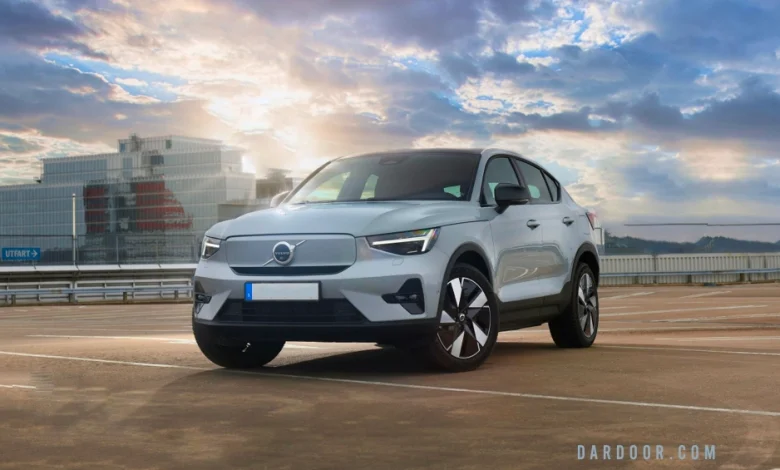
About Volvo EC40 Twin Motor Performance (MY26)
Overview & Context
The EC40 is Volvo’s compact electric crossover / coupe-SUV (cousin to EX40 etc.).
The “Twin Motor” version is the all-wheel drive (AWD) version, with one motor on each axle.
The “Performance” variant is a software / mode upgrade that gives a power boost over the standard Twin Motor.
For MY26, this Performance mode for the EC40 is confirmed: a “Performance drive mode” adds ~ 25 kW boost.
What’s New / What’s Changed in MY26 vs Previous Years
The main change is formalizing the Performance software pack / Performance drive mode for the EC40 Twin Motor, giving the extra ~25 kW and a sharper accelerator mapping.
Design offerings such as the Black Edition (Onyx Black paint, gloss black badging, etc.) are also carried for EC40.
Observations & Considerations
The performance boost is modest (~ 8% additional power) over the standard Twin Motor, so it’s more about sharper response than radical leaps.
The torque remains the same (670 Nm) in Performance mode, so you don’t gain more “twisting force,” just more top-end power delivery.
The 1-stop long trip benchmark is a useful metric (see below for deep analysis): it captures both range and charging speed tradeoffs. For MY26 Performance, it’s ~ 443 km in average conditions.
Prices shown are manufacturer’s recommended retail prices (MSRP/OTR) for the specified countries. They exclude indirect incentives and may vary with options and regional specs. Values are subject to change without notice.
Real-World Range Estimates
Condition
City
Highway (110 km/h)
Combined
🌤️ Mild Weather
587 km
362 km
451 km
🌦️ Average Weather
—
—
400 km
❄️ Cold Weather
402 km
282 km
338 km
Indication of real-world range in several situations. Cold weather: “worst-case” (−10 °C with heating). Mild weather: “best-case” (23 °C without A/C). Highway assumes 110 km/h. Actual range depends on speed, driving style, weather and route conditions.
Long Distance Suitability (1-Stop Range)★★1/2☆☆
First Stop Distance
288 km
First Stop Duration
2h 37min
Charging Stop
0km
Charging Stop
15 min
Second Stop Distance
155 km
Second Stop Duration
1h 24min
Total Distance
443 km
Total Duration
4h 16min
Weather
1-Stop Range
🌤️ Mild Weather
505 km
🌦️ Average Weather
443 km → ★★½☆☆
❄️ Cold Weather
394 km
Volvo EC40 Twin Motor Performance (MY26) ★★½☆☆
0★
1★
2★
3★
4★
5★
15 min329 km3h177 km1h 36m
15 min288 km2h 37m155 km1h 24m
15 min257 km2h 20m138 km1h 15m
0
100
200
300
400
500
600
700
800
900
1000
The “long distance suitability” is a 5-star rating indicating how suitable a vehicle is for long trips. It’s based on the 1-Stop Range: total distance with one 15-minute DC fast-charging stop.
2025 thresholds:
0☆ <200 km;
1★ 200–325;
2★ 325–450;
3★ 450–575;
4★ 575–700;
5★ >700 km.
Half-stars are assigned by linear interpolation.
Battery Details
Nominal / Usable Capacity
82.0 kWh / 79.0 kWh
Type / Cathode
Lithium-ion • NCM
Architecture / Nominal Voltage
400 V / 400 V
Cells / Pack Configuration
324 cells • 108s3p
Form Factor
Pouch
Warranty
8 years (100,000 mi)
Charging Overview
Category
Details
Home / Destination (AC)
Type 2 (left-rear); onboard charger 11 kW; ~8 h 30 m (0→100%) via 11 kW; ~47 km/h
Supported; automatic when navigating to a DC fast charger
Home & Destination Charging (0→100%)
Charging Point
Max. Power
Power
Time
Rate
Wall Plug (230 V / 1×10 A)
2.3 kW
2.3 kW
40 h 30 m
~10 km/h
1-Phase 16 A (230 V)
3.7 kW
3.7 kW
25 h 15 m
~16 km/h
1-Phase 32 A (230 V)
7.4 kW
7.4 kW
12 h 45 m
~32 km/h
3-Phase 16 A (400 V)
11 kW
11 kW
8 h 30 m
~47 km/h
3-Phase 32 A (400 V)
22 kW
11 kW †
8 h 30 m
~47 km/h
† limited by onboard charger. Charging speed depends on EVSE and grid (1-phase vs 3-phase availability).
Fast Charging (10→80%)
Connector: Combined Charging System (CCS Combo 2). Rapid charging enables longer trips by adding as much range as possible in the shortest time. Charging power drops significantly after ~80% SoC; typical rapid sessions end at or before 80%.
Charging Point
Max. Power
Average Power
Time (10→80%)
Rate
CCS 50 kW
50 kW
50 kW
70 min
~241 km/h
CCS 100 kW
100 kW
85 kW †
41 min
~402 km/h
CCS 150 kW
150 kW
105 kW †
33 min
~499 km/h
CCS 175 kW
175 kW
115 kW †
30 min
~563 km/h
CCS 350 kW
205 kW †
125 kW †
28–30 min
~595 km/h
† Limited by vehicle capabilities. Autocharge: automatic session start at supported CCS stations. Plug & Charge: automatic session start at ISO 15118-2 compatible stations. Actual rates vary with temperature, battery state, site load, and driving style.
Claimed Charging Specs (Manufacturer)
Max. Power = peak charge power
Avg. Power = average over 10–80% session
Time = 10–80% duration
Rate = average charging speed of the session.
Max. Power
Charge From
Charge To
Time
Rate
205 kW
10%
80%
28 min
~595 km/h
Performance & Drivetrain
Total Power / Torque
325 kW • 670 Nm
0–100 km/h
4.6 s (0–62 mph)
Top Speed
180 km/h (112 mph)
Drive
AWD (dual-motor)
Energy Consumption & Efficiency
Standard / Basis
Range
Rated Consumption
Vehicle Consumption
EVDB Real Range (Combined)
400 km
—
~198 Wh/km
WLTP (TEL)
552 km
~173 Wh/km
~143 Wh/km
WLTP (TEH)
510 km
~187 Wh/km
~155 Wh/km
TEL = Test Energy Low | TEH = Test Energy High. Rated = official figures incl. charging losses. Vehicle = calculated battery energy used for propulsion and onboard systems.
Real Energy Consumption Estimation
Scenario
City
Highway
Combined
❄️ Cold Weather
~196 Wh/km
~280 Wh/km
~234 Wh/km
🌤️ Mild Weather
~134 Wh/km
~218 Wh/km
~175 Wh/km
Indication of real-world energy use in several situations. Cold: −10 °C with heating. Mild: 23 °C without A/C. Highway assumes 110 km/h. Energy use depends on speed, style, climate and route conditions.
Safety Rating
Region
Rating
Details
Europe (Euro NCAP)
—
Not specified for this exact configuration on the source page
North America
—
NHTSA / IIHS not listed for EC40
South America
—
Latin NCAP not listed
Regional safety ratings vary by year and configuration; consult Euro NCAP, NHTSA, IIHS, or Latin NCAP for official results.
Dimensions & Weight
L × W × H
4440 × 1873 × 1596 mm (width with mirrors 2034 mm)
Wheelbase
2702 mm
Weight (EU) / GVWR / Payload
2185 kg / 2620 kg / 510 kg
Cargo (seats up / max / frunk)
404 L / 1196 L / 31 L
Roof Load
75 kg
Towing (unbraked / braked / vertical)
750 kg / 1800 kg / 100 kg
Turning Circle
11.4 m
Platform / Dedicated EV
Volvo CMA / No
Body / Segment / Roof Rails
SUV • JC – Medium • Yes
Heat Pump
Yes (standard)
Bidirectional Charging (V2X / BPT)
Capability
Status
Meaning
V2L (Vehicle-to-Load)
No
Power external devices from the car
V2H (Vehicle-to-Home)
No
Home backup / whole-home power
V2G (Vehicle-to-Grid)
No
Export to the grid
BPT (Battery Power Transfer)
No
Umbrella term for bidirectional features
Miscellaneous
Seats
5 People
Isofix
Yes, 2 Seats
Car Body
SUV
Segment
JC – Medium
Turning Radius
11.4 m
Platform
Volvo CMA
EV Dedicated Platform
No
Roof Rails
Yes
Heat Pump
Yes
Heat Pump Standard Equipment
Yes
* Estimated values may appear where indicated. Average energy consumption and range assume moderate driving style and climate. Real-life values may differ significantly. Pricing information may not reflect all regions. No rights can be derived from this information.
Predecessor Comparison
Metric
EC40 Twin Motor Performance (MY25)
EC40 Twin Motor Performance (MY26)
Δ
Real Range (Combined)
400 km
400 km
—
0–100 km/h
4.6 s
4.6 s
—
Efficiency (Vehicle)
~198 Wh/km
~198 Wh/km
—
The MY26 successor maintains similar range, acceleration and efficiency to MY25 while adding Plug & Charge and updated pricing where applicable.
Previous Generation
Next Generation
Volvo EC40 Twin Motor Performance MY25
There are no newer versions of this car
Why You'll Love It 😘
Strong Performance / Acceleration The Twin Motor version gives punchy, instant torque and rapid acceleration. Reviewers note that the Performance version (enhanced via software) delivers an extra boost over the base AWD model.
Stylish Design + Premium Interior Ambience The EC40 has a sleek coupe-SUV silhouette which many find more eye-pleasing than the more practical EX40. Inside, the cabin feels upscale, with good materials, comfort, and modern finishes.
Well-integrated Tech & Infotainment (Google Built-In, OTA updates) The Google-based infotainment system gives access to Google Maps, Google Assistant, and apps via Play Store. Over-the-air updates help improve or add software features over time.
Refinement, Quietness & Ride Comfort Reviews often mention that the EC40 is quiet, smooth, and well insulated from wind and road noise, making it a pleasant vehicle for daily driving or highway cruising.
Why You Might Think Twice 🤔
Reduced Practicality / Cargo / Rear Headroom Penalties Because of the sloping coupe-style roofline, the EC40 sacrifices some cargo space and rear headroom compared to its sibling EX40 or more vertical SUVs. Reviewers point out that the EX40 is more practical for many buyers.
Relatively High Price for What You Get Many reviewers feel the EC40 comes at a premium, especially once you pick higher trims or the Performance software upgrade. Some think you pay extra for style over outright utility.
Range & Charging Limitations Under Hard Use While its published range is decent, in real-world driving (especially in colder climates or when driving aggressively) the range can drop substantially. Also, charging speeds (especially beyond certain battery states) may not always reach ideal levels.
Infotainment / Tech Quirks & Limitations Although the infotainment system is powerful, some users report downsides: requiring wired Android Auto, occasional software glitches, or that some tech features (especially in driver assists) lag behind the most advanced offerings from competitors. Also, visibility in some areas (due to styling) is criticized.
1-Stop Range Definition 🔋
The 1-Stop Range is calculated using the standardized driving profile and assumptions outlined below. It represents the total distance covered in two trip stops, separated by a single 15-minute fast-charging session. For vehicles without fast-charging capability, only the distance of the first stop is considered.
🚗 Driving Profile
Begin with a fully charged battery
Stop 1: Drive until the battery reaches 10% state-of-charge (SoC)
Perform a 15-minute fast charge
Stop 2: Continue driving until the battery again reaches 10% SoC
📋 Assumptions
Driving speed, climate, and environmental conditions are based on Real Range Highway data
No additional time required to initiate or stop the charging session
The charging station always delivers the maximum power requested by the vehicle
The battery is assumed to be in optimal health and condition
⚠️ Important Note : In real-world driving, it is practically impossible to replicate these conditions exactly. This benchmark should therefore be viewed as a comparative metric,designed to evaluate vehicles under standardized conditions rather than predict exact trip distances.
5-Star Rating Definition ★
The 1-Stop Range represents the distance a vehicle can travel after a single 15-minute charging stop. To highlight the influence of temperature, this range is calculated under three identical weather conditions used in the Real-World Range benchmark. The 1-Stop Range in combined conditions is the basis for the ★ star rating, which offers a quick and comparable measure of long-distance suitability across different vehicles. This rating helps drivers immediately see whether a car is practical for extended trips relative to its peers.
Assignment of Stars in 2025
☆ 0 less than 200 km
★ from 200 km to 325 km
★★ from 325 km to 450 km
★★★ from 450 km to 575 km
★★★★ from 575 km to 700 km
★★★★★ more than 700 km
Based on 2025 thresholds: 3 stars awarded for 490 km average. Half-stars interpolated. Vehicles with a rating between these values receive a rating based on a linear scale.
Fast Charging (10 -> 80%) ⚡
Rapid charging enables longer journeys by adding as much range as possible in the shortest amount of time. Charging power will decrease significantly after 80% state-of-charge has been reached. A typical rapid charge therefore rarely exceeds 80% SoC. The rapid charge rate of an EV depends on the charger used and the maximum charging power the EV can handle.
Max. Power: maximum power provided by charge point
Avg. Power: average power provided by charge point over a session from 10% to 80%
Time: time needed to charge from 10% to 80% Rate: average charging speed over a session from 10% to 80%
This website uses cookies to improve your experience while you navigate through the website. Out of these, the cookies that are categorized as necessary are stored on your browser as they are essential for the working of basic functionalities of the website. We also use third-party cookies that help us analyze and understand how you use this website. These cookies will be stored in your browser only with your consent. You also have the option to opt-out of these cookies. But opting out of some of these cookies may affect your browsing experience.
Necessary cookies are absolutely essential for the website to function properly. This category only includes cookies that ensures basic functionalities and security features of the website. These cookies do not store any personal information.
Any cookies that may not be particularly necessary for the website to function and is used specifically to collect user personal data via analytics, ads, other embedded contents are termed as non-necessary cookies. It is mandatory to procure user consent prior to running these cookies on your website.



 400 km
 180 km/h
  4.6 Sec
  600 km/h