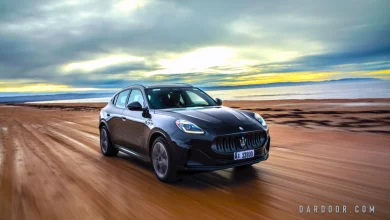
Tesla Model Y Juniper RWD ★★1/2☆☆
Updated RWD entry Model Y with LFP pack, improved real-world efficiency and refreshed charging profile.

 375 km
 201 km/h
  5.9 Sec
  650 km/h
 - It debuted in China, and by March 2025, became available in Europe, the U.S., Canada, Mexico, and Chile.
- The Launch Series trim (initial U.S. offering) starts around US $59,990 before discounts.
- Meanwhile, a Long Range RWD variant is offered at a notably lower price—around US $44,990—compared to the Long Range AWD.
💲 Price & Regional Availability
| Country/Region | MSRP | Order/On-Sale | Status / Notes |
|---|---|---|---|
| Germany | €45,970 | Since Feb 2025 | Configurable |
| Netherlands | €45,990 | Since Feb 2025 | Configurable |
| United Kingdom | £44,990 | Since Feb 2025 | Configurable |
| USA | $59,990 | Since Feb 2025 | Configurable |
| Canada | Discontinued | Not Available | Not Available |
| Mexico | MXN $849,000 | Since Feb 2025 | Configurable |
| Chile | CLP $43,900,000 | Since Feb 2025 | Configurable |
| China | CNY 263,500 | Since Feb 2025 | Configurable |
| United Arab Emirates | AED 198,170 | Since Feb 2025 | Configurable |
🛣️ Real-World Range Estimates
| Weather | City | Highway (110 km/h) | Combined |
|---|---|---|---|
| Mild Weather (23 °C, no A/C) | 550 km | 355 km | 435 km |
| Average Condition | — | — | 375 km |
| Cold Weather (−10 °C, heating) | 360 km | 270 km | 315 km |
🧪 Long Distance Suitability (Benchmark-Based) ★★1/2
This benchmark combines usable battery, efficiency, and fast-charging capability into a single metric: the 1-Stop Range (two driving legs separated by one 15-minute DC fast-charge). It simplifies cross-EV comparison for road-trip readiness.
| First Leg Distance | 276 km |
| Charging Stop | 0km |
| Second Leg Distance | 164 km |
| Total Distance | 440 km |
| First Leg Duration | 2h 31min |
| Charging Stop | 15 min |
| Second Leg Duration | 1h 29min |
| Total Duration | 4h 15min |
🔋 Battery Details (Lithium-ion)
| Nominal / Usable Capacity | 64.0 kWh / 60.5 kWh* |
|---|---|
| Architecture / Chemistry | 400 V • LFP (CATL LFP64) |
| Thermal Management | Active, preconditioning supported |
| Warranty | 8 years • 160,000 km |
🔌 Charging Capabilities
| AC Port / Max | Type 2 • 11 kW |
|---|---|
| DC Port / Max | CCS • 175 kW* (10–80% avg ~110 kW*) |
| Autocharge | Supported |
| Plug & Charge | Not supported |
| Battery Preconditioning | Yes (via navigation) |
🏁 Performance & Drivetrain
| Power / Torque | ~220 kW* • ~420 Nm* |
|---|---|
| 0–100 km/h | 5.9 s |
| Top Speed | 201 km/h |
| Drivetrain | Rear-wheel drive |
🔁 Bidirectional Charging (V2X)
| V2L | No |
|---|---|
| V2H | No |
| V2G | No |
| Status / Notes | — |
🧮 Energy Consumption & Efficiency
| Condition | City | Highway | Combined |
|---|---|---|---|
| Cold | — | — | — |
| Mild | — | — | — |
| Average (DARDOOR) | — | — | 161 Wh/km |
Rated = official figures published by the manufacturer; rated consumption and fuel-equivalency include charging losses. Vehicle = calculated battery energy used by the vehicle for propulsion and onboard systems. Real-world results vary with conditions and usage.
⚡ Real Energy Consumption Estimation
110 – 224 Wh/km
Indication of real-world energy use across scenarios. “Cold Weather” is worst-case (−10 °C with heating). “Mild Weather” is best-case (23 °C without A/C). Highway values assume a constant 110 km/h. Energy use depends on speed, driving behavior, climate, and route profile.
| City – Cold Weather * | 168 Wh/km |
| Highway – Cold Weather * | 224 Wh/km |
| Combined – Cold Weather * | 192 Wh/km |
| City – Mild Weather * | 110 Wh/km |
| Highway – Mild Weather * | 170 Wh/km |
| Combined – Mild Weather * | 139 Wh/km |
🛡️ Safety Ratings
| Program / Region | Result | Notes |
|---|---|---|
| Euro NCAP (Europe) | — | Model Y variants previously tested; Juniper RWD not individually published at time of writing. |
| NHTSA (North America) | Not tested / N/A | Model-year/variant specific data pending. |
| IIHS (North America) | Not tested / N/A | Variant-specific results pending. |
| Latin NCAP (South America) | Not tested / N/A | No official rating published for this variant. |
📏 Dimensions & Weight
| L × W × H | 4790 × 1982 × 1624 mm |
|---|---|
| Wheelbase | 2890 mm |
| Curb / GVWR / Payload | 2003 / 2448 / 520 kg |
| Cargo (Seats Up/Down + Frunk) | 854 L / 2138 L + 117 L frunk |
| Towing (Unbraked/Braked) | 750 / 1600 kg |
| Turning Circle | 12.1 m |
🛣️ Long Distance Suitability (Practical)
🏠🔌 Home & Destination Charging (0 → 100%)
Charging is possible via a regular wall plug or a dedicated charging station. Public charging is always through a station (EVSE). How fast the EV charges depends on the EVSE used and the vehicle’s onboard AC limit. Availability of 1-phase vs 3-phase varies by country.
| Charging Point | Max. Power (kW) | Power (kW) | Time (0 → 100%) | Rate (km/h) |
|---|---|---|---|---|
| Wall Plug (2.3 kW) | 2.3 | 2.3 | 31 h | 12 |
| 1-Phase 16A (3.7 kW) | 3.7 | 3.7 | 19 h 15 m | 19 |
| 1-Phase 32A (7.4 kW) | 7.4 | 7.4 | 9 h 45 m | 38 |
| 3-Phase 16A (11 kW) | 11 | 11 | 6 h 30 m | 58 |
| 3-Phase 32A (22 kW) | 22 | 11 † | 6 h 30 m | 58 |
⚡⏱️ Fast Charging (10 → 80%)
Connector: CCS Combo 2. Autocharge supported; Plug & Charge not supported. Battery preconditioning available via navigation.
⚡ Rapid Charging
Rapid charging is designed to maximize driving range in the shortest possible time, making long-distance journeys more practical.
However, charging power naturally decreases once the battery reaches around 80% state of charge (SoC). For this reason,
most rapid charging sessions typically stop at 80% SoC, as charging beyond that point becomes considerably slower.
The rapid charging performance of an electric vehicle (EV) depends on two key factors:
- The charging station – the maximum power output it can provide.
- The vehicle’s onboard charging capability – which dictates the maximum power the EV can accept.
The table below summarizes the estimated rapid charging characteristics of the
Tesla Model Y RWD. While Tesla has not officially published full specifications for the Model Y’s fast-charging curve, the following data is based on well-informed estimates of its most likely charging behavior.
| Parameter | Description |
|---|---|
| Max. Power | The peak charging power the EV can accept from a compatible rapid charger. |
| Avg. Power | The average charging power sustained during a charging session from 10% to 80% SoC. |
| Time | The estimated duration required to charge the battery from 10% to 80%. |
| Rate | The effective charging speed, expressed as kilometers of range gained per hour of charging, averaged over a session from 10% to 80%. |
| Charging Point | Max. Power | Avg. Power | Time | Rate |
|---|---|---|---|---|
| CCS (50 kW DC) | 50 kW | 45 kW † | 59 min | 260 km/h |
| Supercharger v2 Shared (75 kW DC) | 75 kW | 65 kW † | 41 min | 380 km/h |
| Supercharger v2 (150 kW DC) | 150 kW | 100 kW † | 27 min | 580 km/h |
| CCS (175 kW DC) | 175 kW | 110 kW † | 24 min | 650 km/h |
| Supercharger v3 (250 kW DC) | 175 kW † | 110 kW † | 24 min | 650 km/h |
| CCS (350 kW DC) | 175 kW † | 110 kW † | 24 min | 650 km/h |
| This vehicle supports Autocharge |
|---|
| This vehicle does not support Plug & Charge |
📑 Claimed Charging Specs (Manufacturer)
📊 Tesla Claimed Specifications
The table below presents the manufacturer’s official charging specifications for the
Tesla Model Y RWD. These values may differ from the estimates shown in the previous section
due to a variety of factors such as test conditions, software updates, or regional variations in charging infrastructure.
In real-world testing, such differences can be significant, highlighting the importance of comparing both
laboratory (claimed) data and independent field results. If no real-world test data is available, the estimates above are derived directly from Tesla’s official specifications listed below.
| Parameter | Description |
|---|---|
| Max. Power | The maximum charging power delivered during a session. |
| Charge From | The battery state of charge (SoC) percentage at which the charging session begins. |
| Charge To | The battery state of charge (SoC) percentage at which the charging session ends. |
| Time | The total duration required to complete the charging session. |
| Tesla Claimed Specifications |
|---|
| Max. Power | Charge From | Charge To | Time |
|---|---|---|---|
| 175 kW | No Data | No Data | No Data |
| Stars (2025) | 1-Stop Range |
|---|---|
| ☆ 0 | < 200 km |
| ★ 1 | 200–325 km |
| ★★ 2 | 325–450 km |
| ★★★ 3 | 450–575 km |
| ★★★★ 4 | 575–700 km |
| ★★★★★ 5 | > 700 km |
| Weather | 1-Stop Range (km) |
|---|---|
| Cold | 387 |
| Mild | 510 |
| Average | 440 |
Vehicle result: 440 km → ★★1/2
🏁📊 Competitor Comparison
| Model | Battery (usable kWh) | Range (km) | Max DC (kW) | 10→80% (min) | Efficiency (Wh/km) | 1-Stop Range (avg km) | Stars |
|---|---|---|---|---|---|---|---|
| Tesla Model Y RWD (Juniper) | 60.5 | 375 | 175* | 24* | 161 | 440 | 2.5 |
| Hyundai IONIQ 5 63 kWh RWD (MY24) | 60.0* | 345 | 195 | 18 | 174 | 423 | 2.5 |
| Škoda Enyaq 60 (2025) | 59.0 | 360 | 165 | 24 | 164 | 416 | 2.5 |
| VW ID.4 Pure (MY24-25) | 52.0 | 285 | 145 | 26 | 182 | 318 | 1.5 |
🔁📈 Comparison to Preceding Model
| Metric | Model Y RWD (CATL LFP, 2022-2025) | Model Y RWD (Juniper) | Δ (New − Prev) |
|---|---|---|---|
| Battery (usable kWh) | 57.5* | 60.5* | +3.0 |
| Range (km) | ~350** | 375 | +25 |
| Max DC (kW) | — | 175* | ↑ |
| 10→80% (min) | — | 24* | — |
| Efficiency (Wh/km) | ~169–170** | 161 | ↓ |
| 1-Stop Range (avg km) | — | 440 | — |
| Stars | — | 2.5 | — |
Miscellaneous
| Seats | 5 people |
| Isofix | Yes, 2 seats |
| Turning Circle | 12.1 m |
| Platform | TESLA 3/Y |
| EV Dedicated Platform | Yes |
| Car Body | SUV |
| Segment | JD – Large |
| Roof Rails | No |
| Heat pump (HP) | Yes |
| HP Standard Equipment | Yes |
📚 Definitions & Methodology
1-Stop Range Definition ⚡
For vehicles without fast-charging capability, only the distance of the first leg is considered.
🚗 Driving Profile
- Begin with a fully charged battery
- Leg 1: Drive until the battery reaches 10% state-of-charge (SoC)
- Perform a 15-minute fast charge
- Leg 2: Continue driving until the battery again reaches 10% SoC
📋 Assumptions
- Driving speed, climate, and environmental conditions are based on Real Range Highway data
- No additional time required to initiate or stop the charging session
- The charging station always delivers the maximum power requested by the vehicle
- The battery is assumed to be in optimal health and condition
⚠️ Important Note : In real-world driving, it is practically impossible to replicate these conditions exactly.
This benchmark should therefore be viewed as a comparative metric, designed to evaluate vehicles under standardized conditions rather than predict exact trip distances.
5-Star Rating Definition
Assignment of Stars in 2025
- ☆ 0 less than 200 km
- ★ from 200 km to 325 km
- ★★ from 325 km to 450 km
- ★★★ from 450 km to 575 km
- ★★★★ from 575 km to 700 km
- ★★★★★ more than 700 km
Based on 2025 thresholds: 3 stars awarded for 490 km average. Half-stars interpolated. Vehicles with a rating between these values receive a rating based on a linear scale.
Fast Charging (10 -> 80%)
- Max. Power: maximum power provided by charge point
- Avg. Power: average power provided by charge point over a session from 10% to 80%
- Time: time needed to charge from 10% to 80% Rate: average charging speed over a session from 10% to 80%
© 2025 Dardoor.com • Data for guidance only.