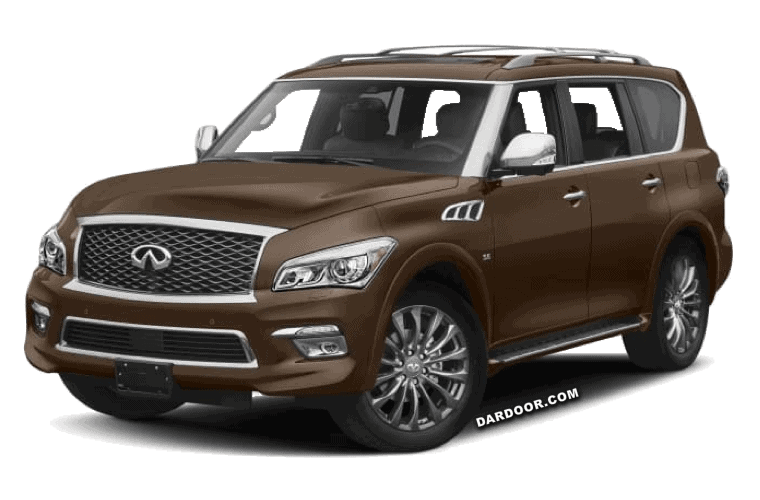
Get the complete and original OEM workshop manual for the 2015 Infiniti QX80, model Z62, with detailed wiring diagrams in a simple PDF format. This manual provides all the essential instructions needed to repair and maintain your Infiniti QX80, just like the ones used by your local Nissan dealer technicians.
| File Format |
PDF |
| File Language |
English |
| File Size |
114 MB |
| Page Count |
6,259 |
| Wiring Diagram |
Included |
| Delivery Method |
Instant Download |
Keep your Infiniti QX80 running smoothly with this indispensable workshop manual. Get your PDF copy today and take control of your vehicle’s maintenance and repairs!
Features:
- Complete OEM Coverage: Includes instruction required to diagnose, repair, and maintain your 2015 Infiniti QX80 (Model Z62).
- Wiring Diagrams Included: Clear and detailed wiring diagrams to assist with troubleshooting and electrical repairs.
- Trusted by Professionals: The same comprehensive guide used by certified Nissan and Infiniti technicians.
- All-Encompassing: From routine maintenance to complex repairs, this manual offers reliable and precise instructions for every task.
Easy-to-Use PDF Format: Convenient access to critical repair information, ensuring your Infiniti QX80 receives expert care.
This manual includes the procedures for maintenance, disassembling, reassembling, inspection, and adjustment of components and diagnostics for the guidance of experienced mechanics. Please peruse and utilize this manual fully to ensure complete repair work to keep your vehicle in optimum condition. When replacement of parts during repair work is needed, be sure to use OEM genuine parts.
Table of Contents : 2015 Infiniti QX80 Repair Manual
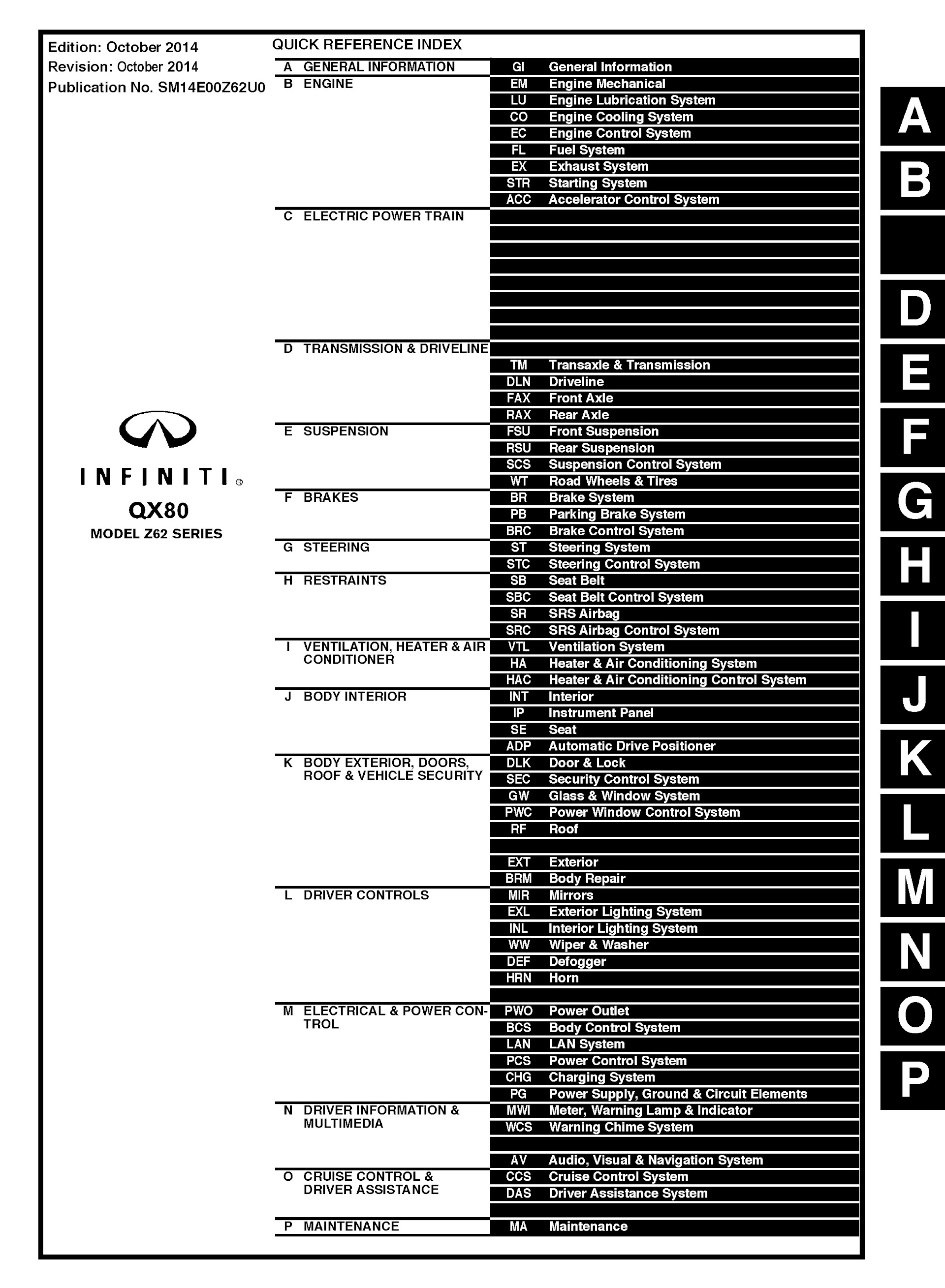
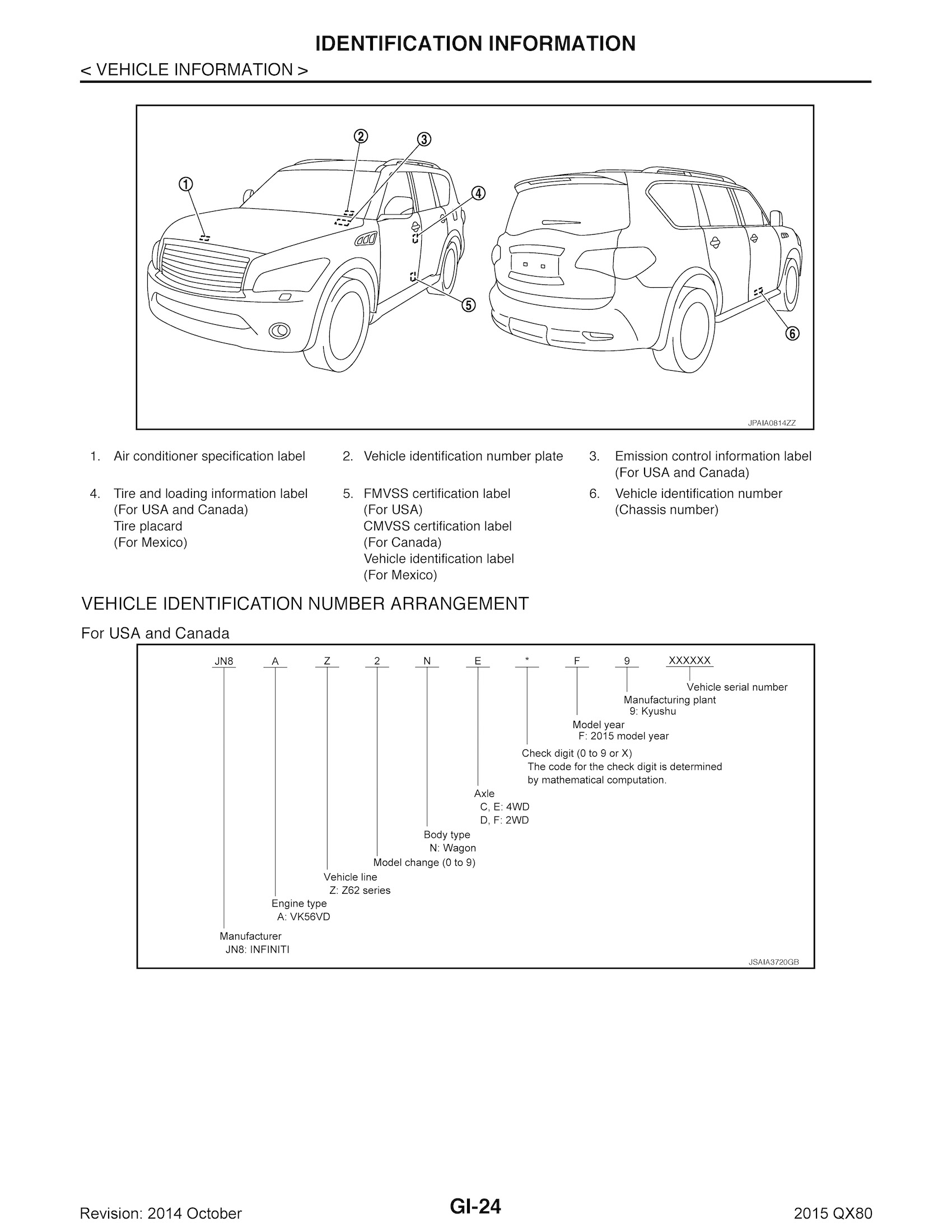
SAMPLE PAGES
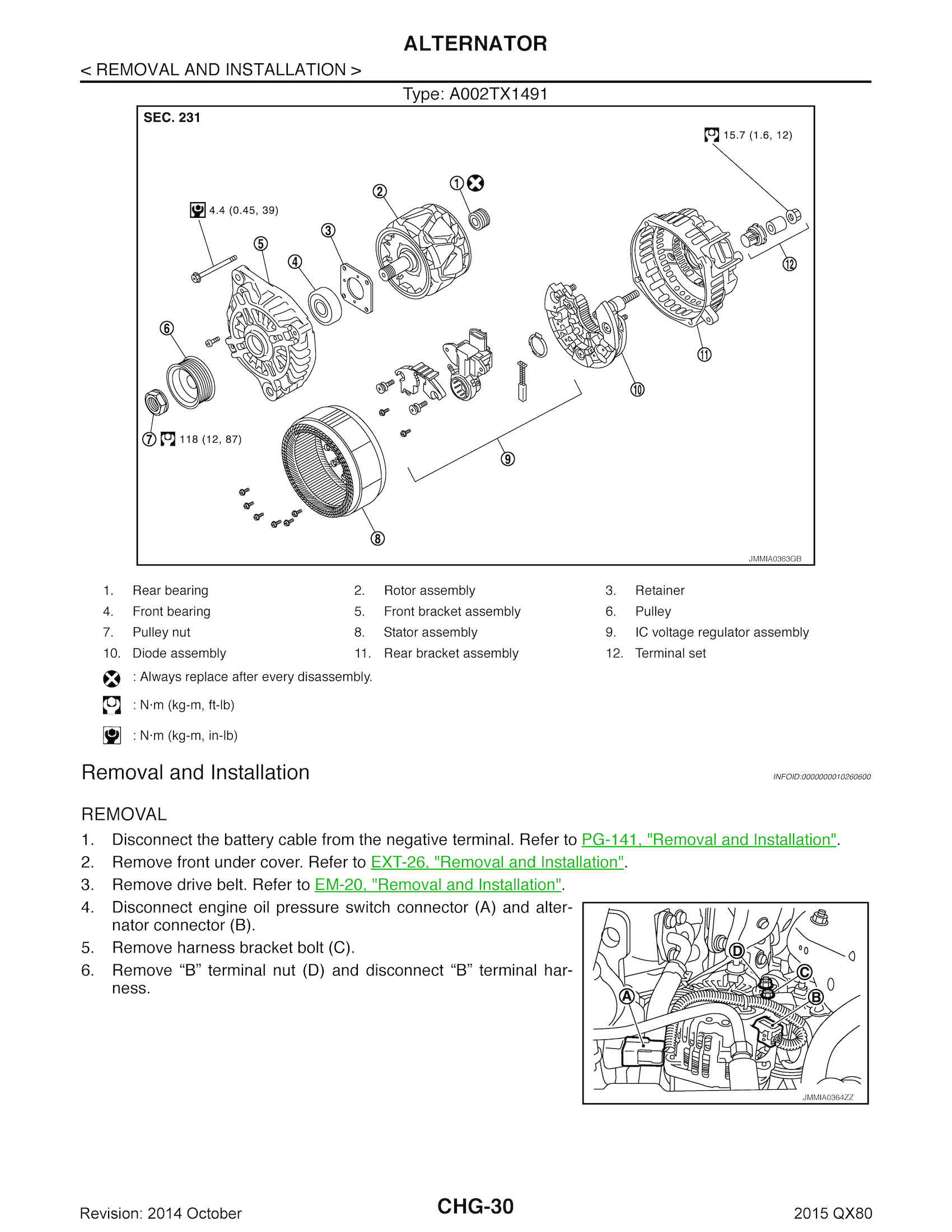
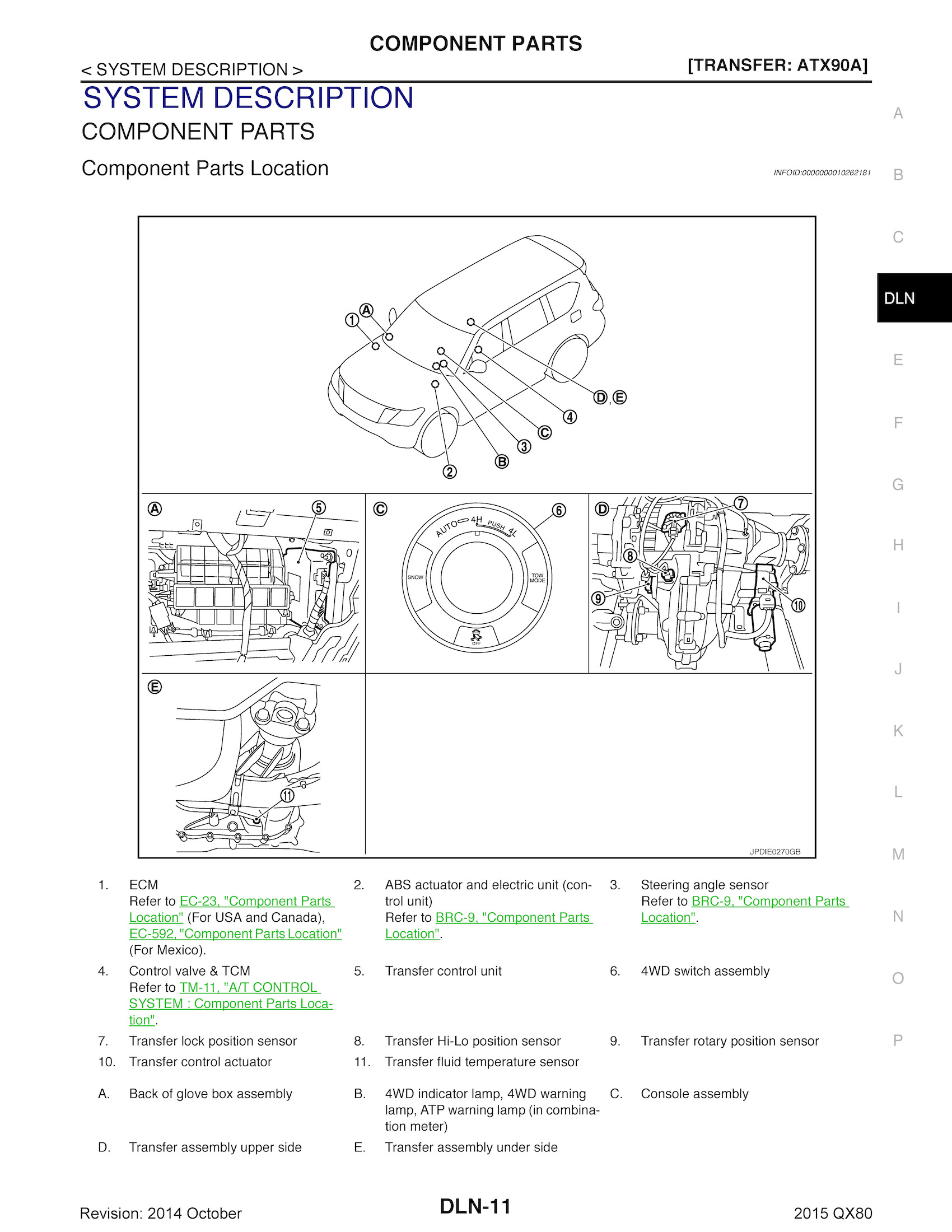
CAUTION:This OEM service and workshop repair manual provides detailed procedures for maintenance, disassembly, reassembly, inspection, adjustment, and diagnostics. It is intended as a comprehensive guide for experienced mechanics. To ensure thorough and accurate repairs that maintain your vehicle’s optimal performance, please read and follow this manual carefully. When replacing parts during any repair work, always use
genuine Nissan parts to ensure quality, safety, and reliability.
🚙 2015 INFINITI QX80 – Full Vehicle Overview, Issues, DTCs & Maintenance Guide
The 2015 INFINITI QX80 is a full-size luxury SUV built on a body-on-frame platform, offering strong V8 power, premium comfort, and serious towing capability. It’s a popular choice for families who need three-row seating and rugged capability without giving up luxury features. Like most large SUVs, ownership costs can rise with fuel consumption, wear items, and age-related electronics.
⚙️ Technical Specifications & Performance
- Engine: 5.6L V8 (VK56VD) with direct injection
- Power / Torque: ~400 hp / ~413 lb-ft
- Transmission: 7-speed automatic
- Drivetrain: RWD or 4WD (All-Mode 4WD)
- Towing Capacity: Up to ~8,500 lb (properly equipped)
- 0–100 km/h: ~7.0–7.5 sec (approx.)
- Seating: 7–8 passengers (trim-dependent)
🔧 Top 10 Common Mechanical Issues (Root Cause & Fix)
- Excessive brake wear / brake judder
🔍 Root Cause: Heavy curb weight overheats pads/rotors; towing worsens heat load.
🛠️ Fix: Install quality ceramic pads + premium rotors; flush brake fluid; confirm caliper slide pins move freely.
- Front suspension clunks (control arms / end links)
🔍 Root Cause: Wear in sway bar links, control arm bushings, and ball joints from SUV weight.
🛠️ Fix: Replace worn end links/bushings; inspect ball joints; perform alignment after suspension work.
- Rear air-suspension sag (if equipped)
🔍 Root Cause: Aging air bags/leaky lines or weak compressor.🛠️ Fix: Leak-test, replace air springs/lines; replace or rebuild compressor if slow to fill.
- Steering vibration / shake at highway speeds
🔍 Root Cause: Tire imbalance, worn tires, or alignment drift; sometimes worn steering components.🛠️ Fix: Road-force balance; rotate/replace tires; alignment; inspect tie rods and steering rack bushings.
- Engine oil leaks (valve cover / front timing cover area)
🔍 Root Cause: Gasket hardening from heat cycles.🛠️ Fix: Replace valve cover gaskets and seals; clean PCV system; verify no excessive crankcase pressure.
- Rough idle / hesitation
🔍 Root Cause: Dirty throttle body, carbon buildup, worn spark plugs, or weak ignition coils.🛠️ Fix: Throttle body clean + relearn; replace plugs at interval; replace coils if misfire data indicates.
- Cooling system weakness (overheating under load)
🔍 Root Cause: Aging radiator, thermostat, or fan clutch/electric fan performance.🛠️ Fix: Pressure test; replace thermostat; service radiator; confirm fan operation; flush coolant on schedule.
- Driveline clunk (U-joints / driveshaft)
🔍 Root Cause: Wear in U-joints or slip yoke; towing accelerates wear.🛠️ Fix: Inspect/replace U-joints; lubricate/replace slip yoke; check differential mounts.
- 4WD engagement issues (4WD models)
🔍 Root Cause: Transfer case actuator/switch issues or low/old transfer case fluid.🛠️ Fix: Scan for 4WD codes; service transfer case fluid; check actuator wiring and vacuum/solenoids if applicable.
- Exhaust manifold tick
🔍 Root Cause: Exhaust gasket leaks or cracked manifold from heat cycling.🛠️ Fix: Inspect for soot trails; replace manifold gaskets or manifolds; verify fastener torque.
💡 Top 10 Common Electrical Issues (Root Cause & Fix)
- Battery drain / no-start after sitting
🔍 Root Cause: Parasitic draw (modules not sleeping), aged battery, or accessory drain.🛠️ Fix: Parasitic draw test; update/replace offending module; fit AGM battery; clean terminals/grounds.
- Infotainment / navigation freezing or rebooting
🔍 Root Cause: Head unit firmware instability or failing internal storage.🛠️ Fix: Software update; hard reset; replace head unit if persistent with confirmed power/ground integrity.
- Backup camera intermittent
🔍 Root Cause: Water intrusion at camera or harness fatigue at tailgate.🛠️ Fix: Replace camera; repair tailgate harness; reseal connectors.
- Power liftgate slow or won’t open
🔍 Root Cause: Weak struts, latch sensor faults, or module calibration.🛠️ Fix: Replace liftgate struts; adjust latch; recalibrate; diagnose liftgate module.
- Power window / door lock actuator failures
🔍 Root Cause: Motor/actuator wear; moisture ingress.🛠️ Fix: Replace failed actuators; verify door harness integrity; lubricate window tracks.
- TPMS warning light
🔍 Root Cause: Weak sensor batteries or sensor damage.🛠️ Fix: Replace TPMS sensors; relearn IDs; verify correct tire pressures.
- Blind-spot / parking sensor faults
🔍 Root Cause: Dirty sensors, bumper impact, or module communication issues.🛠️ Fix: Clean sensors; check alignment; scan for module codes; repair wiring or replace sensor/module.
- Heated/ventilated seat not working
🔍 Root Cause: Failed seat blower motor, heating element, or seat control module.🛠️ Fix: Test power/ground; replace element/motor; confirm switch panel output.
- Instrument cluster warning lights / CAN glitches
🔍 Root Cause: Low battery voltage, corroded grounds, or intermittent CAN connections.🛠️ Fix: Load-test battery/charging system; clean grounds; inspect CAN junctions; repair harness as needed.
- Keyless entry / push-button start issues
🔍 Root Cause: Weak fob battery, antenna faults, or steering lock/immobilizer communication.🛠️ Fix: Replace fob battery; reprogram; scan for immobilizer codes; repair antenna or steering lock module if needed.
📊 Pros & Cons Comparison with Competitors
| Model |
Pros 👍 |
Cons 👎 |
| INFINITI QX80 |
Strong V8 + towing; Quiet, plush ride; Spacious 3rd row; Great value used |
Fuel economy; Brake wear; Aging tech vs newer rivals |
| Lexus LX 570 |
Excellent durability; Off-road capable; High resale |
Very expensive; Heavier/slow; Older infotainment |
| Toyota Land Cruiser |
Legendary reliability; Off-road strength; Solid resale |
High purchase price; Poor fuel economy; Limited cargo behind 3rd row |
| Cadillac Escalade |
Premium presence; Strong V8; Great cabin tech (for era) |
Higher repair costs; Ride can be firm; Theft target in some areas |
| Lincoln Navigator |
Comfortable seats; Strong power; Smooth highway ride |
Complex electronics; Higher maintenance; Fuel economy |
| Nissan Armada |
Similar platform value; Strong V8; Often cheaper parts |
Less luxurious; Noisier cabin; Tech can feel dated |
🛠️ Maintenance Schedule
| Interval ⏱️ |
Maintenance Task 🔧 |
| Every 5,000–7,500 miles / 6–12 months |
Engine oil & filter; inspect tires/brakes; check fluids |
| Every 15,000 miles |
Rotate tires; inspect suspension/steering; replace cabin air filter (as needed) |
| Every 30,000 miles |
Replace engine air filter; brake fluid inspection; differential/transfer-case fluid check (4WD) |
| Every 60,000 miles |
Replace spark plugs (confirm interval for your engine); service transmission fluid (severe use) |
| Every 90,000–105,000 miles |
Coolant service; inspect belts/hoses; service transfer case & differentials if towing/off-road |
| Ongoing |
Keep battery/charging system healthy; clean grounds; maintain tire pressures and alignment |
⚠️ Recalls, Advisories & Safety Alerts (Verify by VIN)
Note: The items below combine known safety recalls (where applicable) and common safety-related service advisories seen across large Nissan/INFINITI SUVs of this era. Always verify your exact recall status by VIN through INFINITI/NHTSA.
- Fuel system – fuel pressure sensor leak risk: Sensor may loosen and leak fuel (fire risk) on some vehicles.
- Airbag-related service campaigns (varies by region): Airbag module or sensor concerns may apply depending on build.
- Brake booster / vacuum assist advisories: Reduced assist symptoms under certain conditions; inspect vacuum lines/pumps.
- ABS actuator/module advisories: Warning lights or reduced ABS/ESC performance; scan and repair promptly.
- Seat belt retractor performance checks: Retractor/pretensioner concerns on some builds; inspect operation.
- Power liftgate safety pinch calibration: Mis-calibration may reduce anti-pinch effectiveness; recalibrate if needed.
- Steering system warnings: If heavy steering or EPS warnings appear, inspect wiring/grounds and steering components.
- Trailer towing wiring / connector overheating: Poor connections can overheat; inspect/repair harness and use correct fusing.
- Rear camera / display intermittent: Loss of image can reduce reversing safety; repair camera/harness promptly.
- Battery/charging low-voltage events: Low voltage can disable safety systems intermittently; load-test battery/alternator.
🧾 Diagnostic Trouble Codes (DTC) Tables
💻 Engine Control Module (ECM)
| Code |
Description |
| P0300 |
Random/Multiple Cylinder Misfire Detected |
| P0301 |
Cylinder 1 Misfire Detected |
| P0171 |
System Too Lean (Bank 1) |
| P0420 |
Catalyst System Efficiency Below Threshold (Bank 1) |
| P0430 |
Catalyst System Efficiency Below Threshold (Bank 2) |
| P0101 |
MAF Sensor Range/Performance |
| P0113 |
Intake Air Temperature Sensor Circuit High |
| P0128 |
Coolant Thermostat (Coolant Temp Below Regulating Temp) |
| P0455 |
EVAP System Leak Detected (Gross Leak) |
| P0456 |
EVAP System Leak Detected (Very Small Leak) |
⚙️ Transmission Control Module (TCM)
| Code |
Description |
| P0700 |
Transmission Control System Malfunction |
| P0720 |
Output Speed Sensor Circuit |
| P0715 |
Input/Turbine Speed Sensor Circuit |
| P0730 |
Incorrect Gear Ratio |
| P0744 |
TCC Solenoid Intermittent |
| P0750 |
Shift Solenoid A Malfunction |
| P0760 |
Shift Solenoid C Malfunction |
| P0841 |
Transmission Fluid Pressure Sensor/Switch A Range/Performance |
| P0871 |
Transmission Fluid Pressure Sensor/Switch C Range/Performance |
| P1778 |
Step Motor / Line Pressure Control (Manufacturer-Specific) |
🛑 ABS / ESC (Brake System)
| Code |
Description |
| C1101 |
ABS Pump Motor Function |
| C1110 |
ABS Actuator Relay / Pump Motor Circuit |
| C1130 |
Engine Signal / CAN Communication to ABS |
| C1143 |
Wheel Speed Sensor (FL) Circuit |
| C1144 |
Wheel Speed Sensor (FR) Circuit |
| C1145 |
Wheel Speed Sensor (RL) Circuit |
| C1146 |
Wheel Speed Sensor (RR) Circuit |
| C1180 |
Yaw Rate / G Sensor Circuit |
| C1210 |
ABS Control Unit Failure / Internal Fault |
| C1A72 |
VDC/ESC System Malfunction (Manufacturer-Specific) |
🎈 SRS Airbag System
| Code |
Description |
| B1018 |
Airbag Diagnosis Sensor Unit (Control Unit) Fault |
| B1049 |
Passenger Airbag Module Circuit |
| B1054 |
Side Airbag Module Circuit (LH) |
| B1059 |
Side Airbag Module Circuit (RH) |
| B1065 |
Occupant Classification System (OCS) Fault |
| B1070 |
Pretensioner Circuit (LH) |
| B1075 |
Pretensioner Circuit (RH) |
| B1081 |
Seat Belt Buckle Switch Circuit |
| B1129 |
Crash Zone Sensor Circuit |
| B1134 |
Airbag Harness / Short to Ground |
📡 Body Control / CAN Communication
| Code |
Description |
| U0100 |
Lost Communication with ECM/PCM |
| U0101 |
Lost Communication with TCM |
| U0121 |
Lost Communication with ABS Control Module |
| U0140 |
Lost Communication with Body Control Module (BCM) |
| U0155 |
Lost Communication with Instrument Cluster |
| U0164 |
Lost Communication with HVAC Control Module |
| U1000 |
CAN Communication Line – Signal Malfunction |
| U1001 |
CAN Communication Circuit |
| U110A |
Lost Communication with Steering / EPS Module |
| U1266 |
Communication Bus Error (Manufacturer-Specific) |
✅ Final Verdict & Conclusion
The 2015 INFINITI QX80 is a powerful, comfortable, and capable luxury SUV—especially for buyers who need real towing and three-row space. Its strengths are the V8 performance, quiet ride, and strong value on the used market. The main trade-offs are fuel economy, heavy wear on brakes/tires, and occasional electrical gremlins as it ages. If you maintain fluids proactively, keep the battery/charging system healthy, and address suspension/brake wear early, the QX80 can be a durable long-term family hauler.