
 220 km
 132 km/h
  13.3Sec
  230 km/h
Charging Port Type CCS Type 2 (Charging Port type affects charging station compatibility.) 
Max AC Charging 22 KW Home Charging, 3-Phase support. On-board AC charger (inverter) Capacity affects AC charging speed. Max DC Charging 80 KW Maximum power the car can accept from a DC faster charger. Architecture 400 V Higher power train voltage means faster charging and better efficiency. Battery Capacity (Usable) 45 kWh Net battery capacity that is available for use. Motor / Power Performance Around 90 kW (121 hp) 1 motor (PMSM) Torque 245 Nm Peak Toque of the car’s electric motor 0-100 km/h 13.3 Second acceleration time from standstill to 100 km/h Top Speed 132 km/h Maximum speed the car can reach Charging 10→ 80% 40 minutes Under Ideal Conditions
About Mercedes EQT Long (2025) – The Premium Seven-Seat Electric MPV
Overview
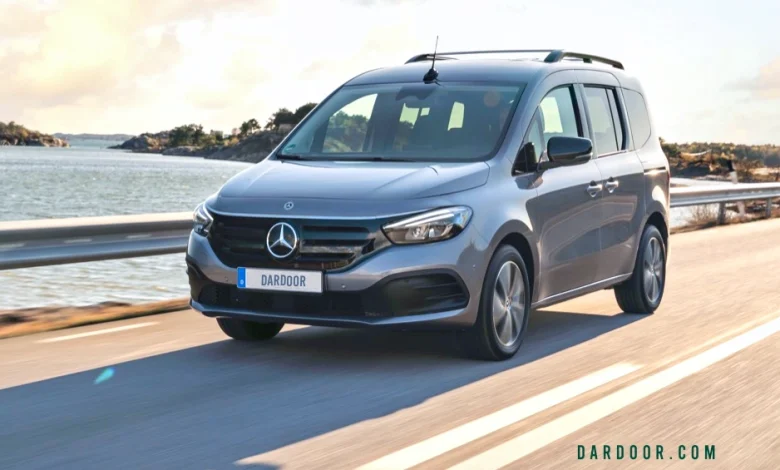
The Mercedes EQT Long is the premium, all-electric minivan you’ve been waiting for, especially if you need to ferry around a small army in style. This seven-seat “Long” variant stretches out the practicality, offering more room for passengers and their luggage. With a starting price of €41,613 in Europe, it combines luxury, zero-emission motoring, and badge prestige into one package, making it a top choice for eco-conscious families.
What’s New for 2025?
The EQT Long itself is the big news! Released in late 2024, this extended-wheelbase version transforms the EQT into a true family hauler. With extra legroom, boot capacity, and seven-seat configuration, it’s tailored for families who want the freshest electric MPV experience without losing Mercedes flair.
Design & Exterior
- Length: 4,922 mm
- Width: 1,859 mm
- Height: 1,811 mm
The EQT Long features the signature Mercedes EQ face with a gloss-black grille panel, sleek LED headlights, and a stylish silhouette that avoids the “boxy van” look. Sliding rear doors ensure easy access, even in tight city spaces, while modern alloy wheels complete its upscale appearance.
Interior, Tech & Cargo
- Seating: Up to 7 passengers
- Infotainment: MBUX system with touchscreen, Apple CarPlay, Android Auto
- Boot Space: 828 litres (with 3rd row folded)
The cabin delivers Mercedes-level quality, far more premium than typical MPVs. Versatility is the focus: easy-folding seats, roomy layout, and tech-rich convenience. Though it lacks a frunk, the boot capacity makes it highly practical for families.
Performance & Driving Experience
- Motor: 90 kW Permanent Magnet Synchronous
- Torque: 245 Nm
- 0–100 km/h: 13.3 seconds
- Drive: Front-Wheel Drive
The EQT Long isn’t about sporty thrills—it’s about refined, predictable, and comfortable driving. Smooth suspension, regenerative braking modes, and quiet electric operation make it a serene family cruiser.
Range, Battery & Charging
- Battery: 45 kWh usable
- Real-World Range: ~227 km
- Efficiency: 5.04 km/kWh
- Charging:
- 22 kW AC onboard charger (full charge in a few hours)
- 80 kW DC fast charging (via CCS Type 2, 10–80% in ~35 minutes)
Ideal for daily commuting and weekend trips, though its limited range means frequent fast-charging stops on longer journeys.
Safety & Driver-Assistance
Built on the same platform as the Mercedes T-Class, which earned a 5-star Euro NCAP rating, the EQT Long comes well-equipped:
- Standard: Active Brake Assist, Active Lane Keeping Assist
- Optional: DISTRONIC adaptive cruise control, Blind Spot Assist, and other premium driver-assistance systems.
Warranty & Maintenance
- Vehicle Warranty: 2 years, unlimited km (Europe)
- Battery Warranty: 8 years / 160,000 km (with capacity guarantee)
- Service: Mercedes dealer network with EV-certified maintenance coverage.
⚡ Verdict: The Mercedes EQT Long blends family practicality with Mercedes prestige, offering a premium zero-emission MPV experience. While its range may limit long-haul suitability, it stands out as one of the most stylish and well-equipped electric seven-seaters in Europe today.
| Combined Efficiency | 205 Wh/km |
|---|---|
| Total System Power | 90 kW (122 PS) |
| Total Torque | 245 Nm |
| 0–100 km/h | 13.3 s |
| Top Speed | 132 km/h |
| Drive | Front-wheel drive |
Price & Regional Availability
| Country/Region | Price |
|---|---|
| 🇬🇧 United Kingdom | 42,000 |
| 🇳🇱 Netherlands | €52,326 |
| 🇩🇪 Germany | €41,613 |
| 🇺🇸 United States | 57,9244 |
| 🇨🇦 Canada | — |
| 🇲🇽 Mexico | — |
| 🇨🇳 China | — |
| 🇨🇱 Chile | — |
Prices are manufacturer’s recommended retail prices (MSRP) where listed by source; exclude incentives and may vary by regional specifications/options. Values subject to change.
Real-World Range Estimates
Between 155 – 330 km
| Condition | City | Highway (110 km/h) | Combined |
|---|---|---|---|
| 🌤️ Mild Weather | 330 km | 200 km | 250 km |
| 🌦️ Average Weather | — | — | 220 km |
| ❄️ Cold Weather | 225 km | 155 km | 190 km |
Indication of real-world range in several situations. Cold = −10 °C with heating. Mild = 23 °C without A/C. Highway assumes a constant 110 km/h. Actual range depends on speed, driving style, weather and route conditions.
Long Distance Suitability (1-Stop Range) ★☆☆☆☆
| First Stop Distance | 157 km | First Stop Duration | 1h 26min |
| Charging Stop | 0km | Charging Stop | 15 min |
| Second Stop Distance | 63 km | Second Stop Duration | 35min |
| Total Distance | 221 km | Total Duration | 2h 16min |
| Weather | 1-Stop Range |
|---|---|
| 🌤️ Mild Weather | 252 km |
| 🌦️ Average Weather | 221 km → ★☆☆☆☆ |
| ❄️ Cold Weather | 196 km |


The “long distance suitability” is a 5-star rating indicating how suitable a vehicle is for long trips. It’s based on the 1-Stop Range: total distance with one 15-minute DC fast-charging stop.
2025 thresholds:
- 0☆ <200 km;
- 1★ 200–325;
- 2★ 325–450;
- 3★ 450–575;
- 4★ 575–700;
- 5★ >700 km.
- Half-stars are assigned by linear interpolation.
Battery Details
| Nominal / Usable Capacity | 48 kWh / 45.0 kWh |
|---|---|
| Battery Type / Cathode | Lithium-ion / No Data |
| Architecture / Voltage | 400 V / 355 V |
| Cells / Pack Config / Form Factor | No data |
| Thermal Management | No data |
| Warranty | 8 Years / 160,000 km |
Charging Overview
| Category | Details |
|---|---|
| Home / Destination (AC) | Type 2 (Mennekes). On-board charger up to 22 kW (vehicle limited to 11 kW for time/rate below); 0→100% ≈ 5 h @11 kW (~44 km/h). |
| Fast DC (CCS) | CCS Combo 2; peak 80 kW; typical avg ≈50 kW (10→80%). 10→80% ≈ 40 min on 100–150 kW DC posts. |
| Plug & Charge | Not supported. |
| Autocharge | Supported. |
| Battery Preconditioning | No data. |
Actual AC/DC speeds depend on grid connection, site load, ambient temperature, cable rating, and initial state of charge.
Home & Destination Charging (0→100%)
- Charging is possible by using a regular wall plug or a charging station.
- Public charging is always via a charging station.
- Charging speed depends on the EVSE used and the vehicle’s AC capacity.
- Availability of 1-phase/3-phase connections varies by country.
| Charging Point | Max. Power | Power | Time (0→100%) | Rate |
|---|---|---|---|---|
| Wall Plug (230 V / 1×10 A) | 2.3 kW | 2.3 kW | 23 h 15 m | 9 km/h |
| 1-Phase 16 A (230 V) | 3.7 kW | 3.7 kW | 14 h 30 m | 15 km/h |
| 1-Phase 32 A (230 V) | 7.4 kW | 7.4 kW | 7 h 15 m | 30 km/h |
| 3-Phase 16 A (400 V) | 11 kW | 11 kW | 5 h | 44 km/h |
| 3-Phase 32 A (400 V) | 22 kW | 22 kW † | 2 h 30 m | 88 km/h |
† limited by on-board charger / vehicle.
Fast Charging (10→80%)
Connector: Combined Charging System (CCS Combo 2). Rapid charging enables longer trips by adding as much range as possible in the shortest time. Charging power drops significantly after ~80% SoC; typical rapid sessions end at or before 80%.
| Charging Point | Max. Power | Average Power | Time (10→80%) | Rate |
|---|---|---|---|---|
| CCS 50 kW | 50 kW | 35 kW † | 57 min | 160 km/h |
| CCS 100 kW | 80 kW † | 50 kW † | 40 min | 230 km/h |
| CCS 150 kW | 80 kW † | 50 kW † | 40 min | 230 km/h |
† Limited by charging capabilities of the vehicle. Autocharge supported. Plug & Charge not supported (ISO 15118). Actual charging rates vary with temperature, battery state, site load, and driving style.
Claimed Charging Specs (Mercedes Benz)
- Max. Power = peak at the post
- Avg. Power = session average (10→80%)
- Time = duration 10→80%
- Rate = avg charging speed over session.
| Charging Point | Max. Power | Avg. Power | Time | Rate |
| CCS (50 kW DC) | 50 kW | 35 kW † | 57 min | 160 km/h |
| CCS (100 kW DC) | 80 kW † | 50 kW † | 40 min | 230 km/h |
| CCS (150 kW DC) | 80 kW † | 50 kW † | 40 min | 230 km/h |
- Autocharge: Enables automatic initiation of a charging session at supported CCS charging stations.
- Plug & Charge: Enables automatic initiation of a charging session at supported CCS charging stations in accordance with ISO 15118.
⚡ Claimed Charging Specifications – Mercedes-Benz EQT 200 Long
The table below shows the claimed specifications from the manufacturer for charging the
Mercedes-Benz EQT 200 Long. These values may differ from the real-world charging performance
shown in the previous section due to various factors such as ambient temperature, charger type, and
battery conditioning. If independent charge tests are available, they usually highlight these
differences. In the absence of such tests, the table relies solely on the official manufacturer data.
| Max. Power | Charge From | Charge To | Time |
|---|---|---|---|
| 80 kW | 10% SoC | 80 % SoC | 38 min |
Notes:
• Max. Power: The maximum charging power reached during the session.
• Charge From: The starting battery state-of-charge (% SoC).
• Charge To: The target battery state-of-charge (% SoC).
• Time: Total time required for the charging session.
Performance & Drivetrain
| Total Power / Torque | 90 kW (122 PS) • 245 Nm |
|---|---|
| 0–100 km/h | 13.3 s |
| Top Speed | 132 km/h |
| Drive | FWD |
Energy Consumption & Efficiency
| Standard / Basis | Range | Rated Consumption | Vehicle Consumption | Fuel-eq. |
|---|---|---|---|---|
| Real Range | 220 km | — | 205 Wh/km | 2.3 L/100 km (veh.) |
| WLTP (TEH) | 254 km | 218 Wh/km | 177 Wh/km | 2.4 / 2.0 L/100 km |
TEL = Test Energy Low | TEH = Test Energy High (if listed). Rated = official figures incl. charging losses. Vehicle = calculated battery energy used for propulsion and on-board systems.
Real Energy Consumption Estimation
Between 136 – 290 Wh/km
| Scenario | City | Highway | Combined |
|---|---|---|---|
| ❄️ Cold Weather | 200 Wh/km | 290 Wh/km | 237 Wh/km |
| 🌤️ Mild Weather | 136 Wh/km | 225 Wh/km | 180 Wh/km |
Indication of real-world energy use in several situations. Cold: −10 °C with heating. Mild: 23 °C without A/C. Highway assumes 110 km/h. Energy use depends on speed, driving style, climate and route conditions.
Safety Rating
| Region | Rating | Details |
|---|---|---|
| Europe (Euro NCAP) | — | Not Available |
| North America | — | NHTSA / IIHS not listed |
| South America | — | Latin NCAP not listed |
Regional safety ratings vary by test year and configuration; check Euro NCAP, NHTSA, IIHS, or Latin NCAP for official results.
Dimensions & Weight
| L × W × H | 4922 × 1859 × 1811 mm (width with mirrors 2159 mm) |
|---|---|
| Wheelbase | 3100 mm |
| Weight Unladen (EU) / GVWR / Payload | 1944 kg / 2550 kg / 681 kg |
| Cargo Volume (seats up / max / frunk) | 828 L / — / 0 L |
| Roof Load | 80 kg |
| Tow Hitch | Possible • 750 kg unbraked / 1500 kg braked • 75 kg vertical load |
| Turning Circle | No data |
| Platform | No data • EV-dedicated: No data |
| Body / Segment / Roof Rails | Small Passenger Van • N – Passenger Van • Yes |
| Heat Pump | Varies by country |
Bidirectional Charging (V2X / BPT)
| Capability | Status | Meaning |
|---|---|---|
| V2L (Vehicle-to-Load) | No data | Power external devices from vehicle |
| V2H (Vehicle-to-Home) | No data | Home backup / whole-home power |
| V2G (Vehicle-to-Grid) | No data | Export to grid |
| BPT (Battery Power Transfer) | No data | Umbrella term for bidirectional features |
Miscellaneous
| Seats / ISOFIX | 7 • ISOFIX ×3 |
|---|---|
| Platform | No data |
| Segment | N – Passenger Van |
* = estimated where indicated. Average energy use and range assume moderate drive style and climate. Real-life values may differ significantly. Pricing info might not reflect all regions. No rights can be derived from this information.
Preceding Model
| Metric | Earlier EQT (context) | EQT 200 Long | Δ |
|---|---|---|---|
| Real Range (Combined) | — | 220 km | — |
| 0–100 km/h | — | 13.3 s | — |
| Efficiency (Vehicle) | — | 205 Wh/km | — |
Previous Generation |
Next Generation |
|
There are no earlier versions of this car |
There are no newer versions of this car |
Why You'll Love It 😘
- True 7-seat practicality
- Premium Mercedes cabin
- Rapid 22kW AC charging
- Ample, versatile cargo
- Expected strong safety
Why You Might Think Twice 🤔
- Modest real-world range
- Leisurely acceleration
- Limited top speed
- Van-based driving feel
- Basic DC charge speed
1-Stop Range Definition 🔋
For vehicles without fast-charging capability, only the distance of the first stop is considered.
🚗 Driving Profile
- Begin with a fully charged battery
- Stop 1: Drive until the battery reaches 10% state-of-charge (SoC)
- Perform a 15-minute fast charge
- Stop 2: Continue driving until the battery again reaches 10% SoC
📋 Assumptions
- Driving speed, climate, and environmental conditions are based on Real Range Highway data
- No additional time required to initiate or stop the charging session
- The charging station always delivers the maximum power requested by the vehicle
- The battery is assumed to be in optimal health and condition
⚠️ Important Note : In real-world driving, it is practically impossible to replicate these conditions exactly.
This benchmark should therefore be viewed as a comparative metric, designed to evaluate vehicles under standardized conditions rather than predict exact trip distances.
5-Star Rating Definition ★
Assignment of Stars in 2025
- ☆ 0 less than 200 km
- ★ from 200 km to 325 km
- ★★ from 325 km to 450 km
- ★★★ from 450 km to 575 km
- ★★★★ from 575 km to 700 km
- ★★★★★ more than 700 km
Based on 2025 thresholds: 3 stars awarded for 490 km average. Half-stars interpolated. Vehicles with a rating between these values receive a rating based on a linear scale.
Fast Charging (10 -> 80%) ⚡
- Max. Power: maximum power provided by charge point
- Avg. Power: average power provided by charge point over a session from 10% to 80%
- Time: time needed to charge from 10% to 80% Rate: average charging speed over a session from 10% to 80%
EV Charger Connector Types