550,000 km on a Hybrid Lexus RX: What Actually Breaks on a “Bulletproof” Crossover
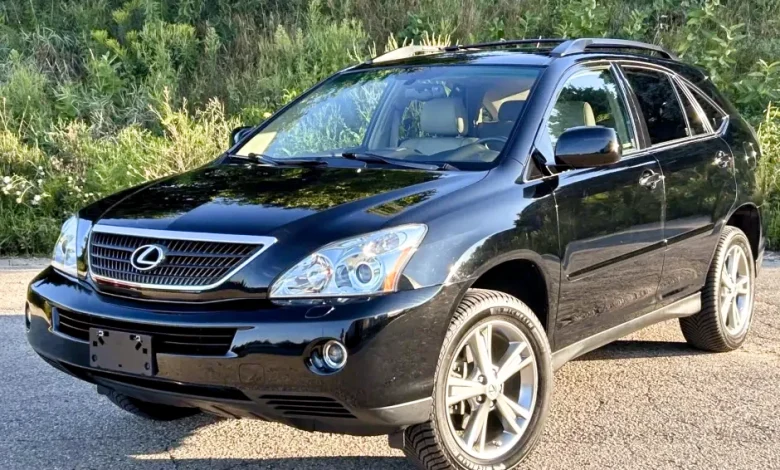
Lexus has built its entire brand identity around two words: premium and reliability. But does that reputation hold up after half a million kilometers? Dardoor.com went looking for an answer and found it behind the wheel of a second-generation Lexus RX400h — a 2006 hybrid crossover with an odometer reading of almost 550,000 km. Its owner, David, walked us through what it’s really like to live with a car this old, this used, and this unusual.
A Quick History of the RX
The Lexus RX line dates back to 1998, when it launched as a more upscale twin of the Toyota Harrier — a model that, at the time, was sold exclusively in Japan. Five generations later, the RX is still in production, with the current model having debuted in 2022.
In the Canadian secondary markets, the second-generation RX most commonly turns up as the RX350, powered by a 3.5-liter V6 and all-wheel drive. Rarer variants include the front-wheel-drive RX270, along with the RX330 and RX300. David’s car is rarer still: an RX400h, the hybrid version.
The RX400h pairs electric motors — which handle torque distribution, silent low-speed acceleration, and on-demand rear-axle engagement — with a 3.3-liter gasoline V6 producing 211 hp. The gasoline engine steps in for hard acceleration, sustained highway speeds, or whenever the battery runs low.
The Battery: Everyone’s First Question
For any hybrid this old, the first concern is always the battery pack — and David admits it was the reason he spent so long researching the car before buying, scouring forums in Canada and beyond for its known weak points.
“I’ve replaced several batteries. A full pack runs about 6,000 CAD, but you can replace individual modules — the catch is there are no original replacement parts for that. It’s either a full battery or nothing,” David explained. “So I went hunting for a workaround, online, everywhere. My battery capacity had dropped to 70%, so I sourced the missing cells myself. Each one costs around 150 CAD; all in, with labor, I spent more than 1,700 CAD.”
Notably, David says nobody had touched the battery pack before 2024 — something that’s visible in its condition and, in his view, speaks to how durable the original hardware actually is.
Ownership History: Real Mileage, Real Wear
David is the car’s third registered owner — and, importantly, he’s confident the mileage is genuine. “When I was shopping for the car, I kept running into rolled-back odometers. To me, honest mileage isn’t just about the seller’s integrity — it says something about the car’s own resource. If it’s covered real distance and is still going, that tells you it’s genuinely tough,” he said.
Engine Overheating and a Cylinder Head Replacement
The RX400h’s gasoline engine — the 3.3-liter 3MZ-FE — is shared with the RX330, just tuned differently. According to David, it hasn’t given him any trouble with oil consumption. He changes the oil every 7,000 km and says the level never drops between changes.
The one real mechanical issue he flags is cylinder head overheating, which eventually required a replacement. “The difficulty is that the cylinder head sits near the engine shield, and it’s genuinely hard to cool properly — so overheating is a fairly common problem on these cars. An original replacement part runs around 300 dollars, but aftermarket alternatives exist too,” he said.
The Inverter Recall — and a Cascade of Sensors
The hybrid system’s inverter, which converts DC power from the electric motor to AC, was also a known problem point. David says Toyota ran a recall campaign on this exact component, and his car had already been serviced under that campaign before he owned it.
Beyond that, a handful of sensors have failed over the car’s life. The transmission position sensor went first — a part that costs around 550 CAD from Toyota but can run as high as 1,000 dollars through parts importers. David ended up paying 1,500 dollars for an aftermarket original.
More recently, an airflow sensor threw a fault code. “I’m currently deciding between original and aftermarket. The original part is around 2,000 dollars. It hasn’t affected how the car drives yet, and I haven’t measured fuel consumption closely, but it might have some impact,” he said.
David is candid about the price gap between OEM and aftermarket parts: “Originals cost four to five times more — it really adds up.”
Fuel Economy: The Highway Costs More Than the City
Counterintuitively, David says his RX400h is thirstier on the highway than in town — the opposite of what you’d expect from most cars. He puts fuel consumption at around 11 liters per 100 km on average, climbing to 13 liters per 100 km in winter.
“That’s the nature of a hybrid like this — it’s built more for city driving,” he explained. His theory, based on forum research and conversations with owners of the non-hybrid RX330, is that the standard 3.3-liter engine actually sees harder overall use than the hybrid version, since the electric motor absorbs most of the load during starts and low-speed driving, leaving the gasoline engine to work mainly at higher speeds.
The Electronics Still Work — All of Them
For a car pushing 20 years old, the electronics have held up remarkably well. The sunroof, power tailgate, power windows, and electric seat adjustments all still function without issue — something David says isn’t actually rare for cars of this era, contrary to popular belief.
Suspension and Chassis: Still on the Original Hub Bearings
David is especially proud of the suspension. The hub bearings — a component that typically wears out around 250,000–300,000 km — are still the factory originals. “That alone tells you something about this car,” he said.
Aside from that, only routine wear items have needed attention: dust boots, and the brakes. “I’ve replaced the rear brakes — the rotors were worn down. The fronts are due next,” he added.
We rode along with David, and it’s easy to see why he’s kept the car this long: it’s remarkably soft and quiet, especially running on electric power, with road imperfections barely registering inside the cabin.
The Body Tells a Different Story
Mechanically resilient as it may be, the RX400h’s exterior shows every one of its 550,000 km. Corrosion has broken through around the wheel arches, particularly on the driver’s side — the result of an earlier repair that clearly didn’t hold up, letting rust resurface through the filler. The headlights and taillights are heavily clouded, and David has decided against trying to polish them back to clarity. “The lights are… fine,” he joked.
The interior tells the same story. The seat upholstery has worn through in several spots, with visible holes, and the steering wheel shows heavy wear from two decades of hands on it. “Once a car’s done 550,000 km, you start noticing every one of these details,” David said.
There’s a genuinely nostalgic touch, too: the dashboard still has a cassette slot alongside a CD player — though don’t expect audiophile sound quality from the factory speakers. That, at least, is an easy fix.
“They Don’t Make Them Like This Anymore”
David doesn’t hold back his opinion on how automotive quality has shifted since 2006 — Lexus included. “Japanese cars aren’t what they used to be. Honestly, I don’t think there’s anything on the market today built with this kind of longevity in mind,” he said.
He points out that even later, newer hybrid Lexus models have proven less durable in his experience and in what he’s read from specialists and other owners. “The generations that came after this one just aren’t as tough or reliable — that’s what both experts and owners say. And it’s no coincidence that cars like this, with mileage this high, are actually still out there on the used market.”