How to Diagnose, Test, and Replace a Faulty Fuel Pump Relay
Essential Guide to Fuel Pump Relays: Cleaning, Testing & Replacement
📌 What Is a Fuel Pump Relay?
The fuel pump relay is an essential electronic component in all vehicles with internal combustion engines. Its primary role is to relay power from the ignition system to the fuel pump. When you turn the ignition key, the relay sends voltage to the fuel pump, which in turn builds fuel pressure needed to start the engine.
⚙️ Fuel Pump Relay Function
When the ignition is switched on, the relay provides power to the fuel pump just long enough to build initial pressure. Once the engine is running, the oil pressure switch often takes over fuel pump power control. Upon shutting off the ignition, the relay again disconnects the power to stop the pump.
🚩 Symptoms of a Bad Fuel Pump Relay
- 🚘 Engine won’t start: Cranks but doesn’t fire due to no fuel supply.
- ⛽ Sudden engine stalls: The relay may cut power while driving.
- 🔇 No humming sound from the fuel pump: A silent fuel pump during ignition cycle could point to relay failure.
- ⚡ Intermittent power loss: Engine may cut out randomly.
- 💤 Hot engine no-start: Temperature-sensitive relay failure.
📍 Where Is the Fuel Pump Relay Located?
Commonly located inside the engine bay’s fuse box (a black plastic box near the battery). In some vehicles, it’s behind the dashboard or under the steering column. Refer to your owner’s manual or check out similar models in Dardoor’s Fuse Diagram Library.
🔍 How to Diagnose a Bad Fuel Pump Relay
1️⃣ Visual Inspection
Check for burnt terminals, corrosion, or loose pins. Clean corroded parts using electrical contact cleaner. Use gloves and goggles for safety.
2️⃣ Continuity Test with Multimeter
- Set multimeter to continuity or low ohms.
- Probe power terminals on the relay.
- If you get a beep or low resistance, the relay is shorted and should be replaced.
3️⃣ Alternative Bypass Test
Use a jumper wire to manually send power to the fuel pump. This is a temporary solution and may expose the system to overheating or fire risk.
💲 Fuel Pump Relay Replacement Cost
Replacement cost typically ranges between $90 and $150, with parts costing around $20–$50 and the rest covering labor.
🧼 Cleaning the Fuel Pump Relay
If exposed to dust and engine heat, the relay may degrade over time. Remove it carefully, inspect it, and clean terminals using a contact cleaner to maintain functionality and reduce the risk of sudden engine stalls.
❓ Frequently Asked Questions (FAQs)
🔌 Can I temporarily bypass a bad fuel pump relay?
🔧 Why does my car start after tapping the fuse box?
🔥 Can heat affect the fuel pump relay?
🕵️ Do fuel pump relays fail gradually or instantly?
⚠️ What else can mimic fuel pump relay failure?
🛠️ How to Inspect & Test a Fuel Pump Relay
If your engine won’t start or you don’t hear the typical humming noise from the fuel pump during ignition, a faulty fuel pump relay might be the cause. Below is a step-by-step inspection and testing guide to help you diagnose it:
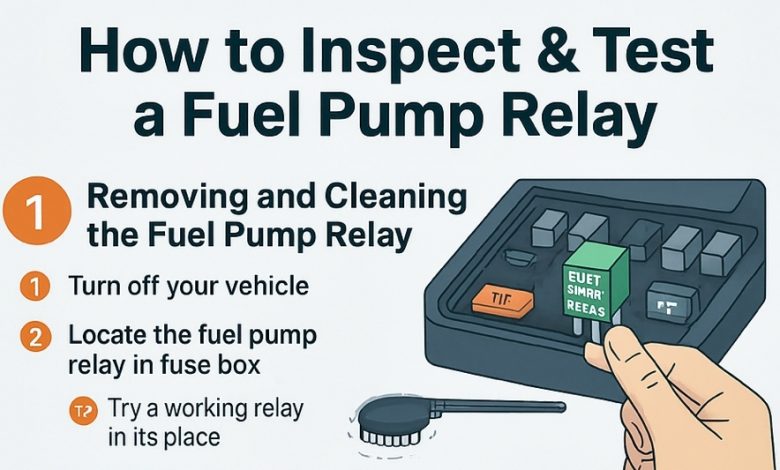
🔧 1. Removing and Cleaning the Fuel Pump Relay
- Turn off your vehicle: Remove the key from the ignition to prevent any electrical risk.
- Locate the fuel pump relay: Found in the fuse box under the hood or under the dashboard. Look for a green or gray cube-shaped component. Use your vehicle’s manual if unsure.
- Remove the relay: Grip and pull it straight up. If it’s stuck, gently wiggle it to release it from the socket.
- Tip: Try a working relay in its place. If the car starts, the original relay is faulty.
- Clean the relay prongs: Use a wire brush to scrape off corrosion. Follow up with an electrical contact cleaner if needed.
- Optional: Clean the terminals inside the fuse box to ensure optimal electrical connection.
🔍 2. Testing the Relay’s Resistance with a Multimeter
- Understand the relay diagram: Look for numbers printed near the pins. Power pins are usually labeled 85 & 86; circuit pins are 30 & 87.
- Set your multimeter: Turn it to the lowest ohm setting (Ω) for resistance testing.
- Connect jumper wires to your car battery: Clip red to positive, black to negative.
- Apply power to the relay: Connect the negative wire to pin 85 and positive to pin 86. A clicking sound indicates the relay is engaging.
- No click? The internal switch might be faulty and the relay needs replacement.
- Check resistance: Use multimeter probes or clips to touch terminals 30 and 87.
- Interpret results:
- 📉 0 Ohms or near-zero (0.001, 0.005): Relay is good.
- 📈 High resistance or infinity: Relay is bad and should be replaced.
🧪 3. Expert Diagnostic Tip – Use an OBD-II Scanner
For a more precise diagnosis, use an OBD-II scanner to check for fuel system-related DTC codes. This tool can detect intermittent relay failures or circuit faults.
- 🛒 Available to rent or borrow from auto parts stores.
- 🧑🔧 Some garages offer free diagnostics during inspections.
✅ Summary Checklist
- 🔌 Disconnect the vehicle battery before handling electrical components.
- 🧽 Clean both relay prongs and fuse box terminals.
- 📏 Use a multimeter for resistance testing between correct terminals.
- 🎧 Listen for clicking sound when powered.
- 🧰 Replace relay if any test fails or corrosion is severe.