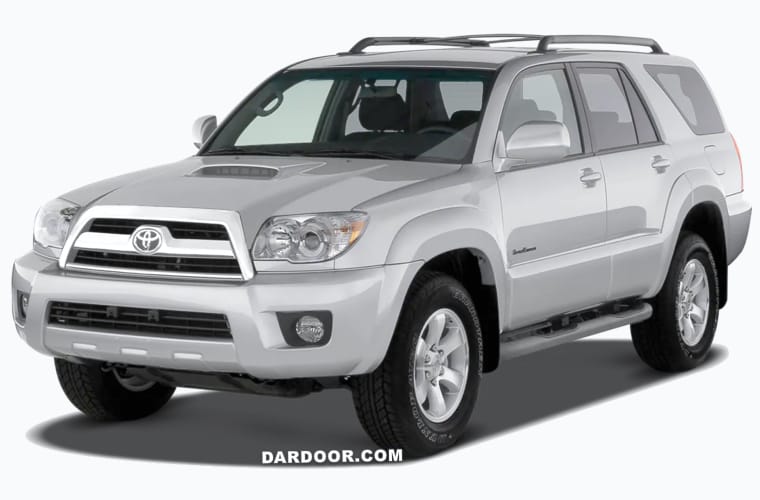
The 2007 Toyota 4Runner is a rugged mid-size SUV built for durability, off-road capability, and long-term reliability. Powered by robust V6 and V8 engines, it blends Toyota’s reputation for quality with strong towing ability and 4WD performance. Popular among outdoor enthusiasts and families alike, the 4Runner is well-regarded for its versatility and dependability.
Technical & Performance
| Category |
4.0L V6 (1GR-FE) |
4.7L V8 (2UZ-FE) |
| Power |
236 hp @ 5,200 rpm |
260 hp @ 5,400 rpm |
| Torque |
266 lb-ft @ 4,000 rpm |
306 lb-ft @ 3,400 rpm |
| Transmission |
5-speed automatic (varies by trim/drive) |
| Fuel tank |
23.0 gal |
| Wheelbase |
110 in |
| Length |
189 in |
| Ground clearance |
9 in |
| Towing capacity (typical) |
Up to 5,000 lb (configuration dependent) |
Up to ~7,000–7,300 lb (configuration dependent) |
👉 Notes: Specs vary by trim (SR5/Sport/Limited), drivetrain (2WD/4WD), and equipment. Always confirm your exact configuration from the door jamb label and owner documentation.
Top 10 Common Mechanical Issues Reported by Owners (with Symptoms, Root Cause, Fix, Cost)
- Brake caliper sticking / uneven brake wear
- Symptoms: pulling while braking, hot wheel smell, uneven pad wear, vibration.
- Root cause: slide pins seize, dust boots tear, caliper piston corrosion (age/salt exposure).
- Fix: service/replace calipers, replace pads/rotors as needed; flush brake fluid.
- Typical cost (USD): $250–$900 per axle (parts + labor), more if rotors and hoses are needed.
- Front suspension clunks (ball joints, sway links, bushings)
- Symptoms: clunk over bumps, vague steering, uneven tire wear.
- Root cause: worn sway bar end links/bushings, lower ball joint wear, aging control arm bushings.
- Fix: replace worn components; align afterward.
- Typical cost (USD): $150–$700 depending on parts replaced; $100–$150 alignment extra.
- Rear air suspension sag (if equipped)
- Symptoms: rear sits low, compressor runs often, bouncy ride, “lean.”
- Root cause: air bags crack/leak, height sensors drift, compressor aging.
- Fix: replace air springs/sensors or convert to coils (common long-term solution).
- Typical cost (USD): $600–$2,000 (bags/sensors/compressor vary); coil conversion often $500–$1,200.
- Cooling system wear (radiator, water pump seep, hoses)
- Symptoms: coolant smell, drips, overheating under load, crusting around pump/radiator tanks.
- Root cause: age-related plastic tank fatigue, seal wear, neglected coolant changes.
- Fix: replace radiator or water pump; refresh hoses/thermostat; correct coolant bleed.
- Typical cost (USD): $250–$1,200 depending on component and engine.
- Driveline “clunk” on takeoff/stop (U-joints/slip yoke/grease)
- Symptoms: thunk when shifting into gear, clunk at stop, vibration at speed.
- Root cause: dry slip yoke or worn U-joints; missed grease intervals on serviceable shafts.
- Fix: grease driveline points; replace U-joints or driveshaft if needed.
- Typical cost (USD): $50–$250 (service) or $250–$900 (U-joints/shaft work).
- 4WD actuator / transfer case engagement issues
- Symptoms: 4HI/4LO won’t engage, blinking 4WD light, binds or won’t shift out.
- Root cause: actuator motor corrosion, infrequent 4WD use, sticky linkage/sensors.
- Fix: exercise 4WD regularly; service actuator; replace actuator if failed.
- Typical cost (USD): $150–$1,800 (depends whether it’s serviceable vs replacement).
- Exhaust manifold crack / leak (ticking on cold start)
- Symptoms: ticking noise cold start, exhaust smell, possible O2-related codes.
- Root cause: heat cycles, corrosion, gasket failure.
- Fix: replace manifold or repair; replace gaskets/hardware; inspect studs.
- Typical cost (USD): $400–$1,500 depending on side and labor.
- Front differential groan/grind (2WD operation on some vehicles)
- Symptoms: cyclical grinding/groaning noise in 2WD that may change in 4WD.
- Root cause: known condition addressed in Toyota communications for certain model years/platform-sharing drivetrains.
- Fix: inspect fluid condition, bearings; follow applicable service guidance; repair/replace differential components if confirmed.
- Typical cost (USD): $150–$2,000 depending on diagnosis and parts.
👉 Reference: Toyota communication describing front differential cyclical noise condition on Tacoma/FJ Cruiser/4Runner platforms.
- Steering rack seep / power steering leaks
- Symptoms: steering fluid drops, groan on turns, wet rack boots.
- Root cause: seal wear, hose crimps leaking, contaminated fluid over time.
- Fix: replace leaking hoses; rack rebuild/replace if internal leak; flush fluid.
- Typical cost (USD): $150–$1,800 depending on rack vs hose.
- Rust on frame/underbody (regional)
- Symptoms: flaky frame scale, seized bolts, fuel/brake line corrosion, inspection failures.
- Root cause: road salt exposure and aging coatings.
- Fix: rust remediation, line replacement as needed, undercoating prevention.
- Typical cost (USD): $200–$2,500+ depending on severity and line repairs.
Top 10 Common Electrical Issues Reported by Owners (with Symptoms, Root Cause, Fix, Cost)
- Secondary Air Injection System faults (common on 4.7L V8)
- Symptoms: check engine light, reduced power/limp mode, cold-start issues, related P24xx codes.
- Root cause: pump/valve sticking or moisture intrusion; system complexity + age.
- Fix: diagnose with scan tool; replace failed pump/valves; confirm TSB guidance and updated parts.
- Typical cost (USD): $800–$3,000 depending on parts and access.
👉 Reference: Toyota air injection system MIL bulletin covering 2UZ-FE applications.
- Rear hatch glass break during defroster operation (program coverage exists)
- Symptoms: rear hatch glass cracks/shatters during or shortly after defroster use.
- Root cause: reported condition acknowledged by Toyota in Warranty Enhancement communications for certain 2003–2009 4Runner vehicles.
- Fix: inspect defroster grid/terminals; replace rear hatch glass per program/coverage if eligible.
- Typical cost (USD): $0 if covered; otherwise commonly $400–$1,200 installed.
👉 Reference: Warranty Enhancement Program for broken rear hatch glass on certain 2003–2009 4Runner vehicles.
- TPMS warning light (sensor batteries)
- Symptoms: TPMS light on, intermittent warnings.
- Root cause: sensor internal battery end-of-life; tire changes without relearn.
- Fix: replace TPMS sensors during tire service; relearn/initialize system.
- Typical cost (USD): $200–$600 for a set depending on sensor brand + labor.
- Blower motor resistor / HVAC fan only works on certain speeds
- Symptoms: fan works only on high (or certain speeds), weak airflow.
- Root cause: resistor pack heat damage; blower aging increases current draw.
- Fix: replace resistor and inspect blower motor condition/cabin filter.
- Typical cost (USD): $120–$450.
- Alternator aging / low-voltage gremlins
- Symptoms: battery light, dim lights, random warning lamps, slow cranking.
- Root cause: alternator diode/regulator wear; corroded grounds.
- Fix: load-test charging system; replace alternator; clean grounds.
- Typical cost (USD): $350–$900.
- Door lock actuators failing
- Symptoms: door won’t lock/unlock reliably, intermittent remote response.
- Root cause: actuator motor wear and gear fatigue.
- Fix: replace actuator assembly (door panel removal required).
- Typical cost (USD): $200–$600 per door.
- Window regulator/motor slow or stuck
- Symptoms: slow window movement, grinding, window drops.
- Root cause: regulator cable wear; motor aging; dry channels.
- Fix: replace regulator/motor; lubricate channels.
- Typical cost (USD): $250–$700 per window.
- ABS wheel speed sensor faults
- Symptoms: ABS/VSC/TRAC lights, ABS activation at low speeds, stored ABS codes.
- Root cause: sensor contamination/damage; harness corrosion near wheel wells.
- Fix: scan ABS module, inspect tone rings/wiring; replace sensor if needed.
- Typical cost (USD): $150–$500 per sensor.
- Spiral cable (clock spring) wear
- Symptoms: airbag light, horn not working, steering wheel controls intermittent.
- Root cause: ribbon cable fatigue after years of steering cycles.
- Fix: replace clock spring; recalibrate if required.
- Typical cost (USD): $250–$700.
- Battery drain / parasitic draw (aftermarket accessories common culprit)
- Symptoms: dead battery after sitting, repeated jump starts.
- Root cause: aging battery, sticking relays, aftermarket alarms/remote starts wired poorly.
- Fix: parasitic draw test; repair wiring/replace faulty module; confirm charging health.
- Typical cost (USD): $120–$600 (diagnosis + fix varies widely).
| Pros |
Cons |
| Body-on-frame durability and real off-road capability |
Fuel economy is dated by modern standards |
| Strong engines (V6 or V8) with proven long-term reliability when maintained |
Age-related repairs add up: suspension, cooling system, actuators |
| Good towing capability for the class (especially V8) |
Rust can be a deal-breaker in salt states/provinces |
| Huge aftermarket and DIY community |
Some known campaigns/coverage items (floor-mat recall, rear hatch glass program) |
Maintenance Schedule (Practical Ownership Plan)
| Interval |
Service items |
Why it matters |
| Every 5,000 mi / 6 months |
Oil + filter; inspect fluids, brakes, tires; grease driveline (if applicable) |
Extends engine life; prevents driveline clunks and uneven wear |
| Every 15,000 mi |
Rotate tires; inspect suspension/steering; cabin air filter |
Reduces tire cupping and front-end noise |
| Every 30,000 mi |
Engine air filter; brake fluid check/flush as needed; differential/transfer case fluid inspection |
Brake feel + drivetrain longevity |
| Every 60,000 mi |
Transmission service (fluid condition-based); coolant inspection; spark plugs (per engine/condition) |
Prevents heat-related wear and drivability issues |
| Every 90,000–120,000 mi |
Cooling system refresh (hoses/thermostat as needed); shocks/struts commonly due |
Most “old SUV” problems start here if maintenance was skipped |
| Monthly |
Engage 4HI (and 4LO where safe) briefly |
Keeps actuators and linkages from sticking |
🔔 Reminder: Use the correct fluid specifications for your exact drivetrain and follow local severe-service intervals if you tow, idle a lot, or drive in dust/salt.
Top 10 Recalls, Advisories, Safety Alerts, and TSB Highlights
👉 Tip: Below is a mixed list of notable recalls plus manufacturer communications/programs that frequently intersect with real-world ownership. Confirm eligibility by VIN (recall status can differ by region and distributor).
1. Floor Mat Recall (2009)
Potential for unsecured or incompatible floor mats to interfere with accelerator pedal. Part of Toyota’s major unintended acceleration recall campaign affecting millions of vehicles
2. Spare Tire Carrier Recall (2013)
Spare tire carrier assembly may corrode and separate, causing the spare tire to detach from the vehicle while driving.
3. Frame Rust Recall (Ongoing inspections)
Vehicles sold or registered in cold-weather states may experience excessive frame rust. Toyota has inspected and replaced frames on affected vehicles under extended warranty programs.
4. Secondary Air Injection System
TSB Check engine light related to secondary air injection pump and valve failures. Common issue requiring replacement of pump assembly ($800-1,500 repair).
5. Lower Ball Joint TSB
Premature wear of lower ball joints causing clunking noises and handling issues. Inspection and replacement recommended every 30-40k miles in severe conditions.
6. Airbag Inflator Recall (Takata – 2016) Defective Takata airbag inflators that could rupture and spray metal fragments. Multiple recall campaigns; check if your VIN has been remedied.
7. Brake Master Cylinder TSB Reports of spongy brake pedal feel due to master cylinder seal degradation. TSB provides inspection and replacement procedures.
8. Transfer Case Actuator TSB 4WD models may experience difficulty engaging or disengaging 4WD modes due to transfer case actuator motor failure.
9. Steering Intermediate Shaft TSB Clicking or clunking noise from steering column during turning. Resolution involves lubricating or replacing intermediate shaft.
10. Rear Differential Seal Leak TSB Rear differential pinion seal may leak fluid. More common on vehicles with higher mileage or those used for towing.
11- Accessory seat heater wiring can be damaged (SET campaign) — risk of overheating in certain dealer-installed accessory heaters.
12- Accessory seat heater wiring (earlier SET action) — similar condition, earlier notice for certain distributor-installed accessories.
13- Safety Recall 90L (Phase 10): floor mat interference with accelerator pedal — accelerator pedal can stick if trapped by unsecured/incompatible mat.
14- Non-compliance recall 10V-036 (labeling) — missing load-carrying capacity modification labels (Southeast Toyota).
15- Non-compliance recall 10V-035 (labeling) — missing load-carrying capacity modification labels (Gulf States Toyota).
16- Warranty Enhancement Program ZG7: rear hatch glass can break during defroster operation — program terms/eligibility apply.
17- TSB: Air Injection System MIL “ON” (2UZ-FE applications) — addresses common air injection MIL conditions that owners frequently encounter.
18- TSB/communication: front differential cyclical groan/grind noise — described condition on the shared drivetrain platform.
19- Advisory reminder: check recalls by VIN regularly — NHTSA recommends periodic checks because VINs can be added over time.
20- Owner best practice: verify campaigns via Toyota Owners / Toyota recall lookup portals (US/CA differ) before paying out-of-pocket.
🔔 Important Note: Always run a VIN-specific check through NHTSA (nhtsa.gov/recalls) or Toyota’s recall website to verify which recalls apply to any specific vehicle you’re considering, and confirm all recall work has been completed.
👉 Note : The 2007 4Runner uses different engines and calibrations by trim and market. Use these tables as a quick reference list (examples), then confirm exact definitions and diagnostic flowcharts in the OEM manual for your VIN.
Engine Control Module (ECM) – 10 Common Codes
| Code |
Common description |
First checks |
| P0300 |
Random/multiple cylinder misfire |
plugs/coils, vacuum leak, fuel quality |
| P0301 |
Cylinder 1 misfire |
coil swap test, injector balance |
| P0420 |
Catalyst efficiency below threshold (Bank 1) |
exhaust leaks, O2 sensors, catalyst aging |
| P0440 |
EVAP system malfunction |
gas cap, purge/vent valves, smoke test |
| P0441 |
EVAP incorrect purge flow |
purge valve operation, hoses |
| P0446 |
EVAP vent control malfunction |
vent valve, charcoal canister |
| P0500 |
Vehicle speed sensor “A” |
ABS/VSS signals, wiring, sensor |
| P0135 |
O2 sensor heater circuit (Bank 1 Sensor 1) |
heater power/ground, sensor, fuse |
| P0128 |
Coolant thermostat (below regulating temp) |
thermostat stuck open, coolant level |
| P2440 |
Secondary air injection system switching valve stuck open (variant) |
air pump/valves, moisture intrusion |
Transmission Control Module (TCM) – 10 Common Codes
| Code |
Common description |
First checks |
| P0700 |
Transmission control system malfunction (generic) |
scan for sub-codes, fluid condition |
| P0715 |
Input/turbine speed sensor circuit |
sensor, harness, connector |
| P0720 |
Output speed sensor circuit |
sensor, wiring, ABS correlation |
| P0741 |
TCC performance or stuck off |
fluid, solenoid, converter wear |
| P0750 |
Shift solenoid “A” malfunction |
solenoid resistance, valve body |
| P0755 |
Shift solenoid “B” malfunction |
solenoid, wiring, debris |
| P0760 |
Shift solenoid “C” malfunction |
solenoid, valve body |
| P0770 |
Shift solenoid “E” malfunction |
solenoid control, fluid |
| P2714 |
Pressure control solenoid “D” performance |
line pressure, solenoid, contamination |
| P2780 |
Downshift switch circuit (variant) |
switch, wiring, scan data |
ABS / ESC (Brake System) – 10 Common Codes
| Code |
Common description |
First checks |
| C0200 |
Front wheel speed sensor RH |
sensor, tone ring, harness |
| C0205 |
Front wheel speed sensor LH |
sensor, wiring |
| C0210 |
Rear wheel speed sensor RH |
sensor, wiring, corrosion |
| C0215 |
Rear wheel speed sensor LH |
sensor, wiring |
| C1241 |
Low battery positive voltage |
alternator/battery/grounds |
| C1201 |
Engine control system malfunction (ABS received) |
check ECM codes first |
| C1223 |
ABS control system malfunction (variant) |
scan data, actuator tests |
| C1256 |
Accumulator low pressure |
hydraulic unit, leaks |
| C1336 |
Zero point calibration of yaw rate sensor |
calibration procedure, alignment |
| C1445 |
Yaw rate / decel sensor output (variant) |
sensor, calibration, wiring |
SRS Airbag System – 10 Common Codes
| Code |
Common description |
First checks |
| B0100 |
Squib circuit (driver airbag) malfunction |
connectors, clock spring |
| B0101 |
Driver squib circuit low/high resistance |
harness checks |
| B0105 |
Passenger squib circuit malfunction |
connectors, seat work history |
| B0111 |
Side squib circuit (variant) |
seat/side airbag connectors |
| B0120 |
Front impact sensor circuit |
sensor mount/corrosion |
| B0131 |
Seat belt pretensioner circuit |
pretensioner wiring |
| B0140 |
Occupant classification system fault (variant) |
seat sensor calibration |
| B1150 |
Airbag ECU malfunction (variant) |
power/ground, water intrusion |
| B1801 |
Driver seat position sensor (variant) |
sensor, connector |
| B1900 |
Communication / initialization error (variant) |
scan tool, battery voltage |
Body Control / CAN Communication – 10 Common Codes
| Code |
Common description |
First checks |
| U0100 |
Lost communication with ECM/PCM |
battery voltage, CAN wiring, grounds |
| U0101 |
Lost communication with TCM |
CAN integrity, module power |
| U0121 |
Lost communication with ABS module |
ABS power/ground, CAN |
| U0140 |
Lost communication with body control module |
BCM fuses, connectors |
| U0155 |
Lost communication with instrument cluster |
cluster power/ground |
| B1241 |
Battery/charging system (body module sense) |
charging test, grounds |
| B2312 |
Door lock circuit malfunction (variant) |
actuator, switch, wiring |
| B2321 |
Back door lock circuit (variant) |
hatch actuator, harness |
| B1421 |
Solar sensor circuit (auto HVAC variant) |
sensor, connector |
| B1500 |
Multiplex communication (variant) |
CAN diagnosis, corrosion points |
Tip: For 4Runner-specific wiring pinouts, connector views, and exact code definitions by calibration, use the OEM wiring and repair manuals. Dardoor listings: 2007 4Runner wiring diagram and
2005–2009 4Runner repair manual ↗
Frequently Asked Questions
What engines are available? The 2007 4Runner offers two engines: a 4.0L V6 (236 hp, 266 lb-ft torque) standard on most trims, and a 4.7L V8 (260 hp, 306 lb-ft torque) available on Limited and standard on Sport Edition.
What’s the fuel economy? The V6 gets around 16-17 mpg city / 20-21 mpg highway. The V8 drops to approximately 15 mpg city / 19 mpg highway. These are thirsty vehicles by modern standards.
Is it reliable? Generally yes. The 2007 4Runner has a strong reputation for reliability and longevity, typical of Toyota SUVs from this era. Many owners report vehicles exceeding 200,000+ miles with proper maintenance.
What are common problems to watch for? Secondary air injection system failures, lower ball joint wear, timing belt issues on V8 models (needs replacement every 90k miles), frame rust on vehicles from salt-belt states, and potential transmission issues.
Does it have 4WD or AWD? Available in both 2WD (RWD) and 4WD configurations. The 4WD system is part-time on most models, with full-time 4WD available on Limited trims. Many feature a locking rear differential and low-range gearing.
How much can it tow? The V6 can tow up to 5,000 lbs, while the V8 increases capacity to 7,300 lbs when properly equipped.
What trim levels were offered? SR5, Sport Edition, Limited, and a special Urban Runner package. The Sport Edition featured the V8, unique suspension, and distinctive styling.
How’s the interior space? Seating for 5 or 7 (optional third row on SR5 and Limited). The third row is cramped and best suited for children. Cargo space is 46.3 cubic feet behind the second row, or 8.9 cubic feet with third row up.
What should I budget for maintenance? Expect regular maintenance costs around $500-800 annually. Major services (timing belt on V8, transmission fluid, coolant flushes) can add $1,000-2,000 every few years. Parts are reasonably priced and widely available.
What’s a fair price today? Prices vary widely based on condition, mileage, and location, but typically range from $8,000-18,000. Low-mileage, well-maintained examples with 4WD command premium prices due to strong demand for this generation.
- Is the 2007 4Runner still a good buy today?
- Yes—if rust is under control and maintenance is documented. It’s one of the most proven body-on-frame SUVs, but the best ones are the ones that have had suspension/cooling and wear-items kept up.
- Which engine is better: V6 or V8?
- The V6 is usually cheaper to run and simpler for many owners. The V8 feels stronger for towing and load, and can be worth it if you actually use that capability. Power figures differ by engine.
- What should I check before buying?
- Frame rust, transfer case/4WD engagement, cooling leaks, brake caliper condition, suspension clunks, and scan for pending codes. Also verify recall/program eligibility by VIN.
- Any “must do” prevention?
- Keep fluids fresh, grease driveline if applicable, exercise 4WD monthly, and don’t ignore small coolant leaks. Small maintenance prevents big bills on older SUVs.
- Where can I get OEM-level wiring/repair info?
- OEM manuals are the fastest way to avoid guesswork. For this platform: 2007 4Runner wiring diagram and 2005–2009 4Runner repair manual
Top 5 Competitors (2007 Model Year)
- Jeep Grand Cherokee ↗ More car-like ride, available HEMI V8, better on-road manners but less reliable long-term.
- Nissan Pathfinder ↗ Similar size and capability, more powerful V6, but known for transmission issues in this generation.
- Ford Explorer ↗ More spacious third row, lower price point, but significantly less reliable and poorer resale value.
- Chevrolet TrailBlazer ↗ Competitive towing, available inline-6 or V8, but inferior reliability and fuel economy.
- Honda Pilot ↗ More refined, better fuel economy, superior third-row space, but less off-road capability and unibody construction vs. body-on-frame.
The 2007 4Runner earns its reputation the hard way: time, miles, and real-world abuse. If you want a modern-feeling crossover, this isn’t it. But if you want a durable SUV that can tow, travel rough roads, and stay in the family for another decade, a clean, rust-controlled 4Runner with proof of maintenance is still one of the smartest used buys—especially if you budget upfront for suspension refresh, brakes, and cooling system catch-up.