Porsche Taycan Sport Turismo Turbo S ★★★★½
Available to order since February 2024

 505 km
 260 km/h
  2.4 Sec
  1320 km/h
Charging Port Type CCS Type 2 
Max AC Charging 11 KW 22 kW Optional Max DC Charging 320 KW (150 KW at 400 V) Architecture 800 V Higher power train voltage means faster charging and better efficiency Battery Capacity (Usable) 97 kWh Net Battery Capacity
About Porsche Taycan Sport Turismo Turbo S
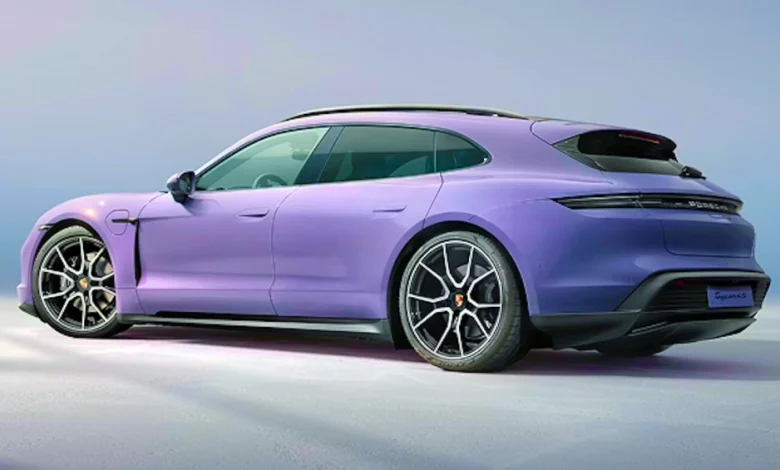
The 2025 Porsche Taycan Sport Turismo Turbo S sits at the very top of Porsche’s EV family tree. It’s a super-estate car that blends hypercar acceleration with practical shooting brake design, making it both thrilling and family-friendly. Priced from around €210,800 new (or €179,000 used), this is the ultimate Porsche EV for those who want it all.
What’s New for 2025
- Increased performance: more power and torque than before.
- Longer range: updated battery & thermal management.
- Faster charging: 320 kW peak DC charging speeds.
- Improved interior tech: polished Porsche Driver Experience interface.
- Adaptive air suspension now standard, offering both comfort and track-level handling.
Design & Exterior
- Shooting brake profile (L: 4963 mm, W: 1966 mm, H: 1388 mm).
- Aggressive Turbo S bumpers and exclusive wheel sets.
- Signature Porsche cues: four-point LED headlights & full-width rear light bar.
- A balance of heritage + futuristic styling.
Interior, Tech & Cargo
- Driver-centric cockpit with Race-Tex and leather.
- 405 L boot, expandable to 1171 L, plus 84 L frunk.
- Curved driver display + central infotainment with Apple CarPlay / Android Auto.
- Seamless luxury-tech integration, practical enough for families.
Performance & Driving Experience
- 0–100 km/h: 2.4s – supercar territory.
- Dual motors (front + rear PMSM) = 700 kW / 1110 Nm torque.
- All-wheel drive with adaptive air suspension.
- Razor-sharp steering, immense grip, yet comfy daily drive.
- Regen braking for one-pedal driving.
Range, Battery & Charging
- 97 kWh usable battery.
- Real-world range: ~495 km (efficiency: 5.1 km/kWh).
- AC charging: 11 kW (9h full), optional 22 kW (4.5h).
- DC fast charging: 320 kW → 10–80% in <20 min.
- Supports Vehicle-to-Load (V2L).
Safety & Driver Assistance
- 5-star Euro NCAP.
- Standard driver aids: adaptive cruise, lane keep assist, blind-spot monitoring.
- Optional cutting-edge Porsche assistance systems for more automation.
- Balanced between safety reassurance and driver involvement.
Warranty & Maintenance
- 2 years / unlimited km Porsche warranty (Europe).
- 8 years / 160,000 km battery coverage (≥70% capacity).
- Maintenance: mostly software updates + wear-item checks.
- Porsche build quality + EV simplicity = reliable but premium running costs.
Headline Snap
| Combined Efficiency | 192 Wh/km |
|---|---|
| Total System Power | 700 kW (952 PS) |
| Total Torque | 1110 Nm |
| 0–100 km/h | 2.4 s |
| Top Speed | 260 km/h |
| Drivetrain | AWD (dual-motor) |
Price & Regional Availability
| Country/Region | Price |
|---|---|
| 🇬🇧 United Kingdom | £162,100 |
| 🇳🇱 Netherlands | €219,900 |
| 🇩🇪 Germany | €210,800 |
| 🇺🇸 United States | — |
| 🇨🇦 Canada | — |
| 🇲🇽 Mexico | — |
| 🇨🇳 China | — |
| 🇨🇱 Chile | — |
Real-World Range Estimates
| Condition | City | Highway (110 km/h) | Combined |
|---|---|---|---|
| 🌤️ Mild Weather | 715 km | 475 km | 580 km |
| 🌦️ Average Weather | — | — | 505 km |
| ❄️ Cold Weather | 490 km | 370 km | 430 km |
Long Distance Suitability (1-Stop Range)
| First Stop Distance | 375 km | First Stop Duration | 3h 24min |
| Charging Stop | 0km | Charging Stop | 15 min |
| Second Stop Distance | 280 km | Second Stop Duration | 2h 33min |
| Total Distance | 655 km | Total Duration | 6h 12min |
| Weather | 1-Stop Range |
|---|---|
| 🌤️ Mild Weather | 748 km |
| 🌦️ Average Weather | 655 km → ★★★★½ |
| ❄️ Cold Weather | 582 km |


The “long distance suitability” is a 5-star rating indicating how suitable a vehicle is for long trips. It’s based on the 1-Stop Range: total distance with one 15-minute DC fast-charging stop.
2025 thresholds:
- 0★ <200 km;
- 1★ 200–325;
- 2★ 325–450;
- 3★ 450–575;
- 4★ 575–700;
- 5★ >700 km.
- Half-stars are assigned by linear interpolation.
Battery Details
| Nominal / Usable Capacity | 105.0 kWh / 97.0 kWh |
|---|---|
| Battery Type / Cathode | Lithium-ion • NCM811 |
| Architecture | 800 V |
| Cells / Pack Configuration | 396 cells • 198s2p |
| Nominal Voltage | No data |
| Form Factor / Name | No data |
| Warranty | 8 years / 160,000 km |
Charging Overview
| Category | Details |
|---|---|
| Home / Destination (AC) | Type 2 front (both sides). On-board charger 11 kW (optional 22 kW). 0→100% ≈ 10 h 30 m @11 kW (~49 km/h). |
| Fast DC (CCS) | CCS front (passenger side). Peak 322 kW; average 262 kW (10→80%). 10→80% ~16–18 min; up to ~1320 km/h session rate. |
| Plug & Charge | Supported (ISO 15118-2) |
| Autocharge | Supported |
| Battery Preconditioning | Supported; automatic when navigating to a DC fast charger |
Home & Destination Charging (0→100%)
Charging can be done via a regular wall plug or AC charging station. Public AC charging is always via a charging station. Charging speed depends on the EVSE and the vehicle’s maximum AC capability. Availability of 1-phase/3-phase connections varies by country.
| Europe — Type 2 (IEC 62196) | ||||
|---|---|---|---|---|
| Charging Point | Max. Power | Power | Time (0→100%) | Rate |
| Standard 11.0 kW On-Board Charger | ||||
| Wall Plug (230 V / 1×10 A) | 2.3 kW | 2.3 kW | 49 h 45 m | 10 km/h |
| 1-Phase 16 A (230 V) | 3.7 kW | 3.7 kW | 31 h | 16 km/h |
| 1-Phase 32 A (230 V) | 7.4 kW | 7.4 kW | 15 h 30 m | 33 km/h |
| 3-Phase 16 A (400 V) | 11 kW | 11 kW | 10 h 30 m | 48 km/h |
| 3-Phase 32 A (400 V) | 22 kW | 11 kW † | 10 h 30 m | 48 km/h |
| Optional 22.0 kW On-Board Charger | ||||
| Wall Plug (230 V / 1×10 A) | 2.3 kW | 2.3 kW | 49 h 45 m | 10 km/h |
| 1-Phase 16 A (230 V) | 3.7 kW | 3.7 kW | 31 h | 16 km/h |
| 1-Phase 32 A (230 V) | 7.4 kW | 7.4 kW | 15 h 30 m | 33 km/h |
| 3-Phase 16 A (400 V) | 11 kW | 11 kW | 10 h 30 m | 48 km/h |
| 3-Phase 32 A (400 V) | 22 kW | 22 kW † | 5 h 15 m | 96 km/h |
† limited by onboard charger
Fast Charging (10→80%)
Connector: Combined Charging System (CCS Combo 2). Rapid charging enables longer trips by adding as much range as possible in the shortest time. Charging power drops significantly after ~80% SoC; typical rapid sessions end at or before 80%.
| Charging Point | Max. Power | Average Power | Time (10→80%) | Rate |
|---|---|---|---|---|
| CCS 50 kW | 50 kW | 50 kW | 86 min | 240 km/h |
| CCS 100 kW | 100 kW | 95 kW † | 45 min | 470 km/h |
| CCS 150 kW | 150 kW | 135 kW † | 32 min | 660 km/h |
| CCS 175 kW | 175 kW | 155 kW † | 28 min | 750 km/h |
| CCS 350 kW | 322 kW † | 262 kW † | 16 min | 1320 km/h |
Claimed Charging Specs (Manufacturer)
Max. Power = peak charge power • Avg. Power = average power over the 10→80% session • Time = duration 10→80% • Rate = average charging speed.
| Max. Power | Charge From | Charge To | Time |
|---|---|---|---|
| 320 kW | 10% | 80% | 18 min |
Performance & Drivetrain
| Total Power | 700 kW (939 hp, 952 PS) |
|---|---|
| 0–100 km/h | 2.4 s |
| Top Speed | 260 km/h |
| Drive | AWD (dual-motor) |
| Motor Type | PMSM (front), PMSM (rear) |
| Motor Torque | 1110 Nm |
Energy Consumption & Efficiency
| Standard / Basis | Range | Rated Consumption | Vehicle Consumption | Fuel-eq. |
|---|---|---|---|---|
| Real Range | 505 km | — | 192 Wh/km | 2.2 L/100 km (veh.) |
| WLTP (TEL) | 604 km | 189 Wh/km | 161 Wh/km | 2.1 / 1.8 L/100 km |
| WLTP (TEH) | 529 km | 215 Wh/km | 183 Wh/km | 2.4 / 2.1 L/100 km |
Real Energy Consumption Estimation
| Scenario | City | Highway | Combined |
|---|---|---|---|
| ❄️ Cold Weather | 198 Wh/km | 262 Wh/km | 226 Wh/km |
| 🌤️ Mild Weather | 136 Wh/km | 204 Wh/km | 167 Wh/km |
Safety Rating
| Region | Rating | Details |
|---|---|---|
| Europe (Euro NCAP) | — | Scores vary by test year and configuration |
| North America | — | NHTSA / IIHS not listed for this specific body/trim |
| South America | — | Latin NCAP not listed |
Dimensions & Weight
| L × W × H | 4963 × 1966 × 1388 mm (width w/ mirrors 2144 mm) |
|---|---|
| Wheelbase | 2900 mm |
| Weight Unladen (EU) / GVWR / Payload | 2395 / 2870 / 550 kg |
| Cargo Volume (up / max / frunk) | 405 L / 1171 L / 84 L |
| Roof Load | 75 kg |
| Tow Hitch | Not possible • 0 kg un/braked • 0 kg vertical |
| Turning Circle | 11.7 m |
| Platform | VW J1 • EV-dedicated |
| Body / Segment / Roof Rails | Station/Estate • F – Luxury • No |
| Heat Pump | Yes (standard) |
Bidirectional Charging (V2X / BPT)
| Capability | Status | Meaning |
|---|---|---|
| V2L (Vehicle-to-Load) | No | Power external devices from the vehicle |
| V2H (Vehicle-to-Home) | No | Home backup / whole-home power |
| V2G (Vehicle-to-Grid) | No | Export energy to grid |
| BPT (Battery Power Transfer) | No | Umbrella term for bidirectional features |
Miscellaneous
| Seats / ISOFIX | 5 • ISOFIX ×2 |
|---|---|
| Platform | VW J1 |
| Segment | F – Luxury |
Preceding Model
| Metric | Taycan Turbo S ST (2022–2024) | Taycan Turbo S ST (2024–) | Δ (New − Prev) |
|---|---|---|---|
| Real Range (Combined) | ~395 km | 505 km | +110 km |
| 0–100 km/h | ~2.9 s | 2.4 s | ~17% quicker |
| Efficiency (Vehicle) | ~213 Wh/km | 192 Wh/km | ≈ 10% better |
The previous model had 110 km less range, ~17% slower acceleration and ~10% higher consumption.
Previous Generation |
Next Generation |
|
Porsche Taycan Turbo S Sport Turisom (2022-2024) |
There are no newer versions of this car |
Why You'll Love It 😘
- ✔️ Blistering supercar acceleration
- ✔️ Exceptional dynamic handling
- ✔️ Ultra-fast 800V charging
- ✔️ Luxurious, high-tech interior
- ✔️ Practical Sport Turismo style
Why You Might Think Twice 🤔
- ❌ Exorbitant purchase price
- ❌ Very costly options
- ❌ Range good, not best
- ❌ Compact rear seating
- ❌ Significant vehicle weight
1-Stop Range Definition 🔋
For vehicles without fast-charging capability, only the distance of the first stop is considered.
🚗 Driving Profile
- Begin with a fully charged battery
- Stop 1: Drive until the battery reaches 10% state-of-charge (SoC)
- Perform a 15-minute fast charge
- Stop 2: Continue driving until the battery again reaches 10% SoC
📋 Assumptions
- Driving speed, climate, and environmental conditions are based on Real Range Highway data
- No additional time required to initiate or stop the charging session
- The charging station always delivers the maximum power requested by the vehicle
- The battery is assumed to be in optimal health and condition
⚠️ Important Note : In real-world driving, it is practically impossible to replicate these conditions exactly.
This benchmark should therefore be viewed as a comparative metric, designed to evaluate vehicles under standardized conditions rather than predict exact trip distances.
5-Star Rating Definition ★
Assignment of Stars in 2025
- ☆ 0 less than 200 km
- ★ from 200 km to 325 km
- ★★ from 325 km to 450 km
- ★★★ from 450 km to 575 km
- ★★★★ from 575 km to 700 km
- ★★★★★ more than 700 km
Based on 2025 thresholds: 3 stars awarded for 490 km average. Half-stars interpolated. Vehicles with a rating between these values receive a rating based on a linear scale.
Fast Charging (10 -> 80%) ⚡
- Max. Power: maximum power provided by charge point
- Avg. Power: average power provided by charge point over a session from 10% to 80%
- Time: time needed to charge from 10% to 80% Rate: average charging speed over a session from 10% to 80%
EV Charger Connector Types