
 400 km
 230 km/h
  3.3 Sec
  420 km/h
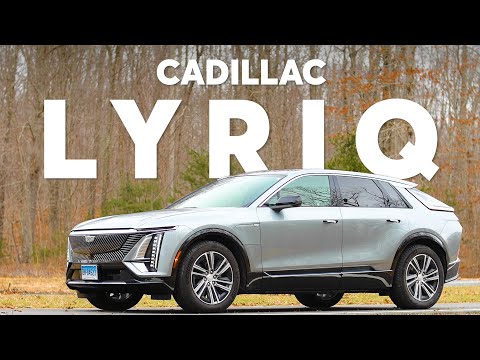
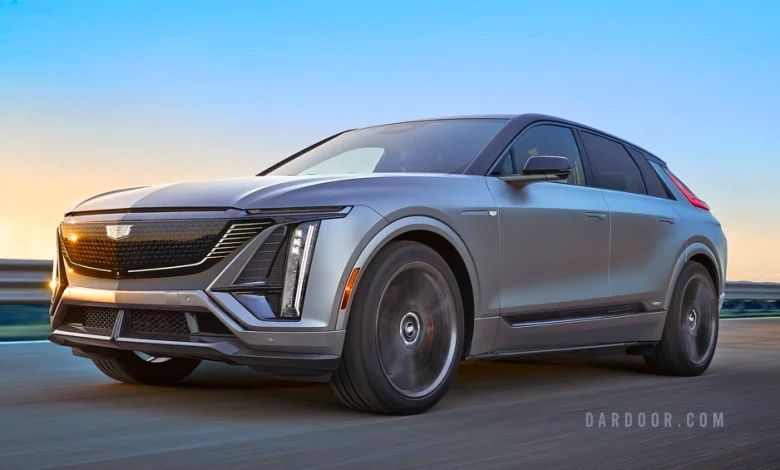
 The 2025 Cadillac Lyriq V is the first all-electric V-Series performance SUV, delivering a striking mix of American luxury, aggressive styling, and explosive electric power. It sets itself apart with a more powerful dual-motor AWD setup, exclusive V design elements, and tech-packed interior features, launching as a flagship for Cadillac’s electrified future.
Charging Port Type CCS Type 2 (Charging Port type affects charging station compatibility.) 
Max AC Charging 22 KW Home Charging, 3-Phase support. On-board AC charger (inverter) Capacity affects AC charging speed. Max DC Charging 190 KW Maximum power the car can accept from a DC faster charger. Architecture 400 V Higher power train voltage means faster charging and better efficiency. Battery Capacity (Usable) 91.0 kWh Net battery capacity that is available for use. Tested Range (EU -WLTP)
460 km Estimated Distance of a Full Charge Tested Range (USA – EPA) 459 km Estimated Distance of a Full Charge Motor / Power Performance Around 458 kW (615 hp) AWD (2 motors) Torque 880 Nm Peak Toque of the car’s electric motor 0-100 km/h 3.3 Second acceleration time from standstill to 100 km/h Top Speed 230 km/h Maximum speed the car can reach Charging 10→ 80% 24 minutes Under Ideal Conditions Drive Type AWD (2 motors) PMSM front, PMSM rear
About Cadillac Lyriq V
What’s New for 2025
- All-new high-performance V-Series variant for Lyriq—fully electric and purpose-built.
- Substantially upgraded dual-motor powertrain: 458 kW (615 hp) and 880 Nm torque.
- V-Series suspension tuning, bigger brakes, and unique design elements.
- Much faster acceleration and sharper handling versus regular Lyriq.
Design & Exterior
- Standout V-specific features: aggressive grille, sporty wheels, aerodynamic tweaks, and exclusive colors.
- Cadillac vertical LED lighting signature and bold presence.
- Dimensions: 5005 mm (L) × 1977 mm (W) × 1627 mm (H).
Interior, Technology & Cargo
- Cabin features unique V trim, sport seats, and a 33-inch curved LED display with built-in Google, Apple CarPlay, and Android Auto.
- Five-seat layout that prioritizes sport-luxury comfort.
- Boot capacity: 793 L (seats up), 1722 L (seats down); no listed frunk.
Performance & Driving Experience
- AWD dual Permanent Magnet Synchronous Motors (front and rear).
- 0–100 km/h in 3.5 seconds; top speed: 210 km/h.
- V-specific adaptive suspension for precise, comfortable ride; powerful brakes; selectable regen modes.
Range, Battery & Charging
- Usable battery capacity: 102 kWh.
- Green Cars Compare estimated range: 436 km; efficiency: 4.27 km/kWh.
- AC charging: 22 kW; DC fast charging: up to 190 kW (10–80% under 40 minutes).
- CCS Type 2 port standard.
Safety & Driver Assistance
- Super Cruise hands-free system anticipated as standard.
- Features: adaptive cruise control, lane-keeping, blind-spot monitoring, emergency braking, 360º camera.
- No Euro NCAP rating yet, but loaded with safety tech.
Warranty & Maintenance Coverage
- Likely 3–5 years/100,000 km vehicle warranty.
- 8 years/160,000 km battery/drivetrain coverage.
- Specific European details pending, but strong reliability prospects given EV simplicity.
The Lyriq V sets a new performance benchmark for Cadillac’s electric lineup, combining head-turning style, thrilling speed, and advanced tech features for both enthusiasts and premium SUV shoppers.
Why You'll Love It 😘
- Exhilarating V-Series power with 459 kW and 880 Nm torque.
- Striking, aggressive styling including carbon accents and unique V badging.
- High-tech, spacious cabin featuring a 33-inch curved display and premium appointments.
- Rapid 22 kW AC charging supports quick home or workplace top-ups.
- Generous cargo capacity: 793 L (seats up), 1722 L (seats folded).
Why You Might Think Twice 🤔
- European availability was unclear, but now first deliveries are planned for Germany, France, and Switzerland starting November 2025, with premium pricing above €108,000.
- Significant curb weight, like most high-powered luxury EVs.
- No front trunk; all storage is in the rear cargo area.
- Standard 400V architecture means DC charging isn’t as fast as 800V rivals.
- Safety ratings are still pending for EU models, leaving crash-test reassurance unconfirmed.
Key Owners-Reported Issues
Key owner-reported issues for the Cadillac Lyriq V focus on reliability and repair delays, particularly with major electric and driver technology systems.
Most Common Owner-Reported Issues
- 12V Battery Faults: A recurring alert disables the vehicle, sometimes rendering it immovable and needing dealer repair; recovery often takes days or weeks.
- Driver Assist System Failures: Frequent breakdowns of the Super Cruise and adaptive cruise/disaster avoidance systems, which have led to hazardous situations and dealer service visits.
- Electronic Glitches: Multiple cases of infotainment freezing, wireless charging issues, and touch-screen overheating, raising concerns about fire risk, as well as non-functional door handles and trunk latches.
- Charging Problems: Some owners report vehicles only reliably charging on DC fast chargers, with AC charging attempts failing or aborting quickly.
- Software Update Limitations: Over-the-air updates are limited to infotainment, with critical driver and safety features requiring lengthy dealer intervention to update.
- Parts and Service Delays: Vehicles often stay at dealerships for long periods due to unavailable parts and frequent software fixes required for safe operation.
While many buyers praise the Lyriq V’s design and tech, persistent electrical and electronics problems, driver assist failures, cumbersome update processes, and service delays are notable and have resulted in some owners labeling the vehicle a “lemon.”
Headline Snapshot
| Combined Efficiency | 228 Wh/km |
|---|---|
| Total System Power | 459 kW (624 PS) |
| Total Torque | 880 Nm |
| 0–100 km/h | 3.3 s |
| Top Speed | 230 km/h |
| Drivetrain | AWD (dual-motor) |
Price & Regional Availability
The 2025 Cadillac Lyriq V starts at $78,595 USD for the base V trim and $83,795 USD for the V Premium version in the United States. In Canada, the Lyriq V typically carries a base MSRP of about $107,001 CAD, with higher trims reaching up to $94,733–$107,000 CAD depending on dealer pricing. Retail prices and dealer specials can drive the final amount higher, especially with premium options included.
The Cadillac Lyriq V is launching in select European markets with a starting price above €108,000 for the V-Series model in countries like Germany, France, and Switzerland. Official pricing may vary slightly by country and dealer, but expect premiums in line with other imported luxury EVs—typically above €108,000 for the base trim, and higher with additional options or V Premium upgrades.
| Country | Price (Cadillac Lyriq V, 2025) | Notes |
|---|---|---|
| 🇬🇧 United Kingdom | £75,000 (estimated) | Expected UK launch with this base price, not yet widely available |
| 🇳🇱 Netherlands | Not Available | Official sales not launched, pricing not listed |
| 🇩🇪 Germany | €108,809 | Official entry price; deliveries from Nov 2025 |
| 🇺🇸 United States | $78,595 USD (base), $83,795 USD (Premium) | Direct from Cadillac official site |
| 🇨🇦 Canada | $107,001 CAD (base), $94,733–$107,000 CAD | Direct from Cadillac official site |
| 🇲🇽 Mexico | Not Available | No official sales or pricing information |
| 🇨🇳 China | Not Available | Not officially launched or priced in China |
| 🇨🇱 Chile | Not Available | No sales or official pricing info available |
- Prices for the US and Canada are official MSRP as listed on Cadillac’s regional websites; European prices are official launch prices; UK price is based on reliable reporting but commercial deliveries are not yet underway.
- The Lyriq V is currently unavailable for order in the Netherlands, Mexico, China, and Chile as of October 2025.
Real-World Range Estimates
Between 290 – 570 km
| Condition | City | Highway | Combined |
|---|---|---|---|
| 🌤️ Mild Weather | 570 km | 360 km | 450 km |
| 🌦️ Average Weather | — | — | 400 km |
| ❄️ Cold Weather | 400 km | 290 km | 340 km |
Indication of real-world range in several situations.
- ❄️ Cold Weather: “worst-case” (−10 °C with heating).
- 🌤️ Mild Weather: “best-case” (23 °C without A/C).
- 🛣️ Highway assumes a constant 110 km/h.
- 🏎️ Actual range depends on speed, driving style, weather and route conditions.
Long Distance Suitability (1-Stop Range)★★½☆☆
| First Stop Distance | 289 km | First Stop Duration | 2h 38min |
| Charging Stop | 0km | Charging Stop | 15 min |
| Second Stop Distance | 103 km | Second Stop Duration | 56min |
| Total Distance | 392 km | Total Duration | 3h 49min |
| Weather | 1-Stop Range | Star Rating* |
|---|---|---|
| 🌤️ Mild Weather | 440 km | ★★½☆☆ |
| 🌦️ Average Weather | 392 km | |
| ❄️ Cold Weather | 354 km |


The “Long Distance Suitability” is a 5-star rating indicating how suitable a vehicle is for long trips. It’s based on the 1-Stop Range: total distance with one 15-minute DC fast-charging stop.
2025 thresholds:
- 0☆ <200 km;
- 1★ 200–325;
- 2★ 325–450;
- 3★ 450–575;
- 4★ 575–700;
- 5★ >700 km.
- Half-stars are assigned by linear interpolation.
Battery Details
| Nominal / Usable | 95.0 kWh (nominal) / 91.0 kWh usable |
|---|---|
| Type / Cathode | Lithium-ion • NCM |
| Architecture | 400 V |
| Form Factor | Pouch (Ultium 140Ah) |
| Warranty | 8 years / 160,000 km |
Charging Overview
| Category | Details |
|---|---|
| Home/Destination (AC) | Type 2; onboard 22 kW; 0→100% ~5 h; ~82 km/h |
| Fast DC (CCS) | CCS; peak 130 kW; ~100 kW avg (10→80%); ~40 min |
| Plug & Charge | Not supported |
| Autocharge | Supported |
| Battery Preconditioning | Supported; automatic via navigation |
Home & Destination Charging (0→100%)
| Charging Point | Max. Power | Power | Time | Rate |
|---|---|---|---|---|
| Wall Plug (2.3 kW) | 2.3 kW | 2.3 kW | 46 h 45 m | 9 km/h |
| 1-Phase 16 A (3.7 kW) | 3.7 kW | 3.7 kW | 29 h | 14 km/h |
| 1-Phase 32 A (7.4 kW) | 7.4 kW | 7.4 kW | 14 h 30 m | 28 km/h |
| 3-Phase 16 A (11 kW) | 11 kW | 11 kW | 9 h 45 m | 41 km/h |
| 3-Phase 32 A (22 kW) | 22 kW | 22 kW† | 5 h | 80 km/h |
† limited by onboard charger availability and vehicle acceptance.
Charging can be via wall plug or charging station; public AC is through a station. Charging speed depends on EVSE and the EV’s onboard capacity. Availability of 1-phase/3-phase options varies by country.
Fast Charging (10→80%)
CCS (Combined Charging System, Combo 2). Rapid charging adds the most range in the least time; power tapers after ~80% SoC, so real-world DC sessions typically stop near 80%.
| Charging Point | Max. Power | Avg. Power | Time | Rate |
|---|---|---|---|---|
| CCS 50 kW | 50 kW | 45 kW† | 89 m | 180 km/h |
| CCS 100 kW | 100 kW | 80 kW† | 50 m | 330 km/h |
| CCS 150 kW | 130 kW† | 100 kW† | 40 m | 420 km/h |
| CCS 175 kW | 130 kW† | 100 kW† | 40 m | 420 km/h |
| CCS 350 kW | 130 kW† | 100 kW† | 40 m | 420 km/h |
† Limited by vehicle.
- Autocharge allows automatic session initiation at supported CCS stations.
- Plug & Charge enables automatic session initiation per ISO 15118 at supported stations.
- Actual rates vary with temperature, battery state, site load, and driving style.
Claimed Charging Specs (Manufacturer)
- Max. Power: The maximum charging power reached during the session.
- Charge From: The starting battery state-of-charge (% SoC).
- Charge To: The target battery state-of-charge (% SoC).
- Time: Total time required for the charging session.
| Max. Power | Charge From | Charge To | Time | Rate |
|---|---|---|---|---|
| 130 kW | 10% | 80% | 40 m | ~420 km/h |
Performance & Drivetrain
| Total Power / Torque | 459 kW • 880 Nm |
|---|---|
| 0–100 km/h | 3.3 s |
| Top Speed | 230 km/h |
| Drive | AWD (dual-motor) |
Energy Consumption & Efficiency
| Basis | Range | Rated (Wh/km) | Vehicle (Wh/km) | Fuel-eq |
|---|---|---|---|---|
| Real Range | 400 km | — | 228 | 2.6 L/100 km eq |
| WLTP | 460 km | 218 | 198 | 2.4 / 2.2 |
- TEL = Test Energy Low
- TEH = Test Energy High.
- Rated = official figures incl. charging losses.
- Vehicle = calculated battery energy used for propulsion and on-board systems.
Energy Consumption
Tested Real Range
| Range * | 400 km | CO2 Emissions | 0 g/km |
| Vehicle Consumption * | 228 Wh/km | Vehicle Fuel Equivalent * | 2.6 l/100km |
| Rated Consumption WLTP | |||
| Range | 460 km | CO2 Emissions | 0 g/km |
| Rated Consumption | 218 Wh/km | Rated Fuel Equivalent | 2.4 l/100km |
| Vehicle Consumption | 198 Wh/km | Vehicle Fuel Equivalent | 2.2 l/100km |
For the LYRIQ 600 E4 (MY24) and LYRIQ-V (MY26):
- Rated consumption (WLTP): This includes power lost during charging (from outlet to battery) and is what manufacturers report for regulatory/fuel equivalency purposes. For LYRIQ-V, it’s higher due to more performance hardware and drag.
- Vehicle consumption: Actual energy used by the car for driving and onboard functions, calculated from battery specs and real-world driving.
In other words, rated values will always be a bit higher than vehicle-only numbers, as they factor in the total electricity needed to replenish the battery. This distinction helps explain why certain EVs appear less efficient on paper (rated/WLTP/EPA values) than drivers sometimes achieve from their battery figures in real-world use.
Real Energy Consumption Estimation
Between 160 – 314 Wh/km
| Scenario | City Wh/km | Highway Wh/km | Combined wh/km |
|---|---|---|---|
| ❄️ Cold Weather | 228 | 314 | 268 |
| 🌤️ Mild Weather | 160 | 253 | 202 |
Indication of real-world range in several situations.
- ❄️ Cold Weather: “worst-case” (−10 °C with heating).
- 🌤️ Mild Weather: “best-case” (23 °C without A/C).
- 🛣️ Highway assumes a constant 110 km/h.
- 🏎️ Actual range use depends on speed, driving style, weather and route conditions.
Safety Rating
| Region | Rating | Details |
|---|---|---|
| Europe (Euro NCAP) | — | Not listed for LYRIQ-V |
| North America | — | NHTSA / IIHS not listed for LYRIQ-V |
| South America | — | Latin NCAP not listed |
Dimensions & Weight
| L×W×H | 5005×1977×1623 mm (W with mirrors 2207 mm) |
|---|---|
| Wheelbase | 3094 mm |
| Weight (EU/GVWR/Payload) | 2745 kg / 3200 kg / 530 kg |
| Cargo (std/max/frunk) | 588 L / 1687 L / 0 L |
| Towing (braked/unbraked) | 1587 kg / 750 kg |
| Turning Circle | 12.1 m |
| Platform | GM BEV3 • EV-dedicated |
| Body / Segment / Roof rails | SUV • JE – Executive • No |
| Heat Pump | Yes (standard) |
Bidirectional Charging (V2X / BPT)
| Capability | Status | Meaning |
|---|---|---|
| V2L | No | Power external devices |
| V2H | No | Home backup / self-consumption |
| V2G | No | Export to grid / aggregation |
| BPT | No | Umbrella term for bidirectional tech |
Miscellaneous
| Seats / ISOFIX | 5 / — |
|---|---|
| Roof Load | — |
Predecessor Comparison
| Metric | LYRIQ 600 E4 (MY24) | LYRIQ-V (MY26) | Δ |
|---|---|---|---|
| Real Range (combined, WLTP) | 460 km | 400 km | −60 km |
| Efficiency (Vehicle) | 222 Wh/km | 228 Wh/km | ↑ (+6 Wh/km) |
| Max DC (claimed/manufacturer) | 190 kW | 130 kW | −60 kW |
- The LYRIQ-V sacrifices real-world range and efficiency for higher performance, with a hit in energy use and DC fast-charging speed versus the Lyriq 600 E4 model.
- The 2026 LYRIQ-V’s lower max DC charging rate means longer rapid charge sessions compared to the standard model.
- Owners prioritizing outright range and charging speed may prefer the LYRIQ 600 E4, while those seeking sportiness and acceleration will opt for the Lyriq-V despite the trade-offs.
Previous Generation |
Next Generation |
|
CADILLAC LYRIQ 600 E4 (MY24) |
There are no newer versions of this car |
1-Stop Range Definition 🔋
For vehicles without fast-charging capability, only the distance of the first stop is considered.
🚗 Driving Profile
- Begin with a fully charged battery
- Stop 1: Drive until the battery reaches 10% state-of-charge (SoC)
- Perform a 15-minute fast charge
- Stop 2: Continue driving until the battery again reaches 10% SoC
📋 Assumptions
- Driving speed, climate, and environmental conditions are based on Real Range Highway data
- No additional time required to initiate or stop the charging session
- The charging station always delivers the maximum power requested by the vehicle
- The battery is assumed to be in optimal health and condition
⚠️ Important Note : In real-world driving, it is practically impossible to replicate these conditions exactly.
This benchmark should therefore be viewed as a comparative metric, designed to evaluate vehicles under standardized conditions rather than predict exact trip distances.
5-Star Rating Definition ★
Assignment of Stars in 2025
- ☆ 0 less than 200 km
- ★ from 200 km to 325 km
- ★★ from 325 km to 450 km
- ★★★ from 450 km to 575 km
- ★★★★ from 575 km to 700 km
- ★★★★★ more than 700 km
Based on 2025 thresholds: 3 stars awarded for 490 km average. Half-stars interpolated. Vehicles with a rating between these values receive a rating based on a linear scale.
Fast Charging (10 -> 80%) ⚡
- Max. Power: maximum power provided by charge point
- Avg. Power: average power provided by charge point over a session from 10% to 80%
- Time: time needed to charge from 10% to 80% Rate: average charging speed over a session from 10% to 80%
EV Charger Connector Types