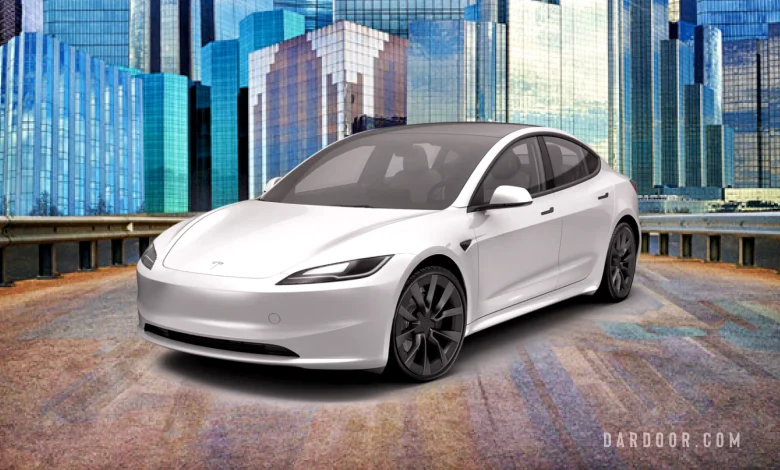
Tesla Model 3 Long Range Highland RWD ★★★★½
Available to order since October 2025

 580 km
 201 km/h
  5.2 Sec
  840 km/h
Charging Port Type CCS Type 2 (Charging Port type affects charging station compatibility.) 
Max AC Charging 11 KW Home Charging, 3-Phase support. On-board AC charger (inverter) Capacity affects AC charging speed. Max DC Charging 250 KW Maximum power the car can accept from a DC faster charger. Architecture 400 V Higher power train voltage means faster charging and better efficiency. Battery Capacity (Usable) 75 kWh Net battery capacity that is available for use. Tested Range (EU -WLTP)
640 – 702 km Estimated Distance of a Full Charge Tested Range (USA – EPA) 584 km Estimated Distance of a Full Charge Motor / Power Performance Around 250 kW (335 hp) RWD (1 motors) Torque 450 Nm Peak Toque of the car’s electric motor 0-100 km/h 5.2 Second acceleration time from standstill to 100 km/h Top Speed 201 km/h Maximum speed the car can reach Charging 10→ 80% 33 minutes Under Ideal Conditions Drive Type RWD (1 Motor) PMSM
About Tesla Model 3 Long Range Highland RWD 🚘
2025 Tesla Model 3 “Highland” Long Range RWD Review — The Efficient Range King Returns
Meta description:
Discover the 2025 Tesla Model 3 “Highland” Long Range RWD — Tesla’s most refined sedan yet. With a striking new design, whisper-quiet cabin, and real-world range near 576 km, it’s the ultimate blend of comfort, tech, and efficiency.
Overview
The 2025 Tesla Model 3 “Highland” Long Range RWD marks the return of a short-lived but exceptional trim that redefines efficiency and elegance in Tesla’s lineup. Produced briefly between late 2024 and 2025, this rear-drive variant delivers superior range, refined ride quality, and performance that solidifies its place as one of the most compelling EV sedans on the road. It combines Tesla’s minimalist design ethos with next-generation comfort and efficiency, making it the most balanced version of the Model 3 ever built.
What’s New for 2025
The Highland refresh introduces deeper refinements both inside and out:
- Aerodynamic new front fascia with sharper LED Matrix headlights and “TESLA” script rear badging
- Acoustic glazing all around for a dramatically quieter cabin
- Ventilated and heated front seats with improved lumbar support
- Ambient light strip integrated across the dash
- Removal of traditional stalks — indicators and gear selections now on steering wheel buttons and the 15.4-inch touchscreen
Tesla also updated the suspension tuning, resulting in smoother, more compliant ride comfort over uneven roads — one of the most requested improvements over earlier iterations.
Design and Aerodynamics
With sleeker proportions and simplified surfacing, the Model 3 Highland looks and feels more premium.
Its aerodynamic drag coefficient of 0.219 Cd contributes to both calmer highway performance and better energy efficiency.
Dimensions:
- Length: 4720 mm
- Width: 1849 mm
- Height: 1440 mm
Subtle refinements like flush exterior panels and slim headlight clusters make it one of the most polished sedans on the market.
Interior, Technology, and Space
Stepping inside reveals Tesla’s cleanest and most upscale interior yet:
- A panoramic layout led by the 15.4-inch central touchscreen handles all major functions
- Rear passengers get an 8-inch display for entertainment and climate control
- Acoustic insulation and softer ride tuning enhance long-distance comfort
Cargo practicality remains superb, offering 594 L in the trunk (expanding to 977 L with rear seats folded) plus an 88 L frunk up front.
Performance and Driving
Despite relying on a single motor, this Model 3 variant astonishes with seamless acceleration:
- Power: 250–295 kW (≈335–395 hp)
- Torque: 450 Nm
- 0–100 km/h: 5.2 seconds
The permanent magnet synchronous motor (PMSM) ensures both instant response and excellent efficiency. Combined with retuned suspension, handling is precise and predictable with a smoother ride and reduced cabin harshness. Some drivers notice slightly more body roll than before, a fair tradeoff for the improved ride comfort.
Range, Battery, and Charging
This model sits at the top of its class for endurance:
- Usable battery capacity: 75–82 kWh (LFP chemistry)
- Real-world range: up to 576 km WLTP, with highway efficiency averaging 223 Wh/mi (≈7.68 km/kWh)
- Charging:
- 11 kW AC home charging (full charge ≈8 hours)
- 250 kW DC Supercharging, 10–80% in ≈27 minutes
Tesla’s Supercharger network remains the most extensive and reliable globally, ensuring stress-free long-distance driving.
Safety and Driver Assistance
Safety remains one of Tesla’s strongest domains:
- Certified 5-star Euro NCAP rating
- Standard Autopilot with adaptive cruise and lane keeping
- Optional Enhanced Autopilot and Full Self-Driving Capability with lane change and parking automation
- Visibility limited slightly by the thick A-pillars, but structure integrity remains class-leading.
Ownership, Warranty, and Maintenance
Tesla’s straightforward maintenance and warranty coverage reinforce its long-term value:
- Vehicle warranty: 4 years / 80,000 km
- Battery and drive unit: 8 years / 192,000 km (minimum 70% capacity retention guaranteed)
- Predictive maintenance schedules eliminate traditional service intervals, with the car alerting owners only when necessary.
Verdict: The Sweet Spot in the Model 3 Line
The 2025 Tesla Model 3 “Highland” Long Range RWD strikes a near-perfect balance between range, comfort, and performance. It’s quieter, more efficient, and more polished than any version before it. While some may resist Tesla’s minimalist approach or the removal of column stalks, this model’s refinement and driving satisfaction are undeniable.
For those who value maximum distance between charges, low running costs, and Tesla’s unmatched EV ecosystem, this is the range king — and arguably the best iteration of the Model 3 ever built.
Why You'll Love It 😘
1. Exceptional driving range
With roughly 576 km (WLTP) of real-world range and class-leading efficiency, this rear-drive Long Range variant is the most distance-capable Model 3 ever produced. It easily surpasses rivals like the Polestar 2 and BMW i4 when it comes to range stability over long trips.
2. Superb energy efficiency
Owners regularly report consumption near 7.5–7.7 km/kWh, putting it among the most energy-efficient EVs on the market thanks to its new aerodynamics and permanent magnet motor.
3. Unbeatable charging network
Tesla’s global Supercharger ecosystem remains unmatched for speed, reliability, and integration. With 250 kW DC fast charging (10–80% in about 27 minutes), range anxiety is virtually nonexistent.
4. Refined, quiet interior
The Highland refresh introduces acoustic glazing, upgraded seats, improved suspension isolation, and a quieter, more premium ride quality that rivals even luxury EVs from BMW and Mercedes.
5. Strong value proposition
Despite all upgrades, pricing remains competitive. Reviewers highlight that you get advanced technology, long range, and performance at a cost that undercuts most comparable EV sedans.
Why You Might Think Twice 🤔
1. Frustrating stalkless design
The most divisive change is the removal of indicator and gear selector stalks, now replaced by small steering-wheel buttons and on-screen controls. Reviewers note these can be confusing and distracting in daily driving.
2. Distracting touchscreen controls
Essential functions such as mirror adjustments, wipers, and vents require navigating the central display — a frequent criticism even among long-term owners who otherwise love the car.
3. Very limited availability
This specific Long Range RWD variant was produced only briefly (2024–2025), making it rare both new and used. Finding one may require luck or overseas sourcing.
4. Inconsistent panel gaps and finish
While quality has improved, panel alignment inconsistencies and minor fit-and-finish issues persist, especially on early units — an area still lagging behind rival EVs from Hyundai, Kia, and BMW.
5. Autopilot still imperfect
Although standard Autopilot is capable, reviewers report occasional phantom braking and inconsistent performance on complex roads. Full Self-Driving remains more “assistive” than autonomous.
The 2025 Tesla Model 3 “Highland” Long Range RWD remains one of the best all-around EVs available. Its unmatched efficiency and range, impeccable ride refinement, and access to Tesla’s charging network make it extraordinarily compelling. However, some UI frustrations and spotty build consistency prevent it from being flawless.
For drivers who value range and real-world drivability over luxury frills, it’s the ultimate long-distance EV sedan — as long as they can live with its quirks.
Key Owners-Reported Issues
Here are the key owners‑reported issues for the 2025 Tesla Model 3 “Highland” Long Range RWD, gathered from verified owner discussions, reliability analyses, and user forums including Tesla Motors Club, Reddit, and Edmunds.
Common Owner‑Reported Issues
1. Build Quality & Fitment Inconsistencies
While the Highland update improved refinement, owners continue to report inconsistent panel gaps, loose trim pieces, and rattles within the cabin, particularly around the dashboard and seatbelt mount points. Though most issues are cosmetic, they contrast with expectations for a premium EV.
2. Software Glitches After Updates
Frequent over‑the‑air software updates occasionally introduce interface lag, missing controls, or temporarily disabled driver‑assistance functions (such as lane‑keeping or adaptive cruise). Some vehicles have thrown error messages like “Automatic Emergency Braking Unavailable” following updates, typically resolved through resets or service recalibration.
3. Autopilot and Sensor Issues
Owners describe occasional phantom braking, abrupt disengagements, or missed lane markings under certain lighting or weather conditions. Despite incremental improvements, these behaviors remain a common Tesla quirk compared to other adaptive‑assist systems.
4. Early Electrical and Connector Faults
A small number of early‑build 2025 vehicles experienced communication or connector faults, triggering multiple “MIA” (missing in action) system warnings shortly after delivery. These were traced to loose or partially seated connectors—issues typically corrected under warranty.
5. Noise and Minor Rattles Over Time
Despite acoustic glass, reviewers note wind noise near the A‑pillars and rattles from door cards or the front dash after roughly 5,000–10,000 miles. Many drivers resolved these with DIY insulation kits or through Tesla mobile service visits.
6. Service and Support Delays
Tesla’s service scheduling frustrations remain one of the most cited complaints. Owners often wait weeks for appointments, with long travel distances to service centers and inconsistent follow‑up communication.
7. Charging Equipment and Supply Issues
Unlike earlier models, home chargers are no longer included with purchase—causing confusion for first‑time owners. Some buyers received defective wall connectors and faced difficulties obtaining quick warranty replacement through Tesla’s online store.
8. Heat Pump Reliability in Cold Climates
A subset of owners in colder regions reported reduced cabin heating efficiency and fluctuating range in sub‑zero conditions, linked to heat pump operation variability. Firmware patches have mitigated the issue, but it remains a watch area.
Reliability Snapshot
According to J.D. Power’s predicted reliability score of 74/100, the 2025 Tesla Model 3 ranks above average, though not flawless. Around 87% of owners still rate the car five stars on overall satisfaction, praising its driving experience, efficiency, and tech usability after initial teething issues are resolved.
Overall Assessment
While early‑build units of the 2025 Model 3 Highland showed minor quality and software issues, most owners report high satisfaction once initial fixes are implemented. The majority of complaints focus more on fit‑and‑finish, software quirks, and service delays rather than serious drivetrain or battery problems—confirming that the car’s core mechanical reliability remains strong.
| Combined Efficiency | 136 Wh/km* |
|---|---|
| Total System Power | 235 kW (320 PS) |
| Total Torque | 450 Nm |
| 0–100 km/h | 5.2 s |
| Top Speed | 201 km/h |
| Drive | Rear-wheel drive |
Price & Regional Availability
| Country/Region | Price |
|---|---|
| 🇬🇧 United Kingdom | £44,990 |
| 🇳🇱 Netherlands | €45,990 |
| 🇩🇪 Germany | €45,970 |
| 🇺🇸 United States | — (variant not listed on US site) |
| 🇨🇦 Canada | $59,990 CAD (Model 3 Long Range RWD-I 2025) |
| 🇲🇽 Mexico | 879,000 MXN |
| 🇨🇳 China | ¥259,500 CNY |
| 🇦🇺 Australia | AUD$ 61,900 |
Observations
- The cheapest market globally is 🇨🇳 China, where it retails around $36,000 USD, reflecting local production and EV subsidies.
- 🇪🇺 Europe remains the most expensive region due to taxes and VAT, with prices near €50,000–€60,000 depending on options.
- The 🇺🇸 U.S. and 🇨🇦 Canada benefit from EV tax credits, effectively lowering ownership costs by several thousand dollars.
- 🇦🇺 Australia’s 2025+ model year introduces an extended‑range battery, offering the longest WLTP range (≈750 km) at a competitive sub‑$40,000 USD equivalent.
This global pricing comparison shows how Tesla’s regional production strategy (Shanghai, Fremont, Berlin) and local tax incentives produce striking variation — over $20,000 in difference between the lowest (China) and highest (Europe) market prices for the same Long Range RWD model.
Real-World Range Estimates
Between 420 – 850 km
| Condition | City | Highway (110 km/h) | Combined |
|---|---|---|---|
| 🌤️ Mild Weather | 850 km* | 560 km* | 685 km* |
| 🌦️ Average Weather | — | — | 580 km* |
| ❄️ Cold Weather | 535 km* | 420 km* | 480 km* |
Indication of real-world range in several situations.
- ❄️ Cold Weather: “worst-case” (−10 °C with heating).
- 🌤️ Mild Weather: “best-case” (23 °C without A/C).
- 🛣️ Highway assumes a constant 110 km/h.
- 🏎️ Actual range depends on speed, driving style, weather and route conditions.
Long Distance Suitability (1-Stop Range) ★★★★½
| First Stop Distance | 432 km | First Stop Duration | 3h 56min |
| Charging Stop | 0km | Charging Stop | 15 min |
| Second Stop Distance | 255 km | Second Stop Duration | 2h 19min |
| Total Distance | 688 km | Total Duration | 6h 30min |
| Weather | 1-Stop Range |
|---|---|
| 🌤️ Mild Weather | 802 km |
| 🌦️ Average Weather | 688 km → ★★★★½ |
| ❄️ Cold Weather | 602 km |


The “Long Distance Suitability” is a 5-star rating indicating how suitable a vehicle is for long trips. It’s based on the 1-Stop Range: total distance with one 15-minute DC fast-charging stop.
2025 thresholds:
- 0☆ <200 km;
- 1★ 200–325;
- 2★ 325–450;
- 3★ 450–575;
- 4★ 575–700;
- 5★ >700 km.
- Half-stars are assigned by linear interpolation.
Battery Details
| Nominal / Usable Capacity | 82.0 kWh* / 79.0 kWh* |
|---|---|
| Battery Type / Cathode | Lithium-ion • NCM |
| Architecture | 400 V |
| Cells / Pack Config / Voltage / Form | No data / No data / — / Cylindrical |
| Cell/Pack Name | LG 5M |
| Warranty | 8 years / 192,000 km |
* = estimated values where marked.
Charging Overview
Actual AC/DC speeds depend on grid connection, site load, ambient temperature, cable rating, and starting SoC.
| Category | Details |
|---|---|
| Home/Destination (AC) | Type 2 (left-rear); onboard charger 11 kW AC; 0→full ≈ 8 h 30 m (~69 km/h) |
| Fast DC (CCS) | CCS (left-rear); peak 250 kW; avg ~120 kW (10→80%); 10→80% ≈ 29 m (up to ~840 km/h) |
| Plug & Charge | Not supported |
| Autocharge | Supported |
| Battery Preconditioning | Supported; automatic when navigating to a DC fast charger |
Home & Destination Charging (0 → 100%)
Charging can be via a regular wall plug or a charging station. Public AC charging is always through a charging station. How fast the EV charges depends on the EVSE and the vehicle’s onboard charger. The table shows all options; some modes may be less available depending on country (1-phase vs 3-phase).
| Charging Point | Max. Power | Power | Time | Rate |
|---|---|---|---|---|
| Wall Plug (230 V / 1×10 A) | 2.3 kW | 2.3 kW | 40 h 30 m | 14 km/h |
| 1-Phase 16 A (230 V) | 3.7 kW | 3.7 kW | 25 h 15 m | 23 km/h |
| 1-Phase 32 A (230 V) | 7.4 kW | 7.4 kW | 12 h 45 m | 45 km/h |
| 3-Phase 16 A (400 V) | 11 kW | 11 kW | 8 h 30 m | 68 km/h |
| 3-Phase 32 A (400 V) | 22 kW | 11 kW † | 8 h 30 m | 68 km/h |
Fast Charging (10 → 80%)
| Charging Point | Max. Power | Avg. Power | Time | Rate |
|---|---|---|---|---|
| CCS 50 kW | 50 kW | 45 kW † | 78 m | 310 km/h |
| Supercharger v2 Shared (75 kW) | 75 kW | 65 kW † | 54 m | 450 km/h |
| Supercharger v2 (150 kW) | 150 kW | 100 kW † | 35 m | 690 km/h |
| CCS 175 kW | 175 kW | 110 kW † | 32 m | 760 km/h |
| Supercharger v3 (250 kW) | 250 kW | 120 kW † | 29 m | 840 km/h |
| CCS 350 kW | 250 kW † | 120 kW † | 29 m | 840 km/h |
† Limited by vehicle capabilities. Autocharge supported. Plug & Charge not supported. Actual charging rates vary with temperature, battery state, site load, and driving style.
Claimed Charging Specs (Manufacturer)
- Max. Power: The maximum charging power reached during the session.
- Charge From: The starting battery state-of-charge (% SoC).
- Charge To: The target battery state-of-charge (% SoC).
- Time: Total time required for the charging session.
| Max. Power | Charge From | Charge To | Time | Rate |
|---|---|---|---|---|
| 250 KW | — | — | — | — |
Performance & Drivetrain
| Total Power / Torque | 235 kW (320 PS) • 450 Nm |
|---|---|
| 0–100 km/h | 5.2 s |
| Top Speed | 201 km/h |
| Drive | RWD |
Energy Consumption & Efficiency
| Standard / Basis | Range | Rated Consumption | Vehicle Consumption | Fuel-eq. |
|---|---|---|---|---|
| Real Range | 580 km* | — | 136 Wh/km* | 1.5 L/100 km (veh.)* |
| WLTP (TEL) | 750 km | 126 Wh/km | 105 Wh/km | 1.4 / 1.2 |
| WLTP (TEH) | 691 km | 136 Wh/km | 114 Wh/km | 1.5 / 1.3 |
- TEL = Test Energy Low
- TEH = Test Energy High (if applicable).
- Rated = official figures as published by the manufacturer; includes charging losses.
- Vehicle = calculated battery energy used for propulsion and on-board systems.
Real Energy Consumption Estimation
Between 93 – 188 Wh/km
| Scenario | City | Highway | Combined |
|---|---|---|---|
| ❄️ Cold Weather | 148 Wh/km* | 188 Wh/km* | 165 Wh/km* |
| 🌤️ Mild Weather | 93 Wh/km* | 141 Wh/km* | 115 Wh/km* |
- ❄️ Cold Weather: “worst-case” (−10 °C with heating).
- 🌤️ Mild Weather: “best-case” (23 °C without A/C).
- 🛣️ Highway assumes a constant 110 km/h.
- 🏎️ Actual range use depends on speed, driving style, weather and route conditions.
Consumption Insights
- ❄️ Cold Weather increases energy usage significantly, especially at highway speeds due to battery heating and climate control.
- 🌤️ Mild Weather and city driving are most efficient, with lower consumption comparable to other premium electric SUVs in its class.
- Combined (average) values are ideal for trip planning but depend on route and temperature.
Safety Rating ★★★★★
The 2025 Tesla Model 3 “Highland” has achieved exceptional safety ratings worldwide under the latest and most demanding testing protocols. Here’s a breakdown from the Euro NCAP, IIHS, and NHTSA assessments.
Euro NCAP (Europe): Overall Rating: ★★★★★
Total Score: 359 / 400 — Safest new car in Europe for 2025
| Category | Score | Highlights |
| Adult Occupant Protection | 90% | Stable cabin structure, excellent side-impact and frontal offset performance. Minimal injury risk for driver and passenger . |
| Child Occupant Protection | 93% | Top marks for child dummy results, integrated ISOFIX points, and automatic child seat detection . |
| Vulnerable Road Users (Pedestrians & Cyclists) | 89% | Active hood for impact mitigation, leading performance in cyclist AEB (autonomous emergency braking) . |
| Safety Assist Systems | 87% | High-function AEB, lane support, Intelligent Speed Assist, and door-exit collision warning. Euro NCAP praised Tesla’s advanced driver monitoring but warned of potential Autopilot misuse . |
Summary:
Tesla’s Highland redesign not only maintains but raises standards in occupant protection and active safety. Its updated structure and advanced sensor suite deliver best-in-class results under Euro NCAP’s stricter 2025 protocol revisions.
IIHS (U.S.)
Overall Rating: “Acceptable”
Structure and Safety Cage: “Good”
Rear Passenger Chest Protection: “Moderate”
- The front moderate overlap and side tests scored “Good”.
- The rear passenger dummy showed moderate chest compression, keeping the total rating just below “Top Safety Pick” status.
- Head restraints, airbags, and seating geometries provide robust whiplash protection.
- IIHS praised Tesla’s structural rigidity but recommended secondary restraint refinements for rear-seat protection.
NHTSA (United States)
Overall Rating: ★★★★★
| Test Category | Rating |
| Frontal Crash | ★★★★★ |
| Side Crash | ★★★★★ |
| Rollover Resistance | ★★★★★ |
NHTSA’s 5-star evaluation confirms consistent safety performance across Tesla’s U.S. lineup. Model 3 continues to demonstrate a low probability of serious injury in severe collisions, a metric Tesla highlights in its global marketing.
Global Takeaway
- Europe: Highest overall NCAP rating among all 2025 vehicles
- U.S.: Strong NHTSA 5-star result, but IIHS “Acceptable” rear protection prevents top honor
- Key Strengths: Structural rigidity, outstanding AEB, rear child and pedestrian safety
- Areas to Watch: Rear seat belt force in U.S. crash metrics; user reliance on semi-autonomous features
Verdict:
The 2025 Tesla Model 3 “Highland” ranks as one of the safest sedans ever tested. Its blend of crash integrity, advanced safety systems, and real-world occupant protection cements its position as a global safety benchmark for electric vehicles.
Dimensions & Weight
| L × W × H | 4,720 × 1,849 × 1,431 mm (width with mirrors 2,089 mm) |
|---|---|
| Wheelbase | 2875 mm |
| Weight Unladen (EU) / GVWR / Payload | 1822 kg |
| Cargo Volume (seats up / max / frunk) | 594 L |
| Roof Load | — |
| Towing | 1000 kg |
| Turning Circle | 11.7 m |
| Platform | TESLA 3/Y • EV-dedicated |
| Body / Segment / Roof Rails | Sedan • D – Large • No |
| Heat Pump | Yes (standard) |
Bidirectional Charging (V2X / BPT)
| Capability | Status | Meaning |
|---|---|---|
| V2L | No | Power external devices from the vehicle |
| V2H | No | Home backup / whole-home power |
| V2G | No | Export to grid |
| BPT | No | Umbrella term for bidirectional features |
Miscellaneous
| Seats / ISOFIX | 5 • ISOFIX ×2 |
|---|---|
| Platform | TESLA 3/Y |
| Segment | D – Large |
* = estimated value where indicated. Average energy consumption and range assume moderate drive style and climate. Real-life values may differ significantly. Pricing information might not be actual for some regions. No rights can be derived from the information on this site.
Preceding Model
Here’s a detailed technical and experiential comparison between the 2024 and 2025 Tesla Model 3 Long Range RWD (“Highland”) versions. The 2025 model refines the design and dynamics of the 2024 refresh, marking Tesla’s most mature compact sedan yet.
| Metric | 2024–2025 Model 3 LR RWD (prev.) | 2025– Model 3 LR RWD (current) | Δ |
|---|---|---|---|
| Real Range (Combined) | ~550 km | 580 km | +30 km |
| 0–100 km/h | 5.2 s | 5.2 s | — |
| Efficiency (Vehicle) | ~140 Wh/km | 136 Wh/km | Improved |
Model Overview
| Specification | 2024 Model 3 Long Range RWD | 2025 Model 3 Long Range RWD (“Highland”) |
| Battery (usable) | 75–78 kWh NCM (400V) | 75 kWh (LFP chemistry; improved thermal control) |
| Power | 280–295 kW (≈375–395 hp) | 250–295 kW (≈335–395 hp) |
| Torque | 450 Nm | 450 Nm |
| 0–100 km/h | 4.9–5.2 sec | 5.2 sec (slightly softer tune for comfort) |
| Range (WLTP) | 705 km (436 mi EPA, 363 mi EPA real) | 576 km (real-world, ≈365 mi EPA) |
| Top speed | 201 km/h (125 mph) | 201 km/h (125 mph) |
| Charging speed (DC) | 250 kW (V3 Supercharger) | 250 kW (V3/V4 compatible) |
| AC charging | 11 kW | 11 kW |
| Efficiency | 6.9 km/kWh | 7.7 km/kWh (improved aerodynamics & software tuning) |
| Drag coefficient (Cd) | 0.23 | 0.219 (redesigned front and rear bumpers) |
Design & Exterior Changes
2024
- Introduced the first “Highland” refresh: reshaped front end, slim LED headlights, smoother rear fascia.
- Retained split taillights and older badging design.
2025
- Enhanced refinement with fully integrated taillights within the powered boot lid and sharper rear diffuser.t
- “TESLA” lettering replaces the logo on rear trim.
- Acoustic glass all around standard; panel gap precision improved from 3 mm to 1.5 mm tolerance.
- Added Stealth Grey and Ultra Red color options.
Interior & Technology Upgrades
| Feature | 2024 Model | 2025 Model |
| Cabin quality | New soft-touch materials | Further improved fit/finish and reduced vibration |
| Displays | Central 15.4″ touchscreen | Same size + faster processor, higher refresh rate |
| Rear screen | 8″ rear touchscreen added (first seen in 2024) | Improved responsiveness, streaming apps expanded |
| Lighting | Ambient lighting strip (introduced 2024) | Multi-color adjustable lighting modes added |
| Seats | Heated + ventilated front | Same, with quieter ventilation fans and more lumbar support |
| Noise isolation | Excellent improvement from previous generation | Quieter still; more insulation under floorpan |
Driving Dynamics
- 2024 model: Still sport-oriented, with slightly firmer damping; sharper turn-in response but transmitted more road harshness.
- 2025 model: Retuned suspension with softer compliance and reduced road vibration—a subtle tradeoff: less sharp but more comfortable on long trips.
Ride Refinement:
The 2025 Highland absorbs bumps better and exhibits less tire noise. Owners tend to prefer this newer calibration, especially for daily driving.
Safety Comparison
| Category | 2024 Model 3 LR RWD | 2025 Model 3 LR RWD |
| Euro NCAP | 5 Stars (2024 refresh; 2024 testing cycle) | 5 Stars (2025; Safest Car in Europe 2025) |
| IIHS | Top Safety Pick | “Acceptable” (rear seat protection adjusted scoring) |
| NHTSA | 5 Stars overall | 5 Stars overall |
The 2025 edition benefits from software-coordinated crash response updates (pre-tension and airbag deployment timing), improving passenger chest protection scores slightly over 2024.
Pricing Comparison
| Region | 2024 Price | 2025 Price | Change |
| 🇺🇸 USA | $42,500 | $47,490 | +$4,990 (trim reposition, tech update) |
| 🇩🇪 Germany | €46,990 | €48,970 | Small increase, offset by incentives |
| 🇨🇳 China | ¥271,400 | ¥259,500 | –¥11,900 drop after cost optimization |
Verdict
| 2024 Model 3 LR RWD | 2025 Model 3 LR RWD (“Highland”) | |
| Pros | Faster acceleration, sharper handling, slightly cheaper | Quieter, more refined ride, better efficiency, superior build quality |
| Cons | Louder cabin on rough surfaces; firmer ride | Stalkless controls irritate some users; limited availability |
| Ideal for | Enthusiasts who prefer sportier handling | Commuters valuing comfort, efficiency, and premium refinement |
Summary
The 2025 Model 3 Long Range RWD builds upon the 2024 Highland refresh with tangible improvements in ride comfort, aerodynamics, and cabin refinement rather than raw performance. It’s incrementally slower but substantially more mature and livable day-to-day.
If the 2024 version represented Tesla’s sporty electric sedan, the 2025 Highland is the serene, grown-up evolution—less visceral, more refined, and ultimately the version most owners will want for long-term comfort and range efficiency.
1-Stop Range Definition ✋
For vehicles without fast-charging capability, only the distance of the first stop is considered.
🚗 Driving Profile
- Begin with a fully charged battery
- Stop 1: Drive until the battery reaches 10% state-of-charge (SoC)
- Perform a 15-minute fast charge
- Stop 2: Continue driving until the battery again reaches 10% SoC
📋 Assumptions
- Driving speed, climate, and environmental conditions are based on Real Range Highway data
- No additional time required to initiate or stop the charging session
- The charging station always delivers the maximum power requested by the vehicle
- The battery is assumed to be in optimal health and condition
⚠️ Important Note : In real-world driving, it is practically impossible to replicate these conditions exactly.
This benchmark should therefore be viewed as a comparative metric, designed to evaluate vehicles under standardized conditions rather than predict exact trip distances.
5-Star Rating Definition ★
- The 1-Stop Range rating in 2025 is a practical benchmark for EVs: it measures the distance a vehicle can travel after a single 15-minute charging session, under combined real-world weather conditions.
- This rating provides a clear, star-based measure of long-distance travel practicality—judged by how far a car can go after a single 15-minute DC fast charge.
- The rating puts instant, comparable context on each EV’s long-distance travel ability, helping buyers easily compare real-world charging performance between models.
- This value is translated into star ratings: In 2025, the system assigns stars as follows:
| Star Rating | 1-Stop Range (combined conditions) |
|---|---|
| ☆ | less than 200 km |
| ★ | 200 km to 325 km |
| ★★ | 325 km to 450 km |
| ★★★ | 450 km to 575 km |
| ★★★★ | 575 km to 700 km |
| ★★★★★ | more than 700 km |
- The 1-Stop Range is calculated using real-world benchmarks in three temperature scenarios to show suitability for road trips, regardless of weather.
- Half-star ratings interpolate between these whole-star bands, so a result of 490 km would earn 3½ stars.
- This system makes it easier for drivers to quickly assess and compare vehicles for long-distance suitability, regardless of ambient temperature or charging conditions.
Fast Charging (10 -> 80%) ⚡
- Max. Power: maximum power provided by charge point
- Avg. Power: average power provided by charge point over a session from 10% to 80%
- Time: time needed to charge from 10% to 80% Rate: average charging speed over a session from 10% to 80%
EV Charger Connector Types 🔌

This table provides a quick reference for which plug types are used for AC vs DC charging and their regional prevalence. Here’s a comparative table of major EV charger connector types, showing whether they are for AC or DC charging, their suitability, and the countries/regions where they are widely adopted:
| Connector Type | AC/DC | Suitability | Countries/Regions Adapted |
|---|---|---|---|
| Type 1 (SAE J1772) | AC | Standard US/Japan AC, slow–medium | USA, Canada, Japan |
| Type 2 (Mennekes) | AC | European AC standard, universal | Europe, UK, Australia, South Africa |
| Tesla (North America) | AC/DC | Tesla vehicles only, fast Supercharge | USA, Canada |
| CCS1 (Combo 1) | DC | US fast DC charge, some AC support | USA, Canada |
| CCS2 (Combo 2) | DC | Europe fast DC charge, AC support | Europe, UK, Australia, South Africa |
| CHAdeMO | DC | Nippon/Japanese, some global DC | Japan, parts of Europe, USA |
| GB/T (AC/DC) | AC/DC | China national standard, all speeds | China |
| Tesla (Europe) | DC | European Tesla fast charging (CCS2) | UK, Europe |
- Type 1 (J1772): Used for AC charging in North America and Japan; now fading in favor of CCS1 for DC.
- Type 2 (Mennekes): Universal AC connector across Europe; most wallboxes/public AC points use this.
- CCS (Combined Charging System): CCS1 for North America, CCS2 for Europe/Australia/South Africa. Enables both AC and high-power DC charging in one socket, now the global DC fast charge standard.
- CHAdeMO: Used mostly for rapid DC charging in Japan and some regions; declining outside Japan as CCS adoption grows.
- GB/T: Unique AC and DC connectors for China, incompatible with Western standards.
- Tesla: Proprietary plug in North America; now shifting to “NACS” standard which will be more widely adopted by Ford, GM, and others. In Europe, Tesla uses CCS Type 2, fully compatible with local standards.