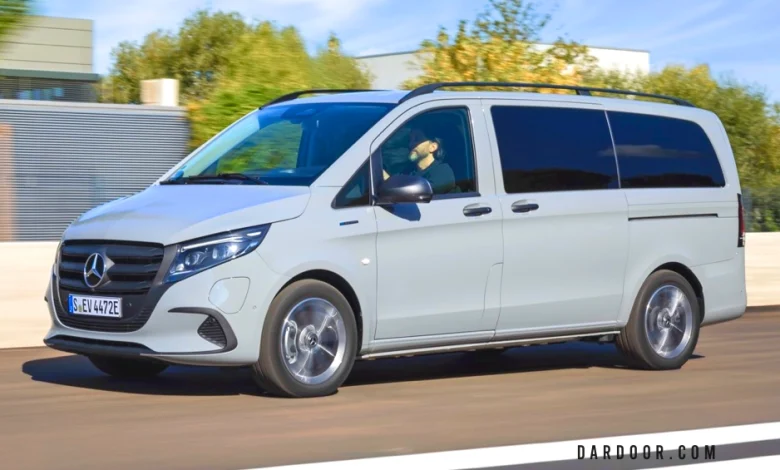
Mercedes-Benz eVito Tourer Extra-Long 60 kWh ★☆☆☆☆
Available to order since February 2024

 215 km
 160 km/h
  12.0 Sec
  200 km/h
Charging Port Type CCS Type 2 
Max AC Charging 11 KW Max DC Charging 110 KW Architecture 400 V Higher power train voltage means faster charging and better effeciency Battery Capacity (Usable) 82.3 kWh Net Battery Capacity
About Mercedes-Benz eVito Tourer Extra-Long 60 kWh
Overview
The 2025 Mercedes eVito Extra-Long 60 kWh is a premium all-electric van designed to move people or cargo efficiently while maintaining zero emissions. With seating for up to nine passengers, this spacious workhorse blends practical utility with Mercedes refinement. Its 5,370 mm length and extra-long body provide exceptional interior space, making it an excellent choice for businesses, shuttle services, or eco-conscious families. In the European market, prices start at around €69,309, positioning it as a high-value option for those seeking maximum electric van capacity.
What’s New for 2025
The 2025 model continues the significant upgrades introduced in 2024, benefiting from Mercedes’ latest van platform. Highlights include:
- Refined interior cabin with higher-quality materials.
- Upgraded MBUX infotainment system for a smoother digital experience.
- Improved driver-assistance features, boosting safety and ease of use.
- 60 kWh battery pack providing a solid balance between usable range and payload practicality.
Design & Exterior
The eVito’s exterior follows Mercedes’ professional van styling while prioritizing functionality.
- Dimensions: 5,370 mm (L) × 1,928 mm (W without mirrors) × 1,890 mm (H).
- Smart, professional front fascia aligned with current Mercedes design language.
- Extra-Long body maximizes passenger and cargo capacity.
- Utility-focused lighting and wheel options designed for everyday durability.
Interior, Tech & Cargo
Step inside, and you’ll find a durable yet premium cabin built for everyday practicality.
- Nine-seat capacity with ample room for passengers.
- Boot space: 1,390 L with all seats up, expanding to 4,990 L with seats folded.
- No front trunk (frunk) available.
- Technology: Upgraded MBUX infotainment system with Apple CarPlay and Android Auto, responsive touchscreen, and smartphone integration.
Performance & Driving Experience
Powered by a Permanent Magnet Synchronous Motor (PMSM) on the front axle:
- Output: 150 kW (201 hp).
- Torque: 360 Nm.
- Acceleration: 0–100 km/h in ~12 seconds.
- Top speed: 160 km/h.
- Driving: Comfortable, stable ride with adjustable regenerative braking for efficiency in city driving.
Range, Battery & Charging
- Battery: 60 kWh usable (66 kWh gross).
- Real-world range: ~214 km (efficiency: 3.57 km/kWh).
- AC charging: Up to 11 kW (0–100% in ~5.5–6 hours).
- DC charging: Up to 80 kW (10–80% in 30–40 minutes).
- Charging port: CCS Type 2.
Safety & Driver Assistance
While a specific Euro NCAP score is not yet available for this trim, Mercedes equips its vans with robust safety features:
- Standard: Active Brake Assist, Attention Assist, Crosswind Assist.
- Optional/Trim-dependent: Adaptive cruise control, lane-keeping assist, blind-spot monitoring.
Warranty & Maintenance
- Vehicle warranty: Typically 2 years (unlimited km, varies by market).
- High-voltage battery: 8 years / 160,000 km coverage, guaranteeing minimum capacity.
- Lower maintenance needs than diesel vans, thanks to fewer moving parts, leading to reduced long-term running costs.
| Combined Efficiency | 279 Wh/km |
|---|---|
| Total System Power | 150 kW (204 PS) |
| Total Torque | 360 Nm |
| 0–100 km/h | 12.0 s |
| Top Speed | 160 km/h |
| Drive | Front-wheel drive |
Price & Regional Availability
| Country/Region | Price |
|---|---|
| United Kingdom | — |
| Netherlands | — |
| Germany | €69,309 |
| United States | — |
| Canada | — |
| Mexico | — |
| China | — |
| Chile | — |
Prices shown are manufacturer’s recommended retail prices (MSRP) for the specified countries. They exclude indirect incentives and may vary by regional specifications/options. Values are subject to change without notice.
Real-World Range Estimates
| Condition | City | Highway | Combined |
|---|---|---|---|
| 🌤️ Mild Weather | 315 km | 190 km | 240 km |
| 🌦️ Average Weather | — | — | 215 km |
| ❄️ Cold Weather | 230 km | 150 km | 185 km |
Indication of real-world range in several situations. Cold = −10 °C (with heating). Mild = 23 °C (no A/C). Highway assumes a constant 110 km/h. Actual range depends on speed, driving style, climate and route conditions.
Long Distance Suitability (1-Stop Range)
| First Stop Distance | 151 km | First Stop Duration | 1h 22min |
| Charging Stop | 0km | Charging Stop | 15 min |
| Second Stop Distance | 50 km | Second Stop Duration | 27min |
| Total Distance | 201 km | Total Duration | 2h 4min |
| Weather | 1-Stop Range |
|---|---|
| 🌤️ Mild Weather | 228 km |
| 🌦️ Average Weather | 201 km → ★☆☆☆☆ |
| ❄️ Cold Weather | 180 km |


The “long distance suitability” is a 5-star rating indicating how suitable a vehicle is for long trips. It’s based on the 1-Stop Range: total distance with one 15-minute DC fast-charging stop.
2025 thresholds:
- 0★ <200 km;
- 1★ 200–325;
- 2★ 325–450;
- 3★ 450–575;
- 4★ 575–700;
- 5★ >700 km.
- Half-stars are assigned by linear interpolation.
Battery Details
| Nominal / Usable | 66.0 kWh / 60.0 kWh |
|---|---|
| Type | Lithium-ion |
| Architecture / Nominal Voltage | 400 V / ~352 V |
| Cells / Pack Configuration | 192 / 96s2p |
| Cathode / Form Factor | No data / — |
| Warranty | No data |
Charging Overview
| Category | Details |
|---|---|
| Home / Destination (AC) | Type 2 • 11 kW onboard • 0→100% ≈ 6 h 30 m • ~33–34 km/h |
| Fast DC | CCS • peak 80 kW • avg ~60 kW (10→80%) • 44 m • ~200 km/h |
| Plug & Charge | Not supported |
| Autocharge | Supported |
| Battery Preconditioning | No data |
Home & Destination Charging (0→100%)
| Charging Point | Max. Power | Power | Time | Rate |
|---|---|---|---|---|
| Wall Plug | 2.3 kW | 2.3 | 30 h 45 m | 7 km/h |
| 1-Phase 16 A | 3.7 kW | 3.7 | 19 h 15 m | 11 km/h |
| 1-Phase 32 A | 7.4 kW | 7.4 | 9 h 45 m | 22 km/h |
| 3-Phase 16 A | 11 kW | 11 | 6 h 30 m | 33 km/h |
| 3-Phase 32 A | 22 kW | 11† | 6 h 30 m | 33 km/h |
Charging is possible via regular wall plug or charging station; public charging is always via a station. Charge speed depends on EVSE power and the vehicle’s onboard charger; the lower of the two is the bottleneck. † Limited by the onboard 11 kW charger.
Fast Charging (10→80%)
Rapid charging adds maximum range in minimum time. Charging power tapers significantly above ~80% state-of-charge; typical rapid sessions stop near 80%. Connector: Combined Charging System (CCS Combo 2).
| Charging Point | Max. Power | Avg. Power | Time | Rate |
|---|---|---|---|---|
| CCS 50 kW | 50 | 40† | 66 m | 130 km/h |
| CCS 100 kW | 80† | 60† | 44 m | 200 km/h |
| CCS 150 kW | 80† | 60† | 44 m | 200 km/h |
| CCS 175 kW | 80† | 60† | 44 m | 200 km/h |
| CCS 350 kW | 80† | 60† | 44 m | 200 km/h |
† Limited by vehicle charging capability. Autocharge: automatic session start at supported CCS stations. Plug & Charge: not supported for this model. Actual rates vary with temperature, battery condition, and driving.
Claimed Charging Specs (Manufacturer)
| Max. Power | Charge From | Charge To | Time |
|---|---|---|---|
| 80 kW | 10% | 80% | 35 m |
Max. Power = peak during session; Time = duration for the specified SoC window.
Performance & Drivetrain
| Total Power | 150 kW (204 PS) |
|---|---|
| Total Torque | 360 Nm |
| 0–100 km/h | 12.0 s |
| Top Speed | 160 km/h |
| Drive | FWD (single-motor) |
Energy Consumption & Efficiency
| Basis | Range | Rated (Wh/km) | Vehicle (Wh/km) | Fuel-eq |
|---|---|---|---|---|
| Real | 215 km | — | 279 | 3.1 L/100 km |
| WLTP (TEL) | 254 km | 261 | 236 | 2.9 / 2.7 |
| WLTP (TEH) | 236 km | 284 | 254 | 3.2 / 2.9 |
TEL = Test Energy Low | TEH = Test Energy High. Rated = official manufacturer figures (incl. charging losses). Vehicle = calculated battery energy used for propulsion and onboard systems.
Real Energy Consumption Estimation
| Scenario | City | Highway | Combined |
|---|---|---|---|
| Cold | 261 Wh/km | 400 Wh/km | 324 Wh/km |
| Mild | 190 Wh/km | 316 Wh/km | 250 Wh/km |
Indication of real-world energy use in several situations. Cold = −10 °C (with heating). Mild = 23 °C (no A/C). Highway assumes a constant 110 km/h. Actual use depends on speed, driving style, climate and route.
Safety Rating
| Region | Rating | Details |
|---|---|---|
| Europe (Euro NCAP) | — | Not listed for this variant/year |
| North America (NHTSA/IIHS) | — | Model not listed |
| South America (Latin NCAP) | — | Model not listed |
Dimensions & Weight
| L × W × H | 5370 × 1928 × 1890 mm |
|---|---|
| Width incl. mirrors | 2244 mm |
| Wheelbase | 3430 mm |
| Weight (EU) / GVWR / Max Payload | 2596 kg / 3500 kg / 979 kg |
| Cargo (std / max / frunk) | 1390 L / 4990 L / 0 L |
| Roof Load | No data |
| Tow Hitch | Not possible (0 kg unbraked/braked) |
| Vertical Load | 0 kg |
| Seats | 8 |
| Body / Segment / Roof Rails | Small Passenger Van • N – Passenger Van • Yes |
| Heat Pump | No data |
Bidirectional Charging (V2X / BPT)
| Capability | Status | Meaning |
|---|---|---|
| V2L | No | Power external devices from vehicle |
| V2H (AC/DC) | No | Home backup / export |
| V2G (AC/DC) | No | Feed power to grid |
| BPT | No | General bidirectional support |
Miscellaneous
* = estimated values. Average energy consumption and range are based on moderate driving style and climate. Real-life values may differ significantly. Pricing information might not be current for some regions. No rights can be derived from the information on this site.
Predecessor Comparison
| Metric | eVito Tourer XL 60 kWh (2023) | eVito Tourer XL 60 kWh (2024–2025) | Δ |
|---|---|---|---|
| Real Range (combined) | 205 km | 215 km | +10 km |
| Efficiency (Vehicle) | 293 Wh/km | 279 Wh/km | ~+5% efficiency |
| DC Peak | Up to 110 kW | 80 kW | − |
| 0–100 km/h | 12.0 s | 12.0 s | = |
Previous Generation |
Next Generation |
|
Mercedes eVito Tourer extra-Long 41 kWh (2019-2020) |
There are no newer versions of this car |
Why You'll Love It 😘
- ✔️ Seats nine comfortably
- ✔️ Vast, flexible cargo
- ✔️ Refined Mercedes interior
- ✔️ Fast 80kW DC charging
- ✔️ Updated MBUX tech
Why You Might Think Twice 🤔
- ❌ Modest 214km range
- ❌ Very expensive
- ❌ Leisurely acceleration
- ❌ No frunk storage
1-Stop Range Definition 🔋
For vehicles without fast-charging capability, only the distance of the first stop is considered.
🚗 Driving Profile
- Begin with a fully charged battery
- Stop 1: Drive until the battery reaches 10% state-of-charge (SoC)
- Perform a 15-minute fast charge
- Stop 2: Continue driving until the battery again reaches 10% SoC
📋 Assumptions
- Driving speed, climate, and environmental conditions are based on Real Range Highway data
- No additional time required to initiate or stop the charging session
- The charging station always delivers the maximum power requested by the vehicle
- The battery is assumed to be in optimal health and condition
⚠️ Important Note : In real-world driving, it is practically impossible to replicate these conditions exactly.
This benchmark should therefore be viewed as a comparative metric, designed to evaluate vehicles under standardized conditions rather than predict exact trip distances.
5-Star Rating Definition ★
Assignment of Stars in 2025
- ☆ 0 less than 200 km
- ★ from 200 km to 325 km
- ★★ from 325 km to 450 km
- ★★★ from 450 km to 575 km
- ★★★★ from 575 km to 700 km
- ★★★★★ more than 700 km
Based on 2025 thresholds: 3 stars awarded for 490 km average. Half-stars interpolated. Vehicles with a rating between these values receive a rating based on a linear scale.
Fast Charging (10 -> 80%) ⚡
- Max. Power: maximum power provided by charge point
- Avg. Power: average power provided by charge point over a session from 10% to 80%
- Time: time needed to charge from 10% to 80% Rate: average charging speed over a session from 10% to 80%
EV Charger Connector Types