
 235 km
 130 km/h
  8 Sec
8 Sec  240 km/h
 | Combined Efficiency | 272 Wh/km |
|---|---|
| Total System Power | 210 kW (286 PS) |
| Total Torque | 415 Nm |
| 0–100 km/h | 8.0 s * |
| Top Speed | 130 km/h |
| Drive | Rear-wheel drive |
* Standardized 0–100 km/h
Price & Regional Availability
| Country/Region | Price |
|---|---|
| 🇬🇧 United Kingdom | £63,866 (Inc VAT) |
| 🇳🇱 Netherlands | €55,900 |
| 🇩🇪Germany & 🇪🇺 Europe | €75,565 |
| 🇺🇸 United States | Not Available |
| 🇨🇦 Canada | Not Available |
| 🇦🇺 Australia | $81,990 |
Prices shown are manufacturer’s recommended retail prices (MSRP) where available. They exclude indirect incentives and can vary by regional specifications and options. Values are subject to change. Germany price per EV-Database.
Real-World Range Estimates
| Condition | City | Highway (110 km/h) | Combined |
|---|---|---|---|
| 🌤️ Mild Weather (23 °C, no A/C) | 345 km | 205 km | 260 km |
| 🌦️ Average Weather | — | — | 235 km |
| ❄️ Cold Weather (−10 °C, heating) | 250 km | 165 km | 205 km |
Indication of real-world range in several situations. Cold: −10 °C with heating. Mild: 23 °C without A/C. Highway assumes constant 110 km/h. Actual range depends on speed, driving style, weather and route conditions.
Long Distance Suitability (1-Stop Range)
| First Leg Distance | 165 km | First Leg Duration | 1h 30min |
| Charging Stop | 0km | Charging Stop | 15 min |
| Second Leg Distance | 68 km | Second Leg Duration | 37min |
| Total Distance | 233 km | Total Duration | 2h 22min |
| Weather | 1-Stop Range |
|---|---|
| 🌤️ Mild Weather | 261 km |
| 🌦️ Average Weather | 233 km → ★☆☆☆☆ |
| ❄️ Cold Weather | 210 km |


The “long distance suitability” is a 5-star rating indicating how suitable a vehicle is for long trips. It’s based on the 1-Stop Range: total distance with one 15-minute DC fast-charging stop.
2025 thresholds:
- 0★ <200 km;
- 1★ 200–325;
- 2★ 325–450;
- 3★ 450–575;
- 4★ 575–700;
- 5★ >700 km.
- Half-stars are assigned by linear interpolation.
Battery Details
| Nominal / Usable Capacity | 68.0 kWh / 64.0 kWh |
|---|---|
| Battery Type / Cathode | Lithium-ion • NCM |
| Architecture / Nominal Voltage | 400 V / — |
| Cells / Pack Config / Form Factor / Name | No data |
| Warranty | No data |
Charging Overview
| Category | Details |
|---|---|
| Home/Destination (AC) | Type 2 (front-right); onboard 11 kW. 0→~235 km ≈ 7 h (~34 km/h). |
| Fast DC (CCS) | CCS (front-right); peak 125 kW; ~70 kW avg (10→80%). 23→188 km in ~40 min (~240 km/h). |
| Autocharge | Supported |
| Plug & Charge | Not supported (ISO 15118) |
| Battery Preconditioning | No data |
Actual speeds depend on site load, ambient temperature, cable rating, and initial SoC.
Home & Destination Charging (0→100%)
Charging is possible via regular wall plug or AC charging station. Public AC charging is through a station. Real-world times depend on EVSE, grid connection (1-phase vs 3-phase), ambient temperature, and state of charge. The table shows all options for charging the Ford e-Tourneo Custom L1 210 kW.
| Charging Point | Max. Power | Power | Time (0→100%) | Rate |
|---|---|---|---|---|
| Wall Plug (230 V / 1×10 A) | 2.3 kW | 2.3 kW | 32 h 45 m | 7 km/h |
| 1-Phase 16 A (230 V) | 3.7 kW | 3.7 kW | 20 h 30 m | 11 km/h |
| 1-Phase 32 A (230 V) | 7.4 kW | 7.4 kW | 10 h 15 m | 23 km/h |
| 3-Phase 16 A (400 V) | 11 kW | 11 kW | 7 h | 34 km/h |
| 3-Phase 32 A (400 V) | 22 kW | 11 kW † | 7 h | 34 km/h |
† limited by onboard charger.
Fast Charging (10→80%)
Connector: Combined Charging System (CCS Combo 2). Rapid charging enables longer trips by adding as much range as possible in the shortest time. Charging power drops significantly after ~80% SoC; rapid sessions typically end at or before 80%.
| Charging Point | Max. Power | Average Power | Time (10→80%) | Rate |
|---|---|---|---|---|
| CCS 50 kW | 50 kW | 40 kW † | 71 min | 130 km/h |
| CCS 100 kW | 100 kW | 60 kW † | 47 min | 210 km/h |
| CCS 150 kW | 125 kW † | 70 kW † | 40 min | 240 km/h |
† Limited by vehicle. Autocharge supported. Plug & Charge not supported (ISO 15118). Actual charging rates vary with temperature, battery state, site load, and driving style.
Claimed Charging Specs (Manufacturer)
Max. Power: session peak • Avg. Power: averaged 10–80% • Time: duration 10–80% • Rate: average charging speed over the session.
| Max. Power | Charge From | Charge To | Time |
|---|---|---|---|
| 125 kW | 10 % | 80 % | 39 min |
Performance & Drivetrain
| Total Power / Torque | 210 kW (286 PS) • 415 Nm |
|---|---|
| 0–100 km/h | 8.0 s |
| Top Speed | 130 km/h |
| Drive | RWD |
Energy Consumption & Efficiency
| Standard / Basis | Range | Rated Consumption | Vehicle Consumption | Fuel-eq. |
|---|---|---|---|---|
| EVDB Real Range | 235 km | — | 272 Wh/km | 3.1 L/100 km (veh.) |
| WLTP (TEL) | 307 km | 242 Wh/km | 208 Wh/km | 2.7 / 2.3 L/100 km |
| WLTP (TEH) | 173 km | 414 Wh/km | 370 Wh/km | 4.7 / 4.2 L/100 km |
TEL = Test Energy Low | TEH = Test Energy High. Rated = official figures including charging losses. Vehicle = calculated battery energy used for propulsion and on-board systems.
Real Energy Consumption Estimation
| Scenario | City | Highway | Combined |
|---|---|---|---|
| Cold Weather | 256 Wh/km | 388 Wh/km | 312 Wh/km |
| Mild Weather | 186 Wh/km | 312 Wh/km | 246 Wh/km |
Indication of real-world energy use: Cold = −10 °C with heating; Mild = 23 °C without A/C; Highway at 110 km/h. Energy use varies with speed, style, climate, and route conditions. [oai_citation:14‡EV Database](https://ev-database.org/car/3163/Ford-e-Tourneo-Custom-L1-210-kW)
Safety Rating
| Region | Rating | Details |
|---|---|---|
| Europe (Euro NCAP) | — | Adult 86% • Child 86% • VRU 79% • Assist 66% (2025) |
| North America | — | NHTSA / IIHS for this exact spec not listed |
| South America | — | Latin NCAP not listed |
Regional safety ratings vary by test year and configuration; check Euro NCAP, NHTSA, IIHS, or Latin NCAP for official results.
Dimensions & Weight
| L × W × H | 5050 × 1999 × 1959 mm (with mirrors 2275 mm) |
|---|---|
| Wheelbase | 3100 mm |
| Weight Unladen (EU) / GVWR / Payload | 2557 kg / 3280 kg / 798 kg |
| Cargo Volume (seats up / max / frunk) | 672 L / 4683 L / 0 L |
| Roof Load | No data |
| Tow Hitch | Possible • 750 kg unbraked / 2000 kg braked • vertical load n/a |
| Turning Circle | 10.9 m |
| Platform | No data • EV-dedicated: No data |
| Body / Segment / Roof Rails | Small Passenger Van • N – Passenger Van • Yes |
| Heat Pump | Yes (standard) |
Bidirectional Charging (V2X / BPT)
| Capability | Status | Meaning |
|---|---|---|
| V2L (Vehicle-to-Load) | No | Power external devices from the vehicle |
| V2H (Vehicle-to-Home) | No | Whole-home backup power |
| V2G (Vehicle-to-Grid) | No | Export energy back to grid |
| BPT (Battery Power Transfer) | No | Umbrella term for bidirectional features |
Miscellaneous
| Seats | 8 seats |
|---|---|
| Segment | N – Passenger Van |
| Car Body | Small Passenger Van |
| Turning Radius | 10.9 m |
| Heat Pump | Yes |
* = estimated where indicated. Average energy consumption and range assume moderate climate and driving style. Real-life values may differ significantly. Pricing may not reflect all regions. No rights can be derived from the information on this site.
Preceding Model
| Metric | Previous Variant | Current L1 210 kW | Δ |
|---|---|---|---|
| EVDB Real Range (Combined) | — | 235 km | — |
| 0–100 km/h | — | 8.0 s | — |
| Efficiency (Vehicle) | — | 272 Wh/km | — |
Comparisons reflect available specs on our database for this exact L1 210 kW variant.
1-Stop Range Definition 🔋
For vehicles without fast-charging capability, only the distance of the first stop is considered.
🚗 Driving Profile
- Begin with a fully charged battery
- Stop 1: Drive until the battery reaches 10% state-of-charge (SoC)
- Perform a 15-minute fast charge
- Stop 2: Continue driving until the battery again reaches 10% SoC
📋 Assumptions
- Driving speed, climate, and environmental conditions are based on Real Range Highway data
- No additional time required to initiate or stop the charging session
- The charging station always delivers the maximum power requested by the vehicle
- The battery is assumed to be in optimal health and condition
⚠️ Important Note : In real-world driving, it is practically impossible to replicate these conditions exactly.
This benchmark should therefore be viewed as a comparative metric, designed to evaluate vehicles under standardized conditions rather than predict exact trip distances.
5-Star Rating Definition ★
Assignment of Stars in 2025
- ☆ 0 less than 200 km
- ★ from 200 km to 325 km
- ★★ from 325 km to 450 km
- ★★★ from 450 km to 575 km
- ★★★★ from 575 km to 700 km
- ★★★★★ more than 700 km
Based on 2025 thresholds: 3 stars awarded for 490 km average. Half-stars interpolated. Vehicles with a rating between these values receive a rating based on a linear scale.
Fast Charging (10 -> 80%) ⚡
- Max. Power: maximum power provided by charge point
- Avg. Power: average power provided by charge point over a session from 10% to 80%
- Time: time needed to charge from 10% to 80% Rate: average charging speed over a session from 10% to 80%
Previous Generation |
Next Generation |
| There are no earlier versions of this van | There are no newer versions of this van |
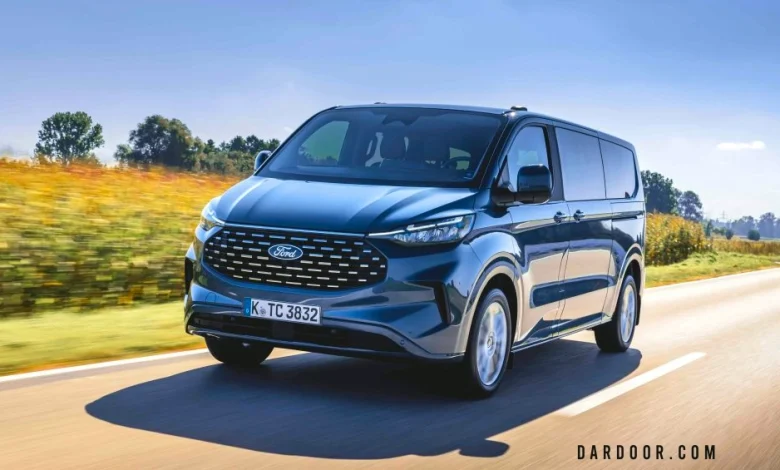
⚡ Power & Speed: How Strong Is the e-Tourneo Custom’s Punch?
🔋 Range Reality: How Far Can You Really Go on a Charge?
• Ranking: 297th out of 363 tested EVs (among 999 models).
Range factors:
- Speed: Higher speeds drain the battery faster.
- Temperature: Cold or very hot weather impacts efficiency.
- Terrain: Steep climbs shorten range.
- Driving style: Aggressive acceleration/braking consumes more energy.
- Features: Using climate control, heating, or infotainment lowers range.
👉 Actual mileage will vary, so it’s smart to plan charging stops in advance with tools like the EV Navigation Interactive Map.
⚡🔌 Charging Choices: What Are Your Options and How Fast Are They?
AC Charging (up to 11 kW):
-
- Using a home wallbox or public AC charger.
- Adds about 40 km of range per hour.
DC Fast Charging (up to 125 kW):
-
- Ideal for long trips.
- Can recharge from 10% to 80% in ~30 minutes (depending on conditions).
- Charging speed varies with battery temperature and state of charge.
💡 Use our EV Charging Calculator to estimate time, speed, and cost based on your charging setup.
📏 Size & Stance: How Big Is the Ford e-Tourneo Custom?
- Length: 5,050 mm •
- Width: 2,275 mm (with mirrors) / 2,032 mm (without mirrors)
- Height: 1,959 mm
- Wheelbase: 3,100 mm
- Curb weight: 2,589 kg
📦 Practicality Check: How Much Cargo Can It Swallow (and Is There a Frunk)?
- Rear trunk (all seats up): 672 L
- Max capacity (seats folded): 4,640 L
- Ranking: 43rd of 212 for trunk space, and an impressive 4th of 217 for max cargo capacity.
- Frunk (front trunk): ❌ Not available.
🚙 Towing Muscle: Can It Pull a Trailer and How Much Can It Handle?
- Braked towing capacity: Up to 2,000 kg
- Unbraked capacity: Lower (varies by market regulations)
- This makes it suitable for hauling mid-size trailers, caravans, or light utility loads.