
 450 km
 220 km/h
  3.5 Sec
  670 km/h
 Headline Snapshot
| Combined Efficiency | 201 Wh/km |
|---|---|
| Total System Power | 505 kW (687 PS) with Dynamic Plus |
| Total Torque | up to 1,000 Nm (boost) |
| 0–100 km/h | 3.5 s |
| Top Speed | 220 km/h |
| Drivetrain | AWD (dual motors) |
Price & Regional Availability
| Country/Region | Price |
|---|---|
| 🇬🇧 United Kingdom | £105,995 |
| 🇳🇱 Netherlands | €129,380 |
| 🇩🇪 Germany | €110,706 |
| 🇺🇸 United States | $96,600 |
| 🇨🇦 Canada | $121,500 |
| 🇲🇽 Mexico | $2,299,900 MXN |
| 🇨🇳 China | ¥862,000 CNY |
Prices shown are manufacturer’s recommended retail prices (MSRP) for the specified countries. They exclude indirect incentives and may vary by regional specifications and options. Values are subject to change without notice.
Real-World Range Estimates
| Condition | City | Highway | Combined |
|---|---|---|---|
| 🌤️ Mild Weather (23 °C, no A/C) | 635 km | 420 km | 515 km |
| 🌦️ Average Weather | — | — | 450 km |
| ❄️ Cold Weather (−10 °C, heating) | 440 km | 330 km | 385 km |
Indication of real-world range in several situations. Cold weather: “worst-case” based on −10 °C and use of heating. Mild weather: “best-case” based on 23 °C and no use of A/C. For “Highway” figures a constant speed of 110 km/h is assumed. The actual range will depend on speed, driving style, weather and route conditions.
Long Distance Suitability (1-Stop Range)
| First Stop Distance | 332 km | First Stop Duration | 3h 1min |
| Charging Stop | 0km | Charging Stop | 15 min |
| Second Stop Distance | 159 km | Second Stop Duration | 1h 27min |
| Total Distance | 491 km | Total Duration | 4h 43min |
| Weather | 1-Stop Range | Star Rating |
|---|---|---|
| 🌤️ Mild Weather | 558 km | ★★★☆☆ (Average = 491 km) |
| 🌦️ Average Weather | 491 km | |
| ❄️ Cold Weather | 438 km |


The “long distance suitability” is a 5-star rating indicating how suitable a vehicle is for long trips. It’s based on the 1-Stop Range: total distance with one 15-minute DC fast-charging stop.
2025 thresholds:
- 0★ <200 km;
- 1★ 200–325;
- 2★ 325–450;
- 3★ 450–575;
- 4★ 575–700;
- 5★ >700 km.
- Half-stars are assigned by linear interpolation.
Battery Details
| Nominal / Usable Capacity | 100.0 kWh / 90.6 kWh |
|---|---|
| Type / Cathode | Lithium-ion • NCM811 |
| Architecture / Nominal Voltage | 400 V • 328 V nominal |
| Cells / Pack Configuration | 360 • 90s4p |
| Form Factor | — |
| Warranty | 10 years / 250,000 km |
Charging Overview
| Category | Details |
|---|---|
| Home / Destination (AC) | Type 2 • Onboard 11 kW (optional 22 kW in some markets) |
| Fast Charging (DC) | CCS • peak 173 kW • ~141 kW avg (10→80%) • ~28 min |
| Plug & Charge | Supported (ISO 15118-2) |
| Autocharge | Supported |
| Battery Preconditioning | Possible; automatic when navigating to DC charger |
Home & Destination Charging (0→100%)
Charging is possible via regular wall plug or charging station. Public charging is always via a charging station. How fast the EV charges depends on the EVSE used and the vehicle’s onboard charger. Some countries mainly use 1-phase, others 3-phase connections.
Standard 11.0 kW On-Board Charger
| Charging Point | Max. Power | Power | Time | Rate |
|---|---|---|---|---|
| Wall Plug (230V 1×10A) | 2.3 kW | 2.3 | 46 h 30 m | 10 km/h |
| 1-Phase 16 A | 3.7 kW | 3.7 | 29 h | 16 km/h |
| 1-Phase 32 A | 7.4 kW | 7.4 | 14 h 30 m | 31 km/h |
| 3-Phase 16 A | 11 kW | 11 | 9 h 45 m | 46 km/h |
| 3-Phase 32 A | 22 kW | 11† | 9 h 45 m | 46 km/h |
Optional 22.0 kW On-Board Charger
| Charging Point | Max. Power | Power | Time | Rate |
|---|---|---|---|---|
| Wall Plug (230V 1×10A) | 2.3 kW | 2.3 | 46 h 30 m | 10 km/h |
| 1-Phase 16 A | 3.7 kW | 3.7 | 29 h | 16 km/h |
| 1-Phase 32 A | 7.4 kW | 7.4 | 14 h 30 m | 31 km/h |
| 3-Phase 16 A | 11 kW | 11 | 9 h 45 m | 46 km/h |
| 3-Phase 32 A | 22 kW | 22† | 5 h | 90 km/h |
† Limited by onboard charger capacity. “Optional” availability varies by market; check local specs.
Fast Charging (10→80%)
Connector: Combined Charging System (CCS Combo 2). Rapid charging enables longer trips by adding maximum range in minimal time. Charging power tapers above ~80% SoC, so rapid sessions typically target ~80%.
| Charging Point | Max. Power | Avg. Power | Time | Rate |
|---|---|---|---|---|
| CCS 50 kW | 50 | 50 | 80 m | 230 km/h |
| CCS 100 kW | 100 | 90† | 45 m | 420 km/h |
| CCS 150 kW | 150 | 125† | 32 m | 590 km/h |
| CCS 175 kW | 173† | 141† | 28 m | 670 km/h |
| CCS 350 kW | 173† | 141† | 28 m | 670 km/h |
† Limited by vehicle charging capability. Autocharge enables automatic session start at supported CCS stations. Plug & Charge enables ISO 15118-compliant automatic session start. Real-world rates vary with temperature, battery state, and usage.
Claimed Charging Specs (Manufacturer)
Definitions: Max. Power = peak charge power during session; Charge From/To = session SoC window; Time = 10→80% duration; Rate = average speed over window.
| Max. Power | Charge From | Charge To | Time |
|---|---|---|---|
| 170 kW | 10% | 80% | 32 min |
Performance & Drivetrain
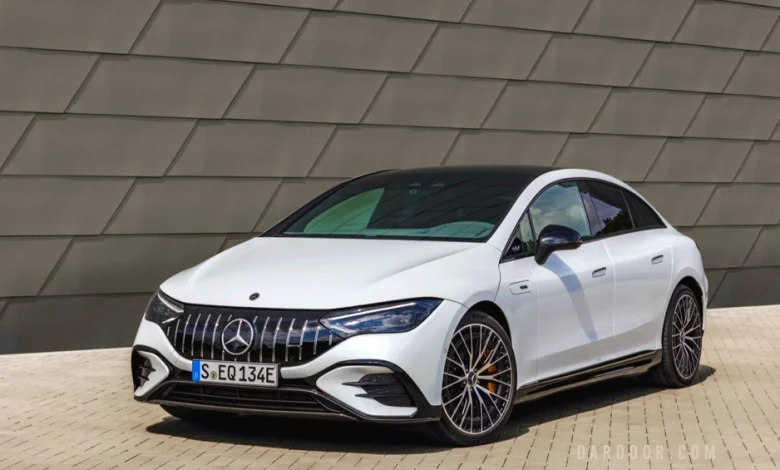
| Total Power | up to 505 kW (boost) |
|---|---|
| Total Torque | up to 1,000 Nm (boost) |
| 0–100 km/h | 3.5 s |
| Top Speed | 220 km/h |
| Drive | AWD (4MATIC+) |
Energy Consumption & Efficiency
| Basis | Range | Rated (Wh/km) | Vehicle (Wh/km) | Fuel-eq |
|---|---|---|---|---|
| EVDB Real | 450 km | — | 201 | 2.3 L/100 km eq |
| WLTP (TEL) | 502 km | 207 | 180 | 2.3 / 2.0 |
| WLTP (TEH) | 435 km | 247 | 208 | 2.8 / 2.3 |
TEL = Test Energy Low | TEH = Test Energy High. Rated = official figures incl. charging losses. Vehicle = calculated battery energy used by propulsion and onboard systems.
Real Energy Consumption Estimation
| Scenario | City | Highway | Combined |
|---|---|---|---|
| Cold Weather | 206 Wh/km | 275 | 235 |
| Mild Weather | 143 Wh/km | 216 | 176 |
Indication of real-world energy use in several situations. Cold: −10 °C with heating. Mild: 23 °C without A/C. Highway assumes 110 km/h. Energy use depends on speed, driving style, climate and route.
Safety Rating
| Region | Rating | Details |
|---|---|---|
| Europe (Euro NCAP) | — | Adult 95% • Child 91% • VRU 83% • Assist 81% (2022, EQE) |
| North America | — | NHTSA / IIHS not listed |
| South America | — | Latin NCAP not listed |
Ratings can vary by model year and configuration.
Dimensions & Weight
| L×W×H | 4964 × 1906 × 1495 mm |
|---|---|
| Wheelbase | 3120 mm |
| Weight (EU) | 2540 kg |
| GVWR / Payload | 3095 kg / 630 kg |
| Cargo (rear / max / frunk) | 430 L / 895 L / 0 L |
| Roof Load | 100 kg |
| Towing (braked / unbraked) | 1700 kg / 750 kg |
| Turning Circle | 11.8 m |
| Platform | DAIMLER EVA2 • EV-dedicated |
| Body / Segment | Sedan • E – Executive • No roof rails |
| Heat Pump | Yes (standard) |
Bidirectional Charging (V2X / BPT)
| Capability | Status | Meaning |
|---|---|---|
| V2L | No | Power external devices/appliances |
| V2H | No | Home backup / energy arbitrage |
| V2G | No | Export energy to grid |
| BPT | No | Umbrella term for bidirectional power transfer |
Miscellaneous
| Seats | 5 Seats |
|---|---|
| Isofix | No Data |
| Car Body | Sedan |
| Segment | E-Executive |
| Turning Radius | 11.8 |
| Platform | DAIMLER EVA2 |
| ED Dedicated Platform | Yes |
| Heat Pump | Yes |
* Estimated values where marked. Average energy consumption and range assume moderate driving and climate. Real-life values may differ significantly. Pricing information might not be current in some regions. No rights can be derived from this information.
Predecessor Comparison
| Metric | EQE AMG 53 (MY24) | EQE AMG 53 (MY25) | Δ |
|---|---|---|---|
| Real Range (combined) | 450 km | 450 km | = |
| 0–100 km/h | 3.5 s | 3.5 s | = |
| Vehicle Consumption | ~201 Wh/km | 201 Wh/km | = |
MY25 succeeds MY24 (on sale April 2024–June 2025) with broadly similar performance and efficiency.
1-Stop Range Definition 🔋
For vehicles without fast-charging capability, only the distance of the first stop is considered.
🚗 Driving Profile
- Begin with a fully charged battery
- Stop 1: Drive until the battery reaches 10% state-of-charge (SoC)
- Perform a 15-minute fast charge
- Stop 2: Continue driving until the battery again reaches 10% SoC
📋 Assumptions
- Driving speed, climate, and environmental conditions are based on Real Range Highway data
- No additional time required to initiate or stop the charging session
- The charging station always delivers the maximum power requested by the vehicle
- The battery is assumed to be in optimal health and condition
⚠️ Important Note : In real-world driving, it is practically impossible to replicate these conditions exactly.
This benchmark should therefore be viewed as a comparative metric, designed to evaluate vehicles under standardized conditions rather than predict exact trip distances.
5-Star Rating Definition ★
Assignment of Stars in 2025
- ☆ 0 less than 200 km
- ★ from 200 km to 325 km
- ★★ from 325 km to 450 km
- ★★★ from 450 km to 575 km
- ★★★★ from 575 km to 700 km
- ★★★★★ more than 700 km
Based on 2025 thresholds: 3 stars awarded for 490 km average. Half-stars interpolated. Vehicles with a rating between these values receive a rating based on a linear scale.
Fast Charging (10 -> 80%) ⚡
- Max. Power: maximum power provided by charge point
- Avg. Power: average power provided by charge point over a session from 10% to 80%
- Time: time needed to charge from 10% to 80% Rate: average charging speed over a session from 10% to 80%