CUPRA Born 170 kW – 79 kWh ★★★½☆
The Sporty Spanish EV Built in Germany - Available since June 2025
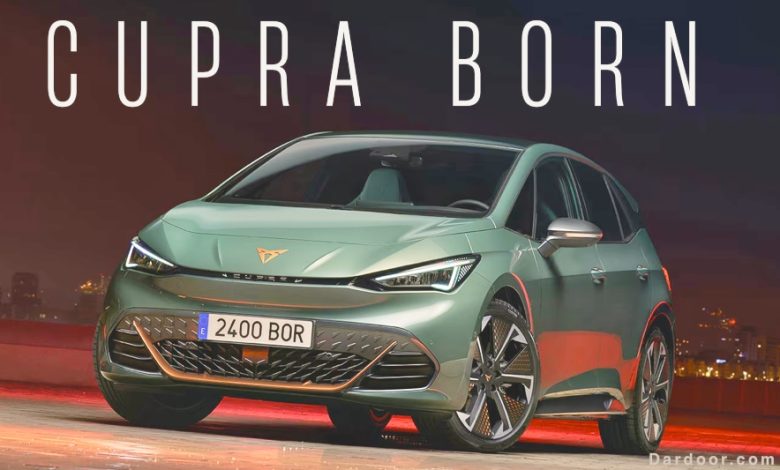
CUPRA Born 170 kW – 79 kWh (2025)
The CUPRA Born, designed in Barcelona and built on Volkswagen’s MEB platform, delivers 170 kW of electric power with a 79 kWh usable battery, offering up to 559 km WLTP range (347 miles) and fast DC charging—10-80% in under 28 minutes. As CUPRA’s first fully electric model, the Born is produced at Volkswagen’s Zwickau plant in Germany, where series manufacturing began in September 2021. This compact EV—combining sporty styling, rear-wheel drive dynamics, and a 5-star Euro NCAP safety rating—underscores CUPRA’s performance-led electrification strategy.”
Key Specifications
- Battery Size: 79 kWh (net usable capacity)
- Range: Up to 372 miles (WLTP) on the Born VZ model
- Charging Speed (DC): Up to 185 kW ultra-rapid DC charging
- Charging Time (DC): Approximately 26 minutes for 10-80% charge
- Charging Speed (AC): Up to 11 kW
- Platform: Based on the Volkswagen Group MEB platform
- The 79 kWh battery is a premium option primarily found in the higher-performance CUPRA Born VZ model, which sits above the standard CUPRA Born.
- It offers improved range and charging speed compared to the model with the smaller battery.
| Combined Efficiency | 168 Wh/km |
|---|---|
| Total System Power | 170 kW (231 PS) |
| Total Torque | 310 Nm |
| 0–100 km/h | 7.1 s |
| Top Speed | 160 km/h |
| Drive | Rear-wheel drive |
Price & Regional Availability
| Country/Region | MSRP | Order/On-Sale | Status / Notes |
|---|---|---|---|
| United Kingdom | £35,495 | Since Jul 2025 | Available to order |
| The Netherlands | €41,990 | Since Jun 2025 | Available to order |
| Germany | €47,350 | Since Jul 2025 | Available to order |
| North America | — | TBD | Model availability/pricing not listed |
| South America | — | TBD | Not listed |
Prices shown are recommended retail prices for the specified countries and do not include indirect incentives. Pricing and included options can differ by region. Dates shown are order dates.
Real-World Range Estimates
| Condition | City | Highway (110 km/h) | Combined |
|---|---|---|---|
| Mild Weather (23 °C, no A/C) | 690 km | 435 km | 540 km |
| Combined | — | — | 470 km |
| Cold Weather (−10 °C, heating) | 455 km | 335 km | 395 km |
Indication of real-world range in several situations. Cold weather: worst-case (−10 °C with heating). Mild weather: best-case (23 °C without A/C). Highway assumes 110 km/h. Actual range depends on speed, driving style, weather and route conditions.
Long Distance Suitability (1-Stop Range)
| Weather | 1-Stop Range |
|---|---|
| Mild | 604 km |
| Average | 526 km → ★★★½ |
| Cold | 466 km |
The 5-star “long distance suitability” rating is based on the 1-Stop Range: total distance with one 15-minute DC charge. 2025 thresholds: 0★ <200 km; 1★ 200–325; 2★ 325–450; 3★ 450–575; 4★ 575–700; 5★ >700 km. Half-stars interpolate between thresholds.
Battery Details
| Nominal / Usable Capacity | 84.0 kWh / 79.0 kWh |
|---|---|
| Battery Type / Cathode | Lithium-ion • NCM |
| Architecture / Nominal Voltage | 400 V • 352 V nominal |
| Number of Cells / Pack Config | 288 cells • 96s3p |
| Form Factor / Name | No data / — |
| Thermal Management | Active cooling & heating; preconditioning supported |
| Warranty | 8 years / 160,000 km |
Battery specs per EV-Database.
Charging Overview
| Category | Details |
|---|---|
| Home / Destination (AC) | Type 2 (right-rear); onboard charger 11 kW AC. 0→100% ≈ 8 h 30 m via 11 kW; ≈ 55–56 km/h. |
| Fast DC (CCS) | CCS (right-rear); peak 185 kW; avg. ~135 kW (10→80%). 10→80% ≈ 26 min; up to ~750 km/h session rate. |
| Plug & Charge | Supported (ISO 15118-2). Autocharge: not supported. |
| Battery Preconditioning | Supported; automatic when navigating to a DC fast charger. |
Actual AC/DC speeds depend on grid connection, site load, ambient temperature, cable rating, and state of charge.
Home & Destination Charging (0 → 100%)
Charging is possible by using a regular wall plug or a charging station. Public charging is always done through a charging station. How fast the EV can charge depends on the charging station (EVSE) used and the maximum charging capacity of the EV. The table below shows all possible options for charging the CUPRA Born 170 kW – 79 kWh. Some modes might not be widely available in certain countries (1-phase vs 3-phase differences).
| Europe — Type 2 (Mennekes IEC 62196) | ||||
|---|---|---|---|---|
| Charging Point | Max. Power | Power | Time (0→100%) | Rate |
| Wall Plug (230 V / 1×10 A) | 2.3 kW | 2.3 kW | 40 h 30 m | 12 km/h |
| 1-Phase 16 A (230 V) | 3.7 kW | 3.7 kW | 25 h 15 m | 19 km/h |
| 1-Phase 32 A (230 V) | 7.4 kW | 7.4 kW | 12 h 45 m | 37 km/h |
| 3-Phase 16 A (400 V) | 11 kW | 11 kW | 8 h 30 m | 55 km/h |
| 3-Phase 32 A (400 V) | 22 kW | 11 kW † | 8 h 30 m | 55 km/h |
† limited by onboard charger.
Fast Charging (10 → 80%)
Connector: Combined Charging System (CCS Combo 2). Rapid DC charging enables longer trips by adding as much range as possible in the shortest time. Power tapers significantly beyond ~80% SoC; rapid sessions typically end at or before 80%.
| Charging Point | Max. Power | Average Power | Time (10→80%) | Rate |
|---|---|---|---|---|
| CCS 50 kW | 50 kW | 50 kW | 70 min | 280 km/h |
| CCS 100 kW | 100 kW | 90 kW † | 39 min | 500 km/h |
| CCS 150 kW | 150 kW | 115 kW † | 30 min | 650 km/h |
| CCS 175 kW | 175 kW | 130 kW † | 27 min | 730 km/h |
| CCS 350 kW | 185 kW † | 135 kW † | 26 min | 750 km/h |
† Limited by vehicle charging capabilities. Autocharge: not supported. Plug & Charge: supported (ISO 15118). Actual rates vary with temperature, battery state, site load, and driving style.
Claimed Charging Specs (Manufacturer)
Definitions:
- Max. Power = peak charge power;
- Avg. Power = 10→80% average;
- Time = 10→80% session time;
- Rate = average charging speed over 10→80%.
| Max. Power | Charge From | Charge To | Time |
|---|---|---|---|
| 185 kW | 5 % | 80 % | 26 min |
Manufacturer-claimed DC data as listed by EV-Database for this variant.
Performance & Drivetrain
| Total Power / Torque | 170 kW (231 PS) • 310 Nm |
|---|---|
| 0–100 km/h | 7.1 s |
| Top Speed | 160 km/h |
| Drive | RWD (rear motor) |
Performance metrics per EV-Database.
Energy Consumption & Efficiency
| Standard / Basis | Range | Rated Consumption | Vehicle Consumption | Fuel-eq. |
|---|---|---|---|---|
| Real Range | 470 km | — | 168 Wh/km | 1.9 L/100 km (veh.) |
| WLTP (TEL) | 559 km | 159 Wh/km | 141 Wh/km | 1.8 / 1.6 L/100 km |
| WLTP (TEH) | 479 km | 178 Wh/km | 165 Wh/km | 2.0 / 1.9 L/100 km |
TEL = Test Energy Low | TEH = Test Energy High. Rated = official figures incl. charging losses. Vehicle = calculated battery energy used for propulsion and on-board systems.
Real Energy Consumption Estimation
| Scenario | City | Highway | Combined |
|---|---|---|---|
| Cold Weather | 174 Wh/km | 236 Wh/km | 200 Wh/km |
| Mild Weather | 114 Wh/km | 182 Wh/km | 146 Wh/km |
Indication of real-world energy use in several situations. Cold weather: worst-case (−10 °C with heating). Mild weather: best-case (23 °C without A/C). Highway assumes 110 km/h. Energy use depends on speed, style, climate and route conditions.
Safety Rating
| Region | Rating | Details |
|---|---|---|
| Europe (Euro NCAP) | — (category scores) | Adult 93% • Child 89% • VRU 73% • Assist 80% (test year 2022) |
| North America | — | NHTSA / IIHS not listed on for this specific spec |
| South America | — | Not listed |
Regional safety ratings vary by year and configuration. Refer to Euro NCAP, NHTSA, IIHS, or Latin NCAP for official local results.
Dimensions & Weight
| L × W × H | 4322 × 1809 × 1540 mm (width with mirrors 2070 mm) |
|---|---|
| Wheelbase | 2766 mm |
| Weight Unladen (EU) / GVWR / Payload | 1977 kg / 2420 kg / 518 kg |
| Cargo Volume (seats up / max / frunk) | 385 L / 1267 L / 0 L |
| Roof Load | 0 kg |
| Tow Hitch | Not supported |
| Towing Weight (unbraked/braked) | 0 / 0 kg • Vertical load 0 kg |
| Turning Circle | 10.2 m |
| Platform | VW MEB • EV-dedicated |
| Body / Segment / Roof Rails | Hatchback • C – Medium • No |
| Heat Pump | Optional |
Dimensions & weight per EV-Database.
Bidirectional Charging (V2X)
| Capability | Status | Meaning |
|---|---|---|
| V2L (Vehicle-to-Load) | Not supported | Power external devices directly from the car |
| V2H (Vehicle-to-Home) | Not supported | Back-up or whole-home power |
| V2G (Vehicle-to-Grid) | Not supported | Export to grid for services like peak-shaving |
| BPT (Battery Power Transfer) | Not supported | Umbrella term for bidirectional features |
V2X capabilities per EV-Database V2X/BPT section for this model.
Miscellaneous
| Seats / ISOFIX | 5 seats • ISOFIX ×3 |
|---|---|
| Platform | VW MEB (EV-dedicated) |
| Segment | C – Medium |
* = estimated where indicated by source. Average energy consumption and range assume moderate climate and driving. Real-life values may differ significantly. Pricing info might not reflect all regions. No rights can be derived from the information on this site.
Preceding Model
| Metric | Born 170 kW – 77 kWh (prev.) | Born 170 kW – 79 kWh (current) | Δ (New − Prev) |
|---|---|---|---|
| Real Range (Combined) | ≈ 460 km | 470 km | +10 km |
| 0–100 km/h | 7.1 s | 7.1 s | — |
| Efficiency (Vehicle) | ≈ similar | 168 Wh/km | ≈ same |
This model succeeds the CUPRA Born 170 kW – 77 kWh (order window Jun 2024–Jul 2025); previous model had ~10 km less range, same acceleration, and similar energy consumption.
1-Stop Range Definition ⚡
For vehicles without fast-charging capability, only the distance of the first stop is considered.
🚗 Driving Profile
- Begin with a fully charged battery
- Stop 1: Drive until the battery reaches 10% state-of-charge (SoC)
- Perform a 15-minute fast charge
- Stop 2: Continue driving until the battery again reaches 10% SoC
📋 Assumptions
- Driving speed, climate, and environmental conditions are based on Real Range Highway data
- No additional time required to initiate or stop the charging session
- The charging station always delivers the maximum power requested by the vehicle
- The battery is assumed to be in optimal health and condition
⚠️ Important Note : In real-world driving, it is practically impossible to replicate these conditions exactly.
This benchmark should therefore be viewed as a comparative metric, designed to evaluate vehicles under standardized conditions rather than predict exact trip distances.
5-Star Rating Definition
Assignment of Stars in 2025
- ☆ 0 less than 200 km
- ★ from 200 km to 325 km
- ★★ from 325 km to 450 km
- ★★★ from 450 km to 575 km
- ★★★★ from 575 km to 700 km
- ★★★★★ more than 700 km
Based on 2025 thresholds: 3 stars awarded for 490 km average. Half-stars interpolated. Vehicles with a rating between these values receive a rating based on a linear scale.
Fast Charging (10 -> 80%)
- Max. Power: maximum power provided by charge point
- Avg. Power: average power provided by charge point over a session from 10% to 80%
- Time: time needed to charge from 10% to 80% Rate: average charging speed over a session from 10% to 80%
© 2025 Dardoor.com • Data for guidance only.