Electric Powertrain Cooling & Thermal Management in EVs — Complete 2025 Technician Guide
BTMS, CTMS, TIMs, adaptive multi-loop cooling, advanced exchangers, AI-driven motor cooling, diagnostics, repairs and preventive maintenance.

1. Overview — Why thermal management matters
Electric vehicles pack energy-dense batteries, power-dense inverters and motors into compact volumes. Each of those subsystems has a narrow temperature band where efficiency, performance and life are optimized. Exceed those bands and you face reduced range, accelerated capacity fade, greater degradation of power electronics, noisy drivetrains, and increased risk of hazardous events such as thermal runaway.
Three essential goals of EV thermal management: (1) keep batteries in their optimal temperature window, (2) keep power electronics and motors within safe junction temperatures, and (3) minimize thermal gradients across cells and components to ensure balanced aging and safe behavior under charge/discharge cycles.
This guide combines high-level architecture discussion with practical diagnostics and repair steps you can follow in the shop. It assumes technicians have standard EV HV training and access to OEM diagnostic tools when needed.
2. Battery Thermal Management Architectures
BTMS design choices trade cost, complexity and performance. Below are the architectures you’ll encounter and the service implications for each.
Air cooling (passive & forced)
Simple and low-cost; limited heat removal and uniformity. Expect fan failures, duct blockage and dust accumulation. Air-cooled packs often have larger safety margins, but are less suitable for high-power fast-charging duty.
Indirect liquid cooling (cold plates)
Currently mainstream for mid- to high-performance and fast-charge-capable EVs. Liquid flows through cold plates or channels under modules — offering high heat transfer and better temperature uniformity. Key service issues: leak detection, coolant contamination and micro-channel clogging in brazed plates.
Immersion cooling
Cells immersed in dielectric fluids provide excellent thermal uniformity. Service implications are different: handle dielectric fluids, ensure seals prevent cross-contamination, and adopt decontamination steps before module access. Immersion reduces the need for aggressive cold plates but raises handling requirements for technicians.
Phase-Change Materials (PCM) & hybrid strategies
PCMs smooth short-term heat spikes and pair well with liquid cooling for peak shaving. They add mass and complexity and must be integrated so they can resolidify between events.
Design guidance for shops
- Know the pack architecture before opening: air, plate-cooled, immersion or hybrid — each has different bleed, leak and servicing sequences.
- Always follow OEM torque and sealing sequences — cold-plate fasteners often carry sealing and electrical isolation responsibilities.
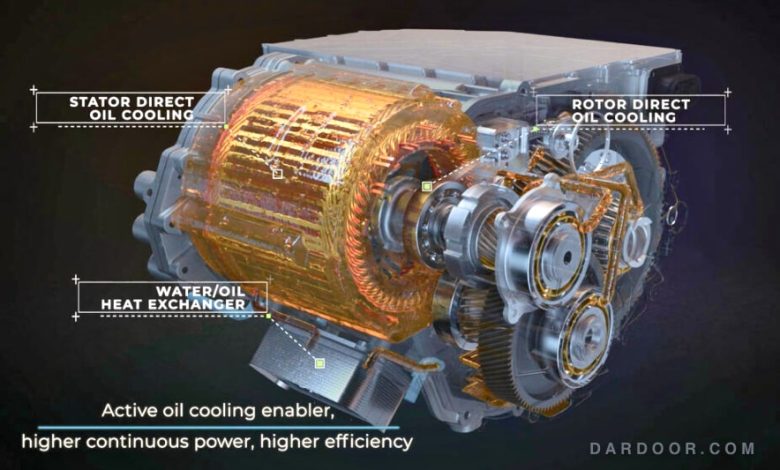
3. Inverter & Motor Cooling Strategies
Power electronics and motors are often cooled on separate loops to avoid unwanted thermal cross-talk and to enable different target temperatures. Typical strategies include:
Dedicated liquid loop for electronics
Inverters and chargers often run on a loop optimized for lower coolant temperatures to protect semiconductor junctions. Service attention: chiller / A/C refrigerant coupling, valve sequencing and thermal interface integrity for power modules.
Motor cooling approaches
Motors use jacket cooling, through-bore cooling, or oil-cooled gear housings. Motors seen in performance EVs may use combined oil + water strategies. Service items: inspect seals, rotor end-cap seals, and oil cooler integrity where oil is used.
Thermal interfaces & hotspot mitigation
Hotspots on inverter dies or motor winding ends require good TIMs, heavy-duty thermal pads/gap fillers and secure fastening that preserves contact under vibration and thermal cycling.
4. Intelligent Heat Management & Thermal Interface Materials (TIM)
Intelligent heat management — what it is
Intelligent heat management combines real-time sensing, supervisory control and adaptive actuation to actively shape heat flow — opening valves, changing pump speeds, engaging chillers or modulating heat-pump behavior based on predicted duty and sensor data. The result: lower energy usage, reduced thermal gradients and improved fast-charge capability while protecting components.
Thermal Interface Materials (TIM) — why they matter
Any two mating solid surfaces (e.g., copper winding end-turns and aluminum housing, or inverter die to cold plate) have microscopic asperities. Those gaps trap air, a poor conductor. TIMs (greases, pads, phase-change materials, graphite sheets) displace air and create a continuous thermal path by using materials with much higher thermal conductivity than air. In practice:
- TIMs lower contact thermal resistance and reduce local junction temperatures.
- They improve transient heat spreading from hotspots to the coolant path.
- Proper TIM selection and correct application during reassembly is a small shop step with large impact — always replace TIMs per OEM instructions after disassembly.
Service notes on TIMs
- Use OEM-specified TIM types (pad, grease, phase-change). Do not substitute random greases — chemical compatibility and compressibility matter.
- Ensure mating surfaces are clean and flat. Replace TIM and apply consistent pressure per OEM torque specs.
- Record TIM brand/lot for traceability; some TIMs age or absorb moisture over time and need periodic inspection in demanding duty cycles.
5. Chassis-mounted Complete Thermal Management System (CTMS)
CTMS modules consolidate pumps, valves, heat exchangers and some heat-pump parts into a single chassis-mounted assembly. CTMS reduces distributed plumbing complexity and centralizes service points, which simplifies some diagnoses but creates single-point modules that, if they fail, may require swapping an entire assembly.
CTMS advantages
- Packaged modules reduce leak-prone hose runs and shorten coolant paths.
- Service swaps can replace a failed sub-system quickly if modular replacements are available.
- CTMS often has integrated diagnostics and standardized connectors that help quicker fault isolation.
Shop implications
Technicians must be familiar with CTMS pinouts, valve maps and service plugs. Refrigerant and coolant interfaces in CTMS units require coordination between HVAC-certified technicians (for refrigerant loops) and EV-certified technicians (for coolant loops and HV isolation).
6. Holistic Multi-Loop Adaptive Cooling — dedicated loops & dynamic control
Best-practice modern EV thermal management uses dedicated loops for battery, motor and power electronics combined under a supervisory controller. The multi-loop approach avoids “thermal theft” (one hot subsystem causing others to warm) and allows each loop to run at the most efficient temperature range.
Features of adaptive multi-loop systems
- Variable-speed pumps and proportional valves tune flow to demand.
- Thermal zoning and module-level flow control reduce delta-T across the pack.
- Predictive preconditioning uses navigation/charging schedules to prepare the pack for optimal charging temperature.
- Supervisory control gracefully de-rates charging or traction power if a loop fails while preserving safety and allowing limp-home capability.
After any hardware replacement technicians must use OEM diagnostics to force valves and flow sequences — otherwise the system may remain in a conservative state and reduce charge or power until recalibrated.
7. Advanced Heat Exchangers & Hybrid Air-Liquid Systems
Advanced exchangers combine microchannels, stacked plates and fin arrays in multi-layer designs that achieve high heat flux removal with compact packaging. Hybrid air-liquid systems use a liquid loop for high-flux subsystems and air for lower-flux rejection to the environment — reducing refrigerant charge and radiator size while maximizing thermal performance.
Common service tasks
- Inspect fins and microchannel surfaces for debris; blocked channels dramatically reduce capacity.
- Leak testing with pressure or vacuum tests using OEM-specified methods — microchannel brazed plates can be repaired only with OEM guidance.
- Fan & shroud checks — airflow must meet design specifications to support radiator performance.
8. AI & Generative Design for Motor Cooling and Fluid Channels
AI and generative design shift motor and cooling design from human intuition to multi-physics, data-driven optimization. Two major impacts:
Optimized fluid channels
AI-driven topology optimization coupled with CFD produces fluid-channel geometries that balance flow distribution, minimize pressure drop, and maximize convective heat transfer. These channels can be manufactured with additive methods or advanced casting and outperform traditional serpentine designs in uniformity and efficiency.
Multi-physics co-design
Generative tools simultaneously optimize electromagnetic performance, structural rigidity, NVH and thermal behavior. This yields motor housings and cold plates that minimize hotspots without sacrificing magnetic efficiency. Predictive ML models can further enable anticipatory cooling strategies, adapting flows ahead of expected thermal events based on driver behavior, route, and charger availability.
Implications for technicians
- AI-designed parts may use unconventional channels and fittings; follow OEM service bulletins for handling and replacement.
- Validating sensor data and ensuring correct firmware versions become critical because predictive strategies rely on correct inputs.
- Replacement parts may be geometry-optimized for additive manufacture — ensure correct part number and serial tracking for warranty/traceability.
9. Key Components: pumps, valves, chillers, heat exchangers & sensors
Component-level knowledge makes diagnosis efficient. Here are typical failure modes and inspection points:
Pumps
Check electrical current draw (bearing wear), cavitation noise (airlocks), and mechanical seizure. Verify rated flow vs actual with inline flow meters.
Valves & manifolds
Motorized valves may stick or lose position feedback. Confirm commanded vs actual position via OEM diagnostics and check for hysteresis in valve response.
Chillers and heat exchangers
Leaks, compressor faults, or low refrigerant reduce chiller capacity — coordinate HVAC testing with refrigerant-certified technicians.
Sensors
Thermistors, pressure transducers, flow sensors and level switches must be validated. Replace failing sensors and re-calibrate per OEM procedures when required.
10. Diagnostics & Instrumentation (on-vehicle tests)
Effective diagnosis combines CAN-level data with thermal and hydraulic measurements.
Initial steps
- Scan for DTCs on BMS, TCU, HVAC and CTMS modules and log freeze-frame data.
- Visual inspection: look for corrosion, coolant residue, loose clamps and damaged hoses.
- Verify HV isolation and safety interlocks before opening pack-level panels.
Thermal & flow checks
- Use IR thermal cameras for fast hotspot mapping during charge/discharge.
- Measure flow with inline meters and pump current to detect cavitation or blockage.
- Use OEM actuations to open/close valves and isolate loops while observing the thermal response.
Document baseline thermal maps and repeat after repair for validation and warranty records.
11. Common Faults & Failure Modes
Common problems you’ll encounter and how they present:
Coolant leaks
Symptoms: loss of level, airlocks, erratic flow, overheating. Use pressure tests and UV dye if compatible with coolant to locate leaks.
Pump failure
Symptoms: low flow, whining noise, high current. Confirm electrical supply voltage before replacing pumps.
Valve sticking
Symptoms: high delta-T between pack sections, unexpected derating. Diagnose with commanded actuations and position-feedback checks.
Sensor drift
Symptoms: BMS reports incorrect temperature, preconditioning fails. Cross-check with calibrated thermocouples or IR probes.
12. Safe Service Procedures & High-Voltage Precautions
Follow strict HV safety rules:
- Complete HV training and use certified PPE (insulated gloves, face shields) as required.
- Perform OEM HV isolation (service plug removal, capacitor discharge time). Verify
0 Vwith an HV-rated meter before working on any pack components. - Contain spills and follow correct disposal for glycol and dielectric fluids. Use a Class B fire extinguisher where flammable fluids are present (note: many dielectric fluids are non-flammable but still require careful handling).
- Record serials for replaced modules and TIM batches for warranty traceability.
13. Preventive Maintenance & Recommended Intervals
Adopt a schedule appropriate to the duty cycle:
| Interval | Action | Notes |
|---|---|---|
| Every 10k–20k km | Visual coolant loop check, reservoir level | Look for seepage, hose swelling, loose clamps |
| Every 30k–60k km / 12 months | Coolant change & filter/strainer check | Use OEM-specified coolant; sample old fluid for analysis |
| Annually | Pump current draw and flow test | Detect bearing wear early |
| 2–4 years | Chiller/HVAC refrigerant service & leak check | Handled by HVAC-certified tech |
| As needed | TIM re-application after module disassembly | Replace TIMs per OEM guidance |
Pro tip: Log thermal maps and pump/valve performance metrics in the vehicle history — trend analysis reveals slow degradation long before failures occur.
14. Repair Workflows & Shop Best Practices
Common workflow: low-flow battery loop
- Scan and capture DTCs; perform IR thermal imaging during a load test.
- Command actuations to isolate loop and verify pump behavior (voltage, current).
- Inspect strainers/filters, clear debris, and flush with recommended coolant.
- Perform OEM bleed/priming sequence and re-run thermal mapping to validate repair.
Replacing a coolant pump
- HV isolation and safety verification.
- Drain loop with containment and replace pump + seals/O-rings.
- Vacuum-fill or OEM bleed procedure; actuate valves to purge air pockets.
- Thermal validation and record serials/firmware versions.
Always use OEM actuations and record before/after data for warranty or fleet reporting.
15. Coolants, Contamination & Materials Compatibility
Use only OEM-specified glycol-based coolants and never mix incompatible chemistries. Contaminants (oil, dielectric fluid, particulates) reduce heat transfer and corrode microchannels. Periodic lab tests (pH, conductivity, inhibitor levels) are recommended in demanding duty cycles.
For immersion systems, use OEM-approved dielectric fluids — do not substitute fluids without supplier approval.
16. Case Studies & Troubleshooting Examples
Case 1 — Fast-charge derate at 60% SOC
Symptom: sudden charge power reduction during rapid DC charging. Diagnosis: IR sweep showed a local module ~6–8°C hotter than neighbors; valve actuation test revealed a stuck manifold valve. Fix: replace valve actuator and clean manifold strainer; re-test fast-charge — derating cleared.
Case 2 — Low flow after cold-plate replacement
Symptom: pump running but low measured flow and elevated pack temps. Diagnosis: omitted OEM bleed sequence left air trapped. Corrective action: perform pump-assisted bleed with diagnostic tool, verify flow and thermal uniformity — resolved.
17. Essential Tools & Test Equipment
- OEM-capable scan tool with CTMS/BMS actuations
- Infrared thermal camera and calibrated thermocouples
- Inline flow meters & pump current clamps
- Coolant vacuum-fill/exchange equipment with contamination filters
- HV insulated tools, HV interlock tester and compliant PPE
- Refrigerant service tools and HVAC-certified partner access
18. End-of-Life & Recycling
Dispose of spent glycol, dielectric fluids and contaminated filters properly. Record coolant batch numbers and provide chain-of-custody documentation when scrapping packs. Engage OEM recycling programs when available.
19. Dardoor & Further Reading
For model-specific diagrams, torque specs and procedures consult Dardoor repair guides and OEM service manuals. Example topics on Dardoor that map to this guide:
- Mastering EV Battery Thermal Management — Inspection & Repair
- EV High-Voltage Systems — Diagnosis & Preventive Maintenance
- CTMS — Chassis Thermal Management Systems
- TIM Selection & Application Guide
- AI & Generative Design for Thermal Systems