Automotive Workshop Safety Guidelines
A technician-grade checklist to prevent injuries, fires, explosions, and costly repeat repairs.
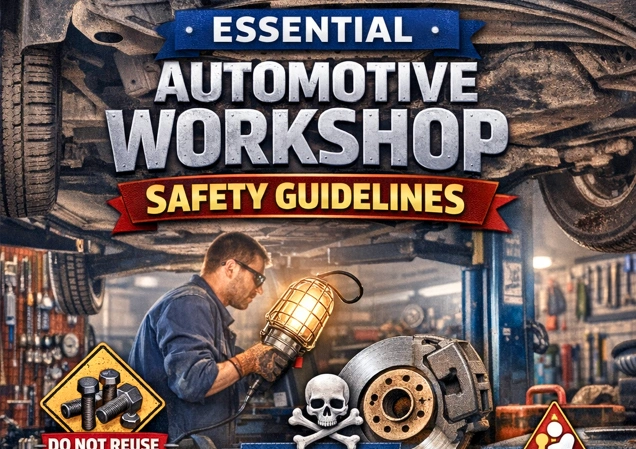
🔩 Fasteners & One-Time Hardware
Rule: Don’t re-use worn, stretched, deformed, corroded, or damaged fasteners. Many are engineered for single-use and may fail if reused.
Common one-time or “replace if removed” items can include (not limited to) nuts, bolts, washers, circlips, and cotter pins. Always follow the service manual. Replace when indicated—or anytime inspection suggests loss of clamp force, thread damage, or visible deformation.
- Why it fails: Some fasteners are torque-to-yield and permanently stretch; reusing them reduces clamping force and can loosen or snap.
- Best practice: Bag and label removed hardware by location. If the manual says “always replace,” treat it as non-negotiable.
💡 Lighting & Fire-Safe Workspaces
Rule: Illuminate the work area adequately—without adding ignition risk.
- Use a portable safety light when working inside or under a vehicle.
- Ensure the bulb is enclosed by a wire cage or shatter-resistant housing.
Why it matters: A broken bulb can expose a hot filament that may ignite spilled fuel or oil vapors. Good lighting also reduces cuts, mis-routed wiring, cross-threading, and missed torque steps.
🫁 Brake/Clutch Dust & Respiratory Safety
Friction materials (brake pads, clutch discs) may contain hazardous fibers, including asbestos in some legacy parts. Do not create dust by grinding, sanding, or cleaning with compressed air.
- Avoid: Compressed air blow-off, dry brushing, aggressive sanding.
- Do instead: Use appropriate brake cleaning methods and containment practices per local safety rules.
Health note: Inhaling hazardous dust can cause serious respiratory disease. Treat unknown dust as harmful and minimize airborne particles.
💍 Personal Safety: Jewelry, Clothing, Hands
Remove finger rings and jewelry before starting. Jewelry can cause electrical shorts, snag rotating tools, or crush fingers under heavy parts.
- Hands: Keep fingers away from pinch points while lowering vehicles, aligning subframes, or seating transmissions.
- Clothing: Avoid loose sleeves near belts, pulleys, fans, and rotating shafts.
🧰 Preparation: Tools, Parts, Procedures
Before starting a job, confirm you have the correct tools, consumables, and replacement parts. Read instructions fully and don’t take shortcuts.
- Use the right tool: Correct sockets (6-point where needed), line wrenches on brake fittings, proper pullers, and approved lifting points.
- Use correct parts: Only replacement parts meeting manufacturer specifications—especially for brakes, steering, suspension, and safety systems.
- Quality mindset: Makeshift procedures often “work once” and fail later, causing comebacks or hazards on the road.
🛢️ Fluids: Catch, Store, Clean, Dispose
Catch draining fuel, oil, coolant, or brake fluid in suitable containers. Never use empty food or beverage containers.
- Storage: Keep flammable fluids away from ignition sources and heat.
- Spills: Wipe up immediately.
- Rags: Don’t store oily rags in piles—some can self-heat and ignite. Use approved containers and disposal practices.
🔧 Power Tools & Torque Control
Use pneumatic and electric tools only to loosen threaded parts and fasteners. Never use them to tighten fasteners—especially in aluminum or light alloy components.
- Always finish with: A torque wrench set to the specification listed in the manual.
- Why: Over-torque can strip threads, crack housings, warp brake rotors, and cause leaks or failures.
- Pro tip: If you can’t get a torque spec, stop and look it up—guessing is how parts fail.
🔋 Battery, Boost Charging & Hydrogen Risk
Keep sparks, matches, and open flame away from the battery. Hydrogen gas can ignite and cause the battery to explode.
✅ Safe boost-charging steps
- Before boost-charging, remove fuses for the ECM, TCM, ABS control module, and trip computer (where applicable).
- If one or more components are not separately fused, disconnect the control module connector(s).
- Do not quick-charge longer than one minute.
- Do not exceed 16.5 volts at the battery with boosting cables attached.
- Wait at least one minute before boosting a second time.
🌱 Environmental Responsibility
Be mindful of the environment and ecology. Before draining oil, find out the proper disposal method in your area.
- Never pour oil onto the ground, down a drain, or into waterways.
- Use approved recycling or waste facilities per local regulations.
❄️ A/C Refrigerant Safety
The A/C system contains chemical refrigerant that can be hazardous. Service should be performed only by trained technicians using approved recovery/recycling equipment and following regulations for discharge and disposal.
- Do not expose A/C components to open flame or high heat.
- Why: Excessive heat increases system pressure and may cause the system to burst.
🛑 Welding & ABS Precautions
Before electrical welding on vehicles equipped with ABS:
- Disconnect the battery negative terminal (ground strap).
- Disconnect the ABS control module connector.
Why: Welding current and voltage spikes can damage sensitive electronics.
🎈 Airbag (SRS) Rules & Testing
Some vehicles include a Supplemental Restraint System (SRS) with airbags deployed by explosive devices. Improper handling can cause accidental activation and serious injury.
- Only trained manufacturer technicians should test, disassemble, or service the airbag system.
- Never use a test light on airbag circuits.
- SRS electrical testing should be performed using approved diagnostic tools only (manufacturer scan tools or approved equivalents).
- Never electrically test an airbag unit while it is not installed in the vehicle.
🛞 Aerosol Tire Inflators
Some aerosol tire inflators are highly flammable. Use extreme caution when repairing a tire that may have been inflated with aerosol sealant.
- Keep sparks, open flames, and ignition sources away.
- Inflate and deflate the tire at least four times before breaking the bead.
- Remove the tire completely from the rim before attempting repair.
🚗 Driving With Test Equipment
When driving or riding in an airbag-equipped vehicle, never hold test equipment in your hands or lap. Objects between you and an airbag can increase injury risk during deployment.
✅ Quick Safety Checklist (Print-Friendly)
- Hardware: Replace one-time fasteners; inspect threads and clamp surfaces.
- Lighting: Use caged safety lights; prevent ignition sources near spills.
- Dust: Don’t blow friction dust with compressed air; avoid airborne particles.
- Tools: Power tools loosen only; torque wrench tightens to spec.
- Fluids: Use proper containers; clean spills immediately; handle oily rags safely.
- Battery: No sparks/flames; follow boost-charging voltage/time rules.
- Welding: Disconnect battery negative + ABS module connector first.
- A/C: Service with recovery equipment; avoid heat/open flame exposure.
- SRS: No test lights; use approved scan tools only; trained techs only.
- Driving tests: Secure equipment; never hold items in front of airbags.
❓ FAQ
Do I really need to replace “single-use” bolts?
Yes. Some bolts are designed to stretch once to achieve the correct clamping force. Reusing them can lead to loosening, leaks, or failure.
Why can’t I tighten bolts with an impact gun?
Impacts can over-torque fasteners, especially in aluminum. Final tightening should be done with a torque wrench to the specified value.
What’s the biggest fire risk in a typical garage?
Fuel and vapors, battery hydrogen gas, and oily rags are common ignition hazards. Good lighting, cleanup, and safe storage reduce risk dramatically.
Can DIYers service A/C and airbags?
These systems involve regulated chemicals and explosive devices. Service should be done by trained technicians using approved equipment and procedures.